Oklahoma ELA 5.3.R.4
The Standard
Students will determine how literary devices contribute to the meaning of a text: • imagery • metaphor • idiom • personification • hyperbole • simile • alliteration • onomatopoeia
Oklahoma Academic Standards for English Language Arts (2021)
Teacher's field guide
What This Standard Means
What Students Need to Do
- Students find striking words and phrases in a story or poem and work out what they mean in context. They explain how comparisons, familiar sayings, exaggeration, vivid details, and sounds shape what a reader pictures or feels.
What Mastery Looks Like
- A student can explain that 'the wind whispered' makes a scene feel quiet, while 'I waited a million years' shows impatience. They point to the words and explain what each adds, rather than just naming a device.
Common Misconceptions
- Students may read 'spill the beans' as a real mess or treat 'a million years' as a fact. They may call 'the moon is a lamp' a simile because it compares two things. Some can spot 'buzz' but cannot explain how its sound helps them picture the scene.
How to Assess It
- Exit ticket: Read 'The wind whispered through the trees. I waited a million years for the bus.' Name one device in each sentence and explain what it suggests.
Lesson moves
Ways to Teach It
Give pairs a short poem and colored sticky notes; have them tag sound words, comparisons, and vivid details, then explain one tag.
Put 'The moon was a flashlight' on the board and ask what it suggests that 'The moon was bright' does not.
Play device bingo with eight device names and a free square; read 'buzz' and 'as cold as ice,' requiring a reason before marking.
Show a cereal ad that says 'Crunch!' and ask how that sound word helps sell the cereal.
Free download
Printable 5.3.R.4 Worksheet
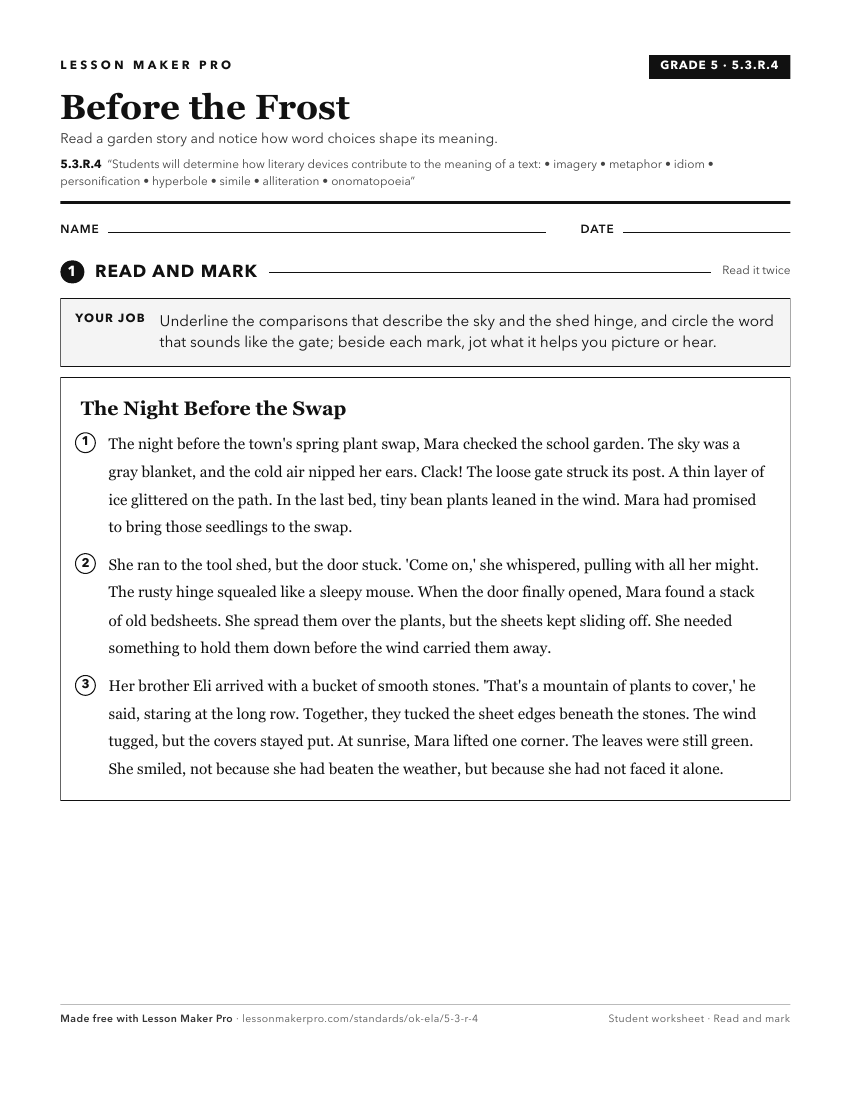
A ready-to-print activity worksheet aligned to 5.3.R.4, with an answer key for the teacher on its own page. No account needed.
PDF, US Letter, prints cleanly in black and white.
Download the worksheetKeep exploring
Related Standards
- 6.3.R.4
Analyze how literary devices contribute to the meaning of a text:- figurative language (i.e., simile, metaphor, personification, hyperbole, imagery, symbolism, ...
- 7.3.R.4
Analyze literary devices to support an interpretation of a text:- figurative language (i.e., simile, metaphor, personification, hyperbole, imagery, symbolism, i...
- 4.3.R.4
Find textual evidence of literary devices:- metaphor- idiom- personification- hyperbole- simile- alliteration- onomatopoeia
- 8.3.R.4
Analyze literary devices to support interpretations of a text:- figurative language (i.e., simile, metaphor, personification, hyperbole, imagery, symbolism, idi...
Turn this exact standard into a lesson
Grade, subject, topic, and the complete standard are prefilled. Create one free, no account needed.
Also for this standard:Make a WorksheetMake a QuizMake a Sub Lesson