Oklahoma ELA 2.3.R.1
The Standard
Students will determine the author’s purpose (i.e., tell a story, provide information).
Oklahoma Academic Standards for English Language Arts (2021)
Teacher's field guide
What This Standard Means
What Students Need to Do
- Students read or listen to a short text and decide whether the writer is telling a story or giving information. They use characters and events, or facts and explanations, to explain their choice.
What Mastery Looks Like
- Given a story and a fact page about the same animal, a student identifies each writer’s purpose. They point to an event or fact in the text as a clue.
Common Misconceptions
- Students may call a text a story just because it has pictures or an animal. They may call a story informational because it includes one true fact. Some name the topic instead of the writer’s purpose.
How to Assess It
- Print: “Frog lost his hat. He found it under a leaf.” and “Frogs have strong back legs. They use them to jump.” Ask students to label each writer’s purpose and circle one clue.
Lesson moves
Ways to Teach It
Print the two frog passages from the exit ticket; students cut them out, sort them under “story” or “information,” and circle a clue.
Read the frog passages aloud and ask, “Which writer tells a story? What words helped you decide?”
Write four ant cards, two with a named ant solving a problem and two with ant facts; students sort them and explain one choice.
Pair a classroom storybook about a firefighter with a school fire drill notice; ask students what each writer wants readers to learn or enjoy.
Free download
Printable 2.3.R.1 Worksheet
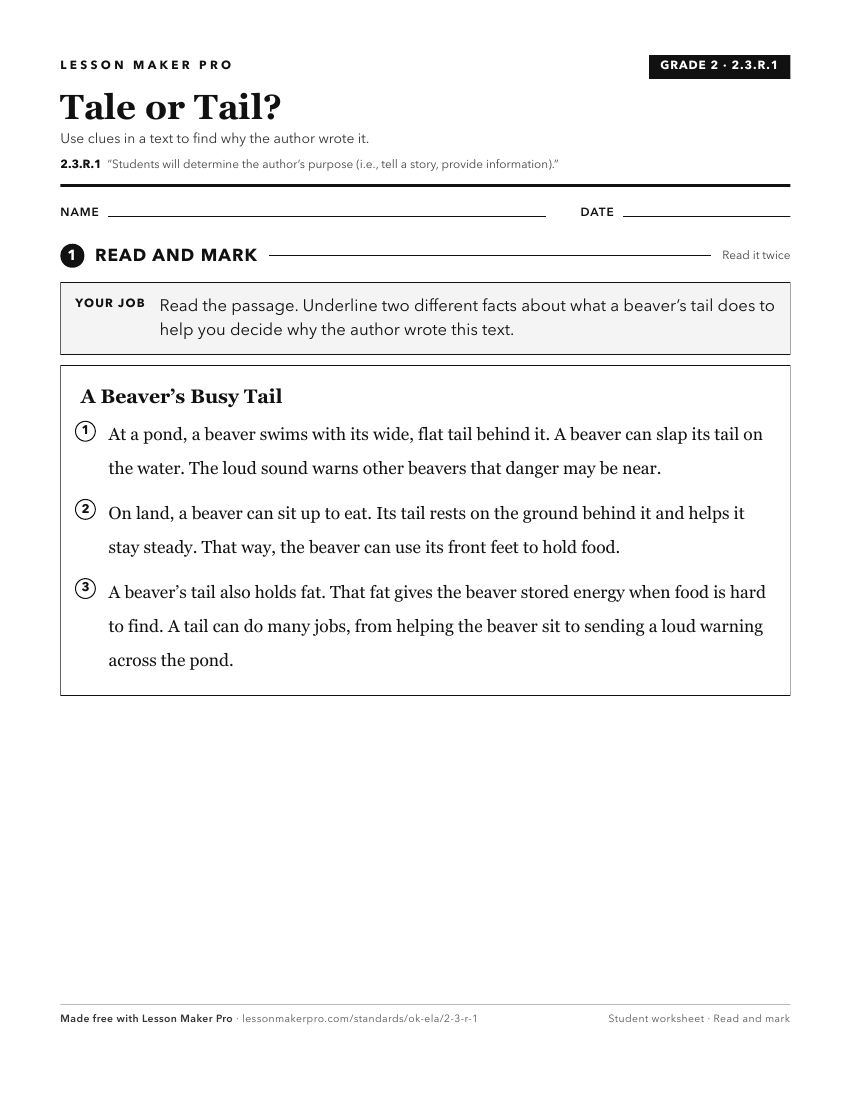
A ready-to-print activity worksheet aligned to 2.3.R.1, with an answer key for the teacher on its own page. No account needed.
PDF, US Letter, prints cleanly in black and white.
Download the worksheetKeep exploring
Related Standards
- 1.3.R.1
Identify the author's purpose (i.e., tell a story, provide information) with prompting.
- 4.3.R.1
Determine the author's purpose (i.e., entertain, inform, persuade) by identifying key details.
- 5.3.R.1
Determine the author's purpose (i.e., entertain, inform, persuade), and draw conclusions to determine if the author's purpose was achieved.
- 3.3.R.1
Determine if the author's purpose is to entertain, inform, or persuade.
Turn this exact standard into a lesson
Grade, subject, topic, and the complete standard are prefilled. Create one free, no account needed.
Also for this standard:Make a WorksheetMake a QuizMake a Sub Lesson