Oklahoma ELA 1.3.R.2
The Standard
Students will describe who is telling a story with prompting.
Oklahoma Academic Standards for English Language Arts (2021)
Teacher's field guide
What This Standard Means
What Students Need to Do
- Students listen to or read a short story and name who tells it. With a question or clue, they decide whether a character tells it or a voice outside the story.
What Mastery Looks Like
- A student can say, “Sam tells it because he says ‘I.’” When a story names the characters instead, the student can say the storyteller is outside the story.
Common Misconceptions
- Students may name the main character even when someone else tells the story. They may also name the author without looking for clues in the story.
How to Assess It
- Read, “I am Sam. I lost my red mitten.” Ask, “Who tells this story? What word gives you a clue?”
Lesson moves
Ways to Teach It
Give pairs two story cards, one using “I” and one naming Mia; have them sort the cards by who tells the story.
Read “I chased the puppy” and “Lena chased the puppy”; ask, “Who tells each version? What changed?”
Play storyteller detective: read a short passage, then have students hold up a “character” or “outside voice” card and explain their choice.
Write a two-line recess journal and a two-line school notice about the same game; ask students to name each storyteller.
Free download
Printable 1.3.R.2 Worksheet
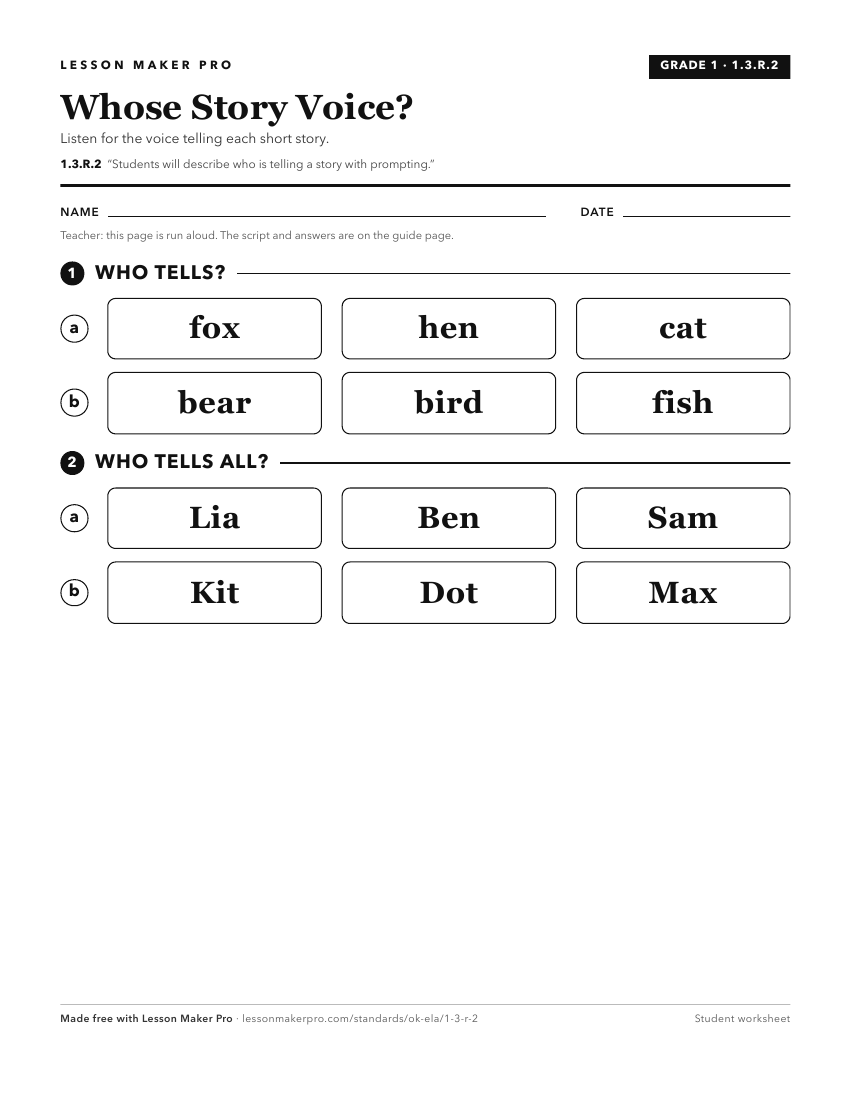
A ready-to-print activity worksheet aligned to 1.3.R.2, with an answer key for the teacher on its own page. No account needed.
PDF, US Letter, prints cleanly in black and white.
Download the worksheetKeep exploring
Related Standards
- K.3.R.3
Describe characters and setting in a story with prompting.
- 1.3.R.1
Identify the author's purpose (i.e., tell a story, provide information) with prompting.
- K.2.W.2
Sequence the action or details of stories/texts with prompting.
- 1.3.W.1
Write narratives incorporating characters, plot (i.e., beginning, middle, end), and a basic setting (i.e., time, place) with prompting.
Turn this exact standard into a lesson
Grade, subject, topic, and the complete standard are prefilled. Create one free, no account needed.
Also for this standard:Make a WorksheetMake a QuizMake a Sub Lesson