NY Next Generation Math NY-8.NS.1
The Standard
Understand informally that every number has a decimal expansion; for rational numbers show that the decimal expansion eventually repeats. Know that other numbers that are not rational are called irrational.
New York State Next Generation Mathematics Learning Standards
Teacher's field guide
What This Standard Means
What Students Need to Do
- Students connect rational numbers to decimal expansions that terminate or eventually repeat. They recognize nonterminating, nonrepeating decimals as representations of irrational numbers.
What Mastery Looks Like
- A student writes 3/8 as 0.375 and 2/11 as 0.1818..., then identifies both as rational. The student identifies √2 as irrational rather than forcing it into a fraction pattern.
Common Misconceptions
- Students may think a terminating decimal is not repeating because no repeated digits are shown. They may also call any long decimal irrational or claim 22/7 equals π exactly.
How to Assess It
- Ask students to classify 0.625, 0.272727..., and √5 as rational or irrational. Require one reason tied to each decimal expansion.
Lesson moves
Ways to Teach It
Divide fraction cards with calculators, record at least eight decimal places, and highlight any repeating block that appears.
Ask, "Why can 0.5 be written as 0.5000..., and what does that show about rational numbers?"
Play a classification game with fractions, terminating decimals, repeating decimals, square roots, and π, requiring a reason for every placement.
Compare a calculator's decimal approximation of √2 with a measured square's diagonal and discuss why the display must stop.
Free download
Printable NY-8.NS.1 Worksheet
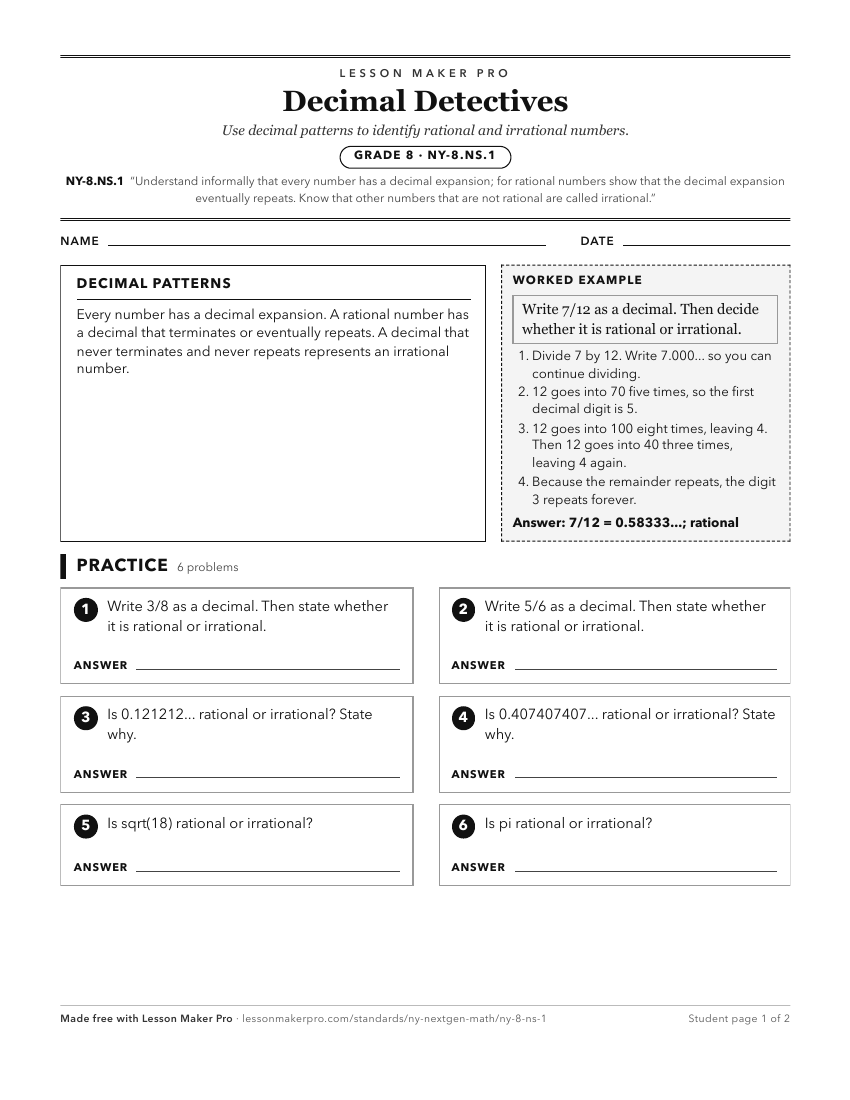
A ready-to-print activity worksheet aligned to NY-8.NS.1, with an answer key for the teacher on its own page. No account needed.
PDF, US Letter, prints cleanly in black and white.
Download the worksheetKeep exploring
Related Standards
- NY-7.NS.2.d
Convert a fraction to a decimal using long division; know that the decimal form of a rational number terminates in 0s or eventually repeats.
- NY-8.NS.2
Use rational approximations of irrational numbers to compare the size of irrational numbers, locate them approximately on a number line, and estimate the value ...
Turn this exact standard into a lesson
Grade, subject, topic, and the complete standard are prefilled. Create one free, no account needed.
Also for this standard:Make a WorksheetMake a QuizMake a Sub Lesson