NY Next Generation Math NY-8.EE.7.a
The Standard
Recognize when linear equations in one variable have one solution, infinitely many solutions, or no solutions. Give examples and show which of these possibilities is the case by successively transforming the given equation into simpler forms.
New York State Next Generation Mathematics Learning Standards
Teacher's field guide
What This Standard Means
What Students Need to Do
- Students transform linear equations in one variable into simpler equivalent forms and determine whether each has one solution, no solution, or infinitely many solutions. They give examples and justify the classification.
What Mastery Looks Like
- A student transforms 2(x + 3) = 2x + 6 into 6 = 6 and identifies infinitely many solutions. The student recognizes 4x + 1 = 4x - 2 as no solution and solves 3x + 2 = 14 uniquely.
Common Misconceptions
- Students may label a true identity as having no solution or divide by a canceled variable expression. They may stop at 0 = 0 or 0 = 5 without interpreting what it means.
How to Assess It
- Give one equation from each solution category. Ask students to transform, classify, and verify each equation with substitution or a clear explanation.
Lesson moves
Ways to Teach It
Use balance models and equation strips to transform examples until a variable value, true statement, or contradiction appears.
Ask students what 0 = 0 and 0 = 7 reveal about the original equation's solutions.
Play equation classification sort with transformation chains, one-solution results, identities, and contradictions.
Compare two pricing plans whose equations meet once, never meet, or represent the same cost.
Free download
Printable NY-8.EE.7.a Worksheet
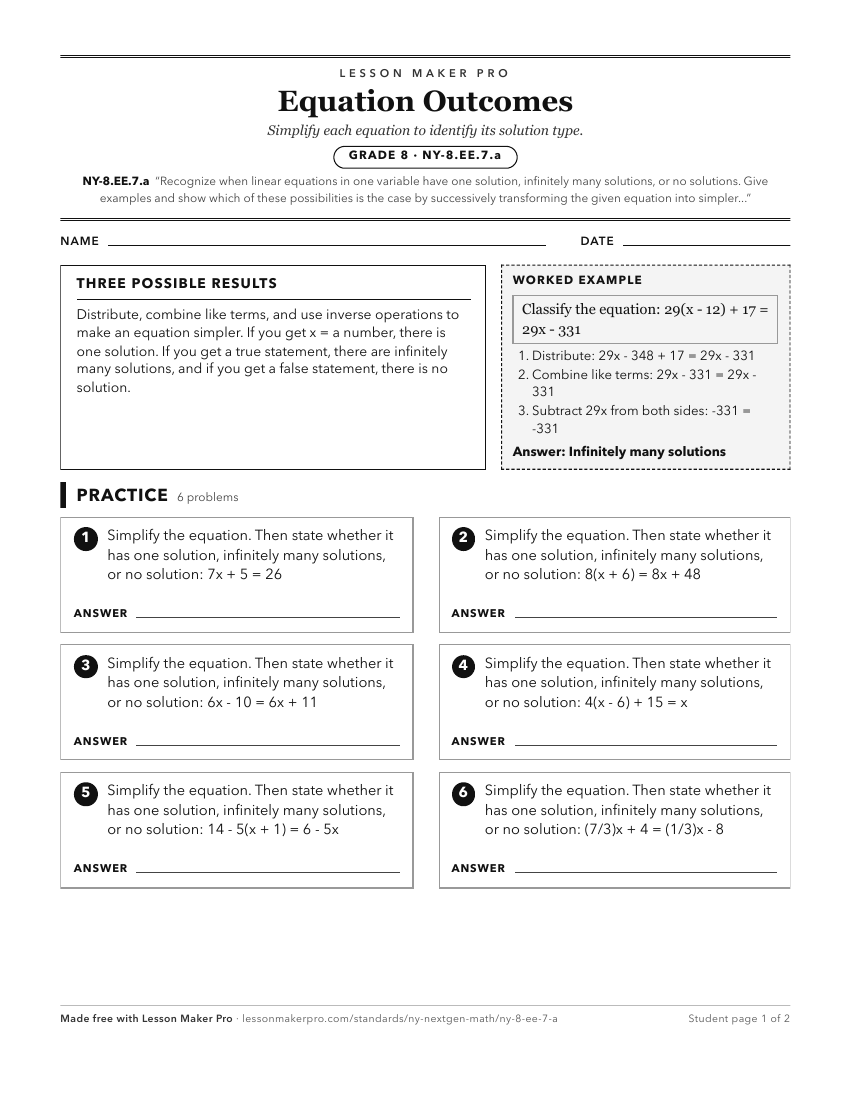
A ready-to-print activity worksheet aligned to NY-8.EE.7.a, with an answer key for the teacher on its own page. No account needed.
PDF, US Letter, prints cleanly in black and white.
Download the worksheetKeep exploring
Related Standards
- NY-8.EE.7
Solve linear equations in one variable.
- NY-8.EE.8.b
Solve systems of two linear equations in two variables with integer coefficients: graphically, numerically using a table, and algebraically. Solve simple cases ...
- NY-8.EE.8.a
Understand that solutions to a system of two linear equations in two variables correspond to points of intersection of their graphs, because points of intersect...
Turn this exact standard into a lesson
Grade, subject, topic, and the complete standard are prefilled. Create one free, no account needed.
Also for this standard:Make a WorksheetMake a QuizMake a Sub Lesson