NY Next Generation Math NY-4.MD.3
The Standard
Apply the area and perimeter formulas for rectangles in real world and mathematical problems.
New York State Next Generation Mathematics Learning Standards
Teacher's field guide
What This Standard Means
What Students Need to Do
- Students apply rectangle area and perimeter formulas in mathematical and real situations. They find an unknown side when enough area, perimeter, or side-length information is given.
What Mastery Looks Like
- Given an area of 48 square feet and a length of 8 feet, a student finds the width as 6 feet. The student then calculates the perimeter as 28 feet and labels each result correctly.
Common Misconceptions
- Students may confuse area with perimeter, add side lengths when finding area, or multiply only two sides for perimeter. They may use square units for perimeter or linear units for area.
How to Assess It
- A rectangular room has area 54 square meters and length 9 meters. Ask students to find its width and perimeter and explain each formula used.
Lesson moves
Ways to Teach It
Build rectangles with grid tiles, record side lengths, and verify both the area and perimeter formulas on each model.
Ask students how two rectangles can have the same area but different perimeters.
Play formula match with rectangle diagrams, missing dimensions, area equations, perimeter equations, and labeled solutions.
Plan a rectangular garden's planting area and fencing length from given dimensions or one unknown side.
Free download
Printable NY-4.MD.3 Worksheet
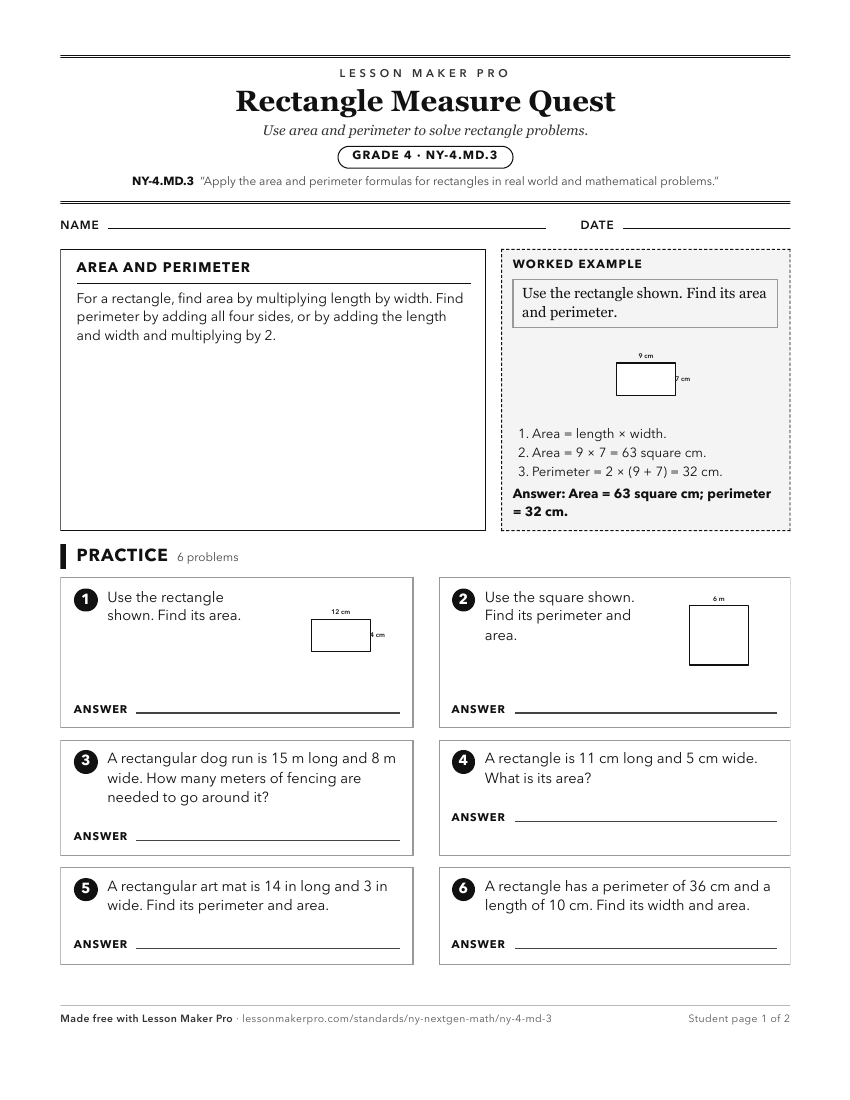
A ready-to-print activity worksheet aligned to NY-4.MD.3, with an answer key for the teacher on its own page. No account needed.
PDF, US Letter, prints cleanly in black and white.
Download the worksheetKeep exploring
Related Standards
Turn this exact standard into a lesson
Grade, subject, topic, and the complete standard are prefilled. Create one free, no account needed.
Also for this standard:Make a WorksheetMake a QuizMake a Sub Lesson