NY Next Generation Math GEO-G.MG.2
The Standard
Apply concepts of density based on area and volume of geometric figures in modeling situations.
New York State Next Generation Mathematics Learning Standards
Teacher's field guide
What This Standard Means
What Students Need to Do
- Students use area or volume to model density in context. They calculate and interpret quantities such as people per square unit or mass per cubic unit.
What Mastery Looks Like
- The student selects an appropriate geometric area or volume, computes density with correct units, and compares models meaningfully. The conclusion reflects the assumptions in the shape model.
Common Misconceptions
- Students may divide in the wrong order or use perimeter instead of area. They may compare density values with incompatible units or ignore empty space in a volume model.
How to Assess It
- Give two regions or solids with populations or masses and dimensions. Ask students to compute both densities and make a unit-based comparison.
Lesson moves
Ways to Teach It
Fill equal-area grid regions with different counter populations and calculate density for each.
Ask how changing a region's geometric model could change its reported density.
Play density comparison with area, volume, quantity, and unit cards.
Compare population density, planting density, or material density using geometric approximations.
Free download
Printable GEO-G.MG.2 Worksheet
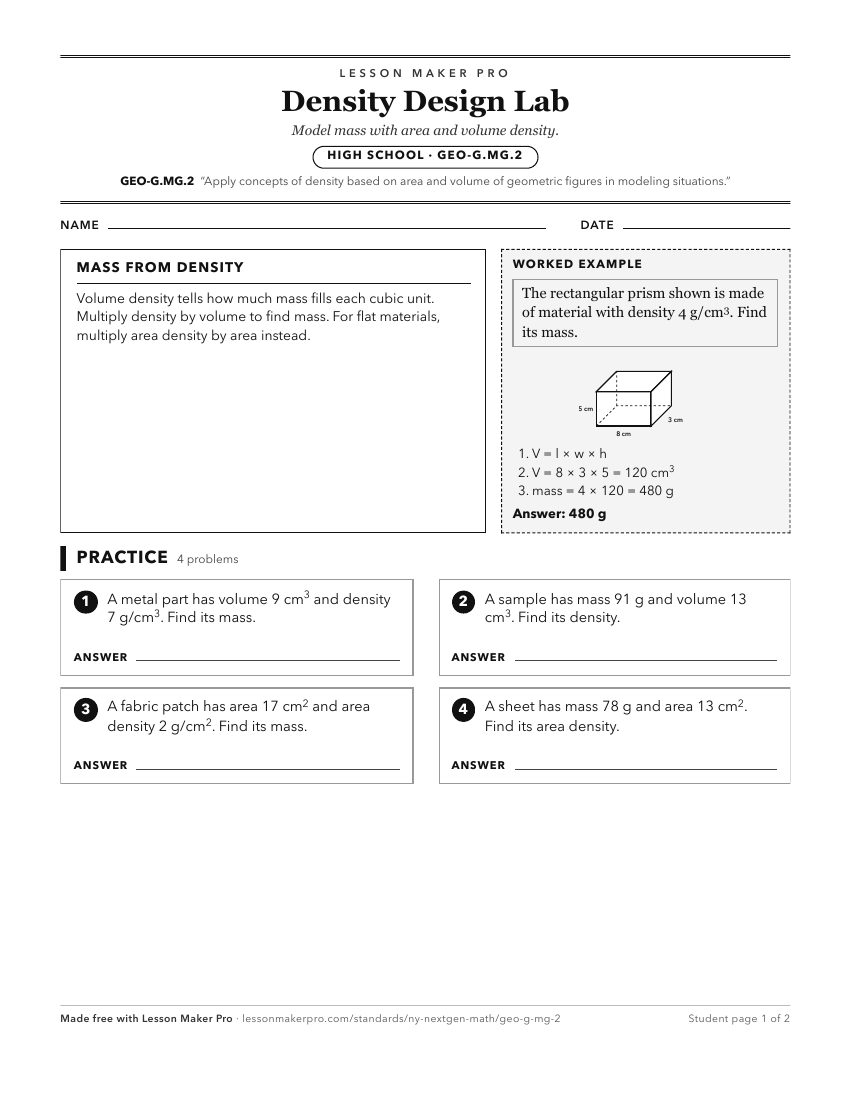
A ready-to-print activity worksheet aligned to GEO-G.MG.2, with an answer key for the teacher on its own page. No account needed.
PDF, US Letter, prints cleanly in black and white.
Download the worksheetKeep exploring
Related Standards
Turn this exact standard into a lesson
Grade, subject, topic, and the complete standard are prefilled. Create one free, no account needed.
Also for this standard:Make a WorksheetMake a QuizMake a Sub Lesson