NY Next Generation Math AI-F.LE.1.a
The Standard
Justify that a function is linear because it grows by equal differences over equal intervals, and that a function is exponential because it grows by equal factors over equal intervals.
New York State Next Generation Mathematics Learning Standards · Construct and compare linear, quadratic, and exponential models and solve problems.
Teacher's field guide
What This Standard Means
What Students Need to Do
- Students justify linear models through equal differences over equal intervals and exponential models through equal factors. They connect these patterns across tables, graphs, equations, and contexts.
What Mastery Looks Like
- The student calculates successive differences or ratios and states why the result supports one model. The interval sizes are checked before comparing changes.
Common Misconceptions
- Students may compare unequal intervals, use ratios when values include zero without care, or identify a pattern from one change only. They may name a model without a justification.
How to Assess It
- Give tables for y equals 3x plus 2 and y equals 2 times 3 to the x. Ask students to justify each classification from equal intervals.
Lesson moves
Ways to Teach It
Use difference and factor strips between table columns to display additive and multiplicative change.
Ask students why equal intervals must be used when testing differences or factors.
Play justification match by pairing data tables with valid difference or ratio arguments.
Determine whether a real savings, depreciation, or population pattern changes by equal amounts or equal factors.
Free download
Printable AI-F.LE.1.a Worksheet
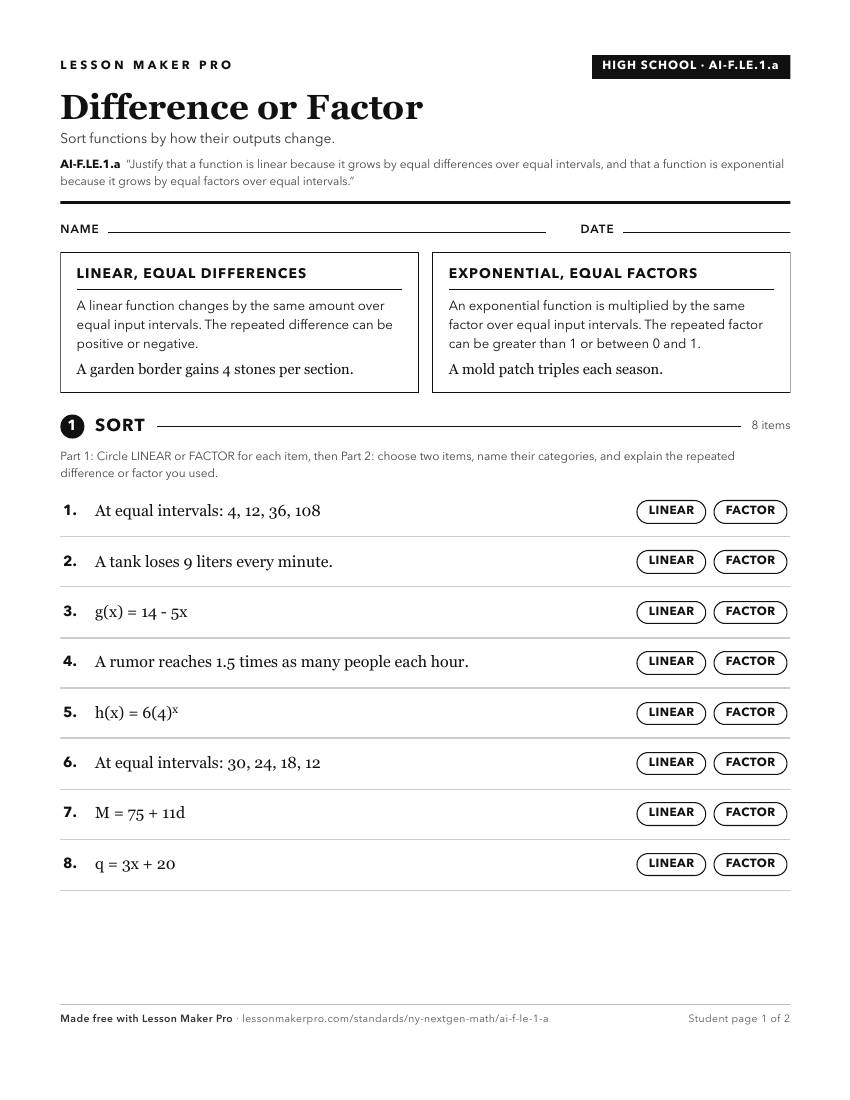
A ready-to-print activity worksheet aligned to AI-F.LE.1.a, with an answer key for the teacher on its own page. No account needed.
PDF, US Letter, prints cleanly in black and white.
Download the worksheetKeep exploring
Related Standards
- AI-F.LE.3
Observe using graphs and tables that a quantity increasing exponentially eventually exceeds a quantity increasing linearly, quadratically, or (more generally) a...
- AII-F.LE.5
Interpret the parameters in a linear or exponential function in terms of a context.
- AI-F.LE.1
Distinguish between situations that can be modeled with linear functions and with exponential functions.
- AI-F.LE.1.b
Recognize situations in which one quantity changes at a constant rate per unit interval relative to another, and therefore can be modeled linearly.
Turn this exact standard into a lesson
Grade, subject, topic, and the complete standard are prefilled. Create one free, no account needed.
Also for this standard:Make a WorksheetMake a QuizMake a Sub Lesson