NGSS K-ESS3-2
The Standard
Ask questions to obtain information about the purpose of weather forecasting to prepare for, and respond to, severe weather.
Next Generation Science Standards
Teacher's field guide
What This Standard Means
What Students Need to Do
- Students ask questions about local severe weather and use simple forecasts to find answers. They explain how forecasts help people prepare and choose safe actions.
What Mastery Looks Like
- Students can ask a useful question about an approaching storm. They can use a simple forecast to name a matching safety step, such as going indoors or moving to higher ground.
Common Misconceptions
- Children may think a forecast is always certain or that forecasters control the weather. They may treat ordinary rain as severe weather. They may also think the same safety action works for every weather event.
How to Assess It
- Show a picture of a severe weather alert. Ask, “What question would you ask, and what could you do to get ready?”
Lesson moves
Ways to Teach It
Give pairs picture cards of supplies, then have them pack a pretend severe weather kit and explain each choice.
Read a simple storm alert, then ask students to draw and label one action their family should take.
Play a matching game where students pair forecast cards, such as flood or thunderstorm, with safe action cards.
View a local weather forecast and have students identify any alert, its timing, and one way the school could prepare.
Free download
Printable K-ESS3-2 Worksheet
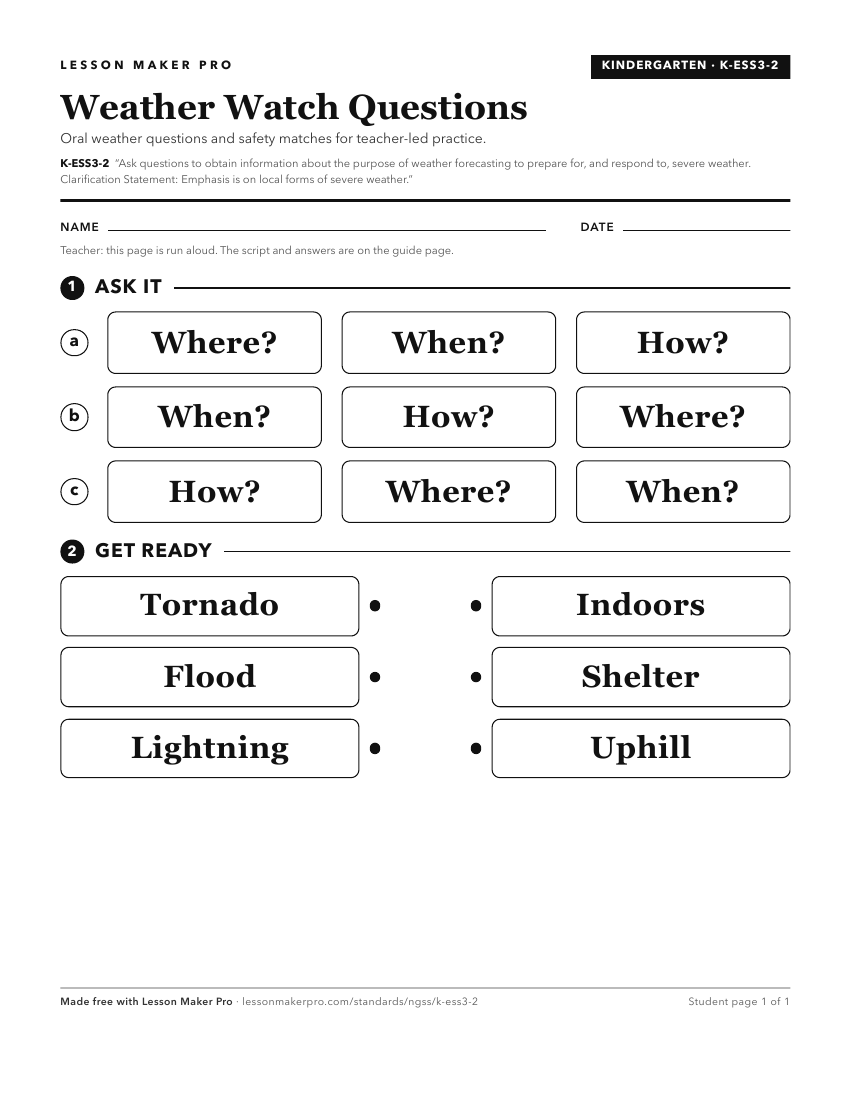
A ready-to-print activity worksheet aligned to K-ESS3-2, with an answer key for the teacher on its own page. No account needed.
PDF, US Letter, prints cleanly in black and white.
Download the worksheetKeep exploring
Related Standards
- K-ESS2-1
Use and share observations of local weather conditions to describe patterns over time.
- MS-ESS2-5
Collect data to provide evidence for how the motions and complex interactions of air masses results in changes in weather conditions.
- MS-ESS3-2
Analyze and interpret data on natural hazards to forecast future catastrophic events and inform the development of technologies to mitigate their effects.
- 3-ESS2-1
Represent data in tables and graphical displays to describe typical weather conditions expected during a particular season.
Turn this exact standard into a lesson
Grade, subject, topic, and the complete standard are prefilled. Create one free, no account needed.
Also for this standard:Make a WorksheetMake a QuizMake a Sub Lesson