NGSS HS-ESS1-3
The Standard
Communicate scientific ideas about the way stars, over their life cycle, produce elements.
Next Generation Science Standards
Teacher's field guide
What This Standard Means
What Students Need to Do
- Students explain how fusion and stellar explosions form different elements during a star’s life. They compare lower-mass and massive stars, using diagrams, models, or clear written explanations.
What Mastery Looks Like
- Students can use a labeled timeline or diagram to compare element production in lower-mass and massive stars. They connect each fusion stage to its products and explain how stellar explosions form and spread additional elements.
Common Misconceptions
- Students may think every star makes every element, or that larger stars simply make more of the same elements. They may also think supernovas create all elements, rather than recognizing that fusion makes many elements during earlier stages.
How to Assess It
- Give students this exit prompt: Compare a Sun-like star and a massive star, naming the elements each can produce and when those elements form.
Lesson moves
Ways to Teach It
Give groups stage, star-mass, and element cards; have them build two star timelines and defend where each element belongs.
Ask students to write: How would the element output of a Sun-like star differ from that of a massive star?
Run a relay where teams match fusion stages to products, then correct one deliberately misplaced card and explain their reasoning.
Use a periodic-table abundance graph to trace the carbon in a pencil and iron in a nail back to earlier stars.
Free download
Printable HS-ESS1-3 Worksheet
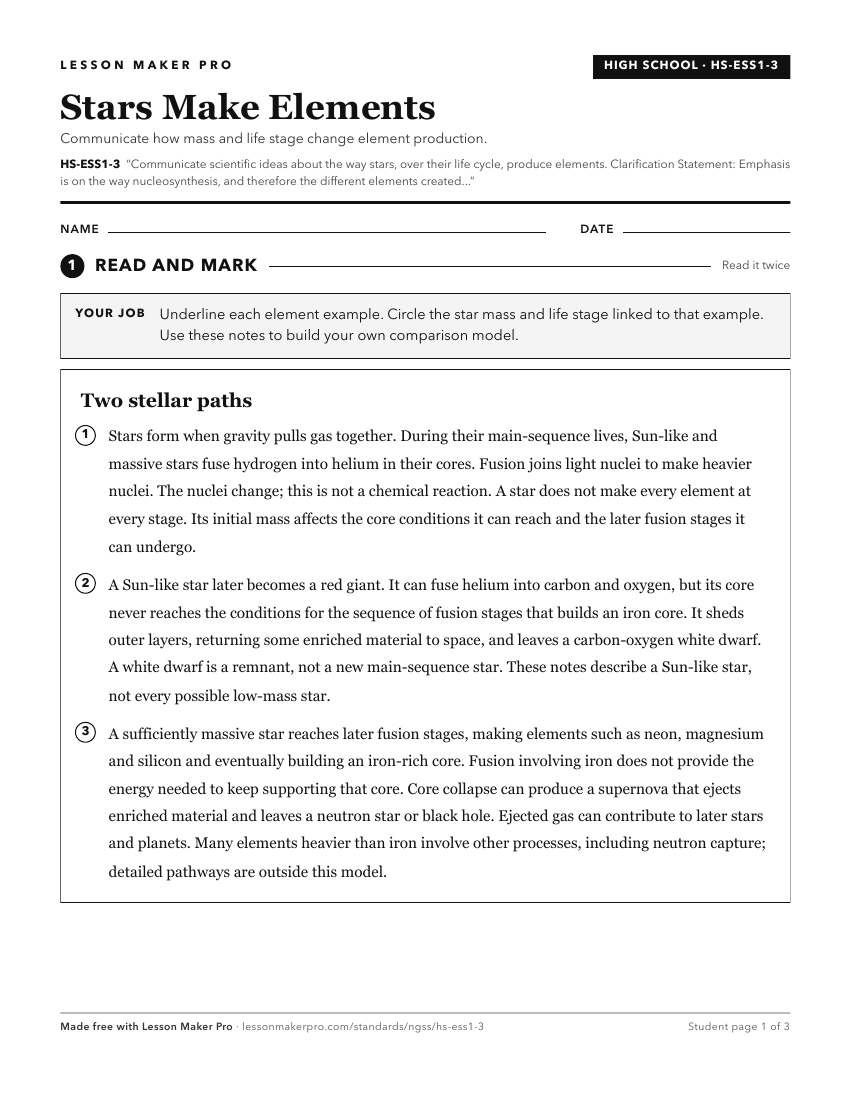
A ready-to-print activity worksheet aligned to HS-ESS1-3, with an answer key for the teacher on its own page. No account needed.
PDF, US Letter, prints cleanly in black and white.
Download the worksheetLearning progression
Where This Standard Sits
See the whole path on the Earth & Space Science progression map.
Before This Standard
If students are struggling here, check these first.
Keep exploring
Related Standards
- HS-PS2-6
Communicate scientific and technical information about why the molecular-level structure is important in the functioning of designed materials.
- MS-ESS2-1
Develop a model to describe the cycling of Earth's materials and the flow of energy that drives this process.
- 1-ESS1-1
Use observations of the sun, moon, and stars to describe patterns that can be predicted.
- HS-ESS1-1
Develop a model based on evidence to illustrate the life span of the sun and the role of nuclear fusion in the sun's core to release energy that eventually reac...
Turn this exact standard into a lesson
Grade, subject, topic, and the complete standard are prefilled. Create one free, no account needed.
Also for this standard:Make a WorksheetMake a QuizMake a Sub Lesson