NGSS HS-PS2-6
The Standard
Communicate scientific and technical information about why the molecular-level structure is important in the functioning of designed materials.
Next Generation Science Standards
Teacher's field guide
What This Standard Means
What Students Need to Do
- Students examine provided molecular models and connect structural features to how a designed material works. They communicate how attractions and repulsions between charged particles produce properties such as conductivity, flexibility, durability, or receptor binding.
What Mastery Looks Like
- Given a molecular structure, students identify features such as chain length, mobile electrons, charge, and shape. They explain how attractions and repulsions lead to a specific material property or function.
Common Misconceptions
- Students may think stronger attractions always produce a better material. They often confuse bonds within molecules with attractions between molecules. Some assume metal electrons are fixed or that shape alone determines how a drug binds.
How to Assess It
- Exit ticket: Show a diagram of short molecules and a diagram of long polymer chains. Ask, “Which material should be more flexible and durable, and how do molecular attractions help produce that behavior?”
Lesson moves
Ways to Teach It
Build short and long polymer chains with magnetic beads and pipe cleaners, then compare bending, tangling, and resistance to separation.
Write a claim explaining why copper conducts electricity better than rubber, using mobile electrons and electrostatic attractions as evidence.
Play a structure-function card match using molecular diagrams, material properties, and force explanations, then defend each match to a partner.
Compare nylon fishing line and plastic wrap with provided chain diagrams, then link chain arrangement and attractions to each product’s use.
Free download
Printable HS-PS2-6 Worksheet
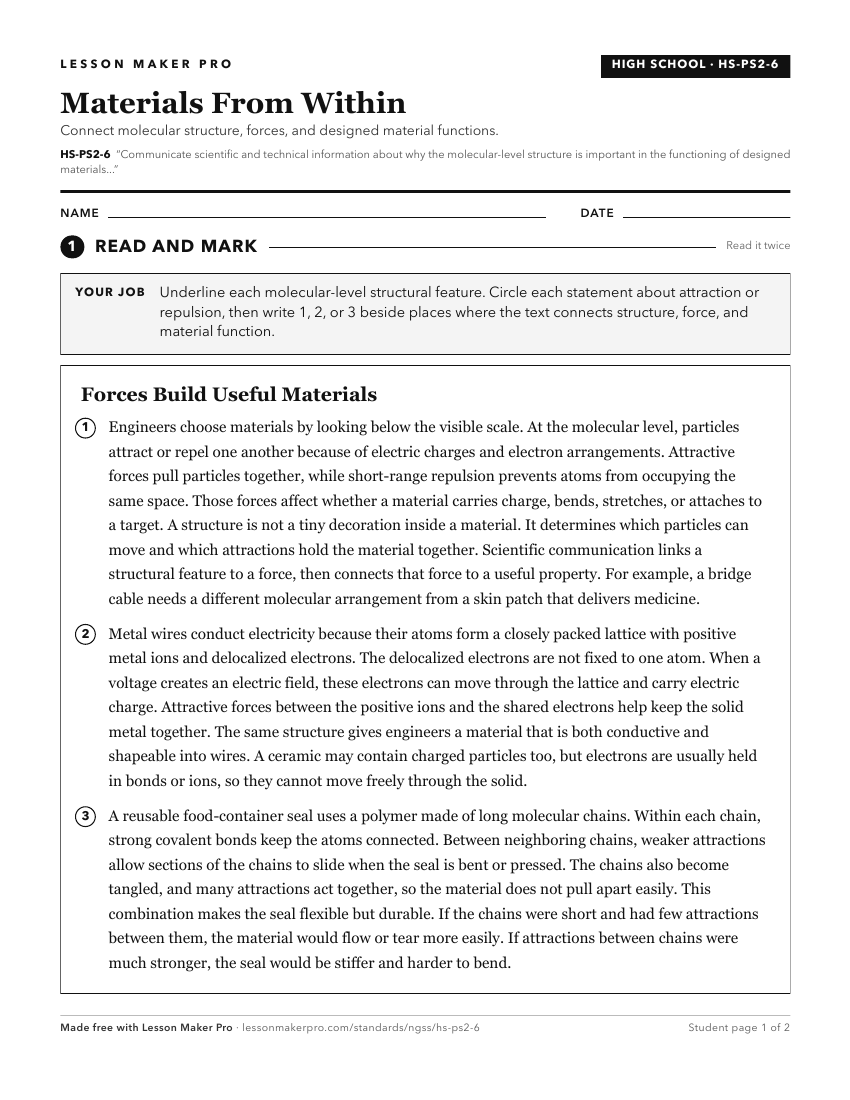
A ready-to-print activity worksheet aligned to HS-PS2-6, with an answer key for the teacher on its own page. No account needed.
PDF, US Letter, prints cleanly in black and white.
Download the worksheetKeep exploring
Related Standards
- MS-PS1-1
Develop models to describe the atomic composition of simple molecules and extended structures.
- MS-PS1-3
Gather and make sense of information to describe that synthetic materials come from natural resources and impact society.
- HS-PS4-5
Communicate technical information about how some technological devices use the principles of wave behavior and wave interactions with matter to transmit and cap...
- HS-ESS1-3
Communicate scientific ideas about the way stars, over their life cycle, produce elements.
Turn this exact standard into a lesson
Grade, subject, topic, and the complete standard are prefilled. Create one free, no account needed.
Also for this standard:Make a WorksheetMake a QuizMake a Sub Lesson