Mississippi Science HAP.3.4
The Standard
- HAP.3
- Students will investigate the structures and functions of the integumentary system, including the cause and effect of diseases and disorders.
Enrichment: Use an engineering design process to design and model/simulate effective treatments for skin disorders (e.g., tissue grafts). *
2026 Mississippi College- and Career-Readiness Standards for Science · Integumentary System
Teacher's field guide
What This Standard Means
What Students Need to Do
- Students choose a skin injury, such as a severe burn, and set goals and limits for a treatment. They build a model, test it, and change the design based on the results.
What Mastery Looks Like
- A student can make a model graft that covers a wound, stays in place when the model bends, and uses limited donor material. They can explain why a real graft also needs blood supply and why the model cannot show whether it will heal.
Common Misconceptions
- Students may think a graft will survive on any wound, even without blood supply. They may also treat a good fit on paper as proof that the graft will heal on a person.
How to Assess It
- Exit ticket: A model graft covers a burn but lifts when the elbow bends. Name one design change, one way to retest it, and one thing the model cannot tell you.
Lesson moves
Ways to Teach It
Draw a wound across folded cardstock, tape on a felt graft, bend the fold ten times, and measure any exposed area.
Ask: Why might a graft that stays attached to cardstock fail on a patient? Write two limits of the model.
Give pairs a fixed-size felt donor piece and three wound outlines; have them cut grafts to cover the most area with the least waste.
Show a photo of a mesh skin graft and ask how its openings help surgeons cover a larger burn with limited donor skin.
Free download
Printable HAP.3.4 Worksheet
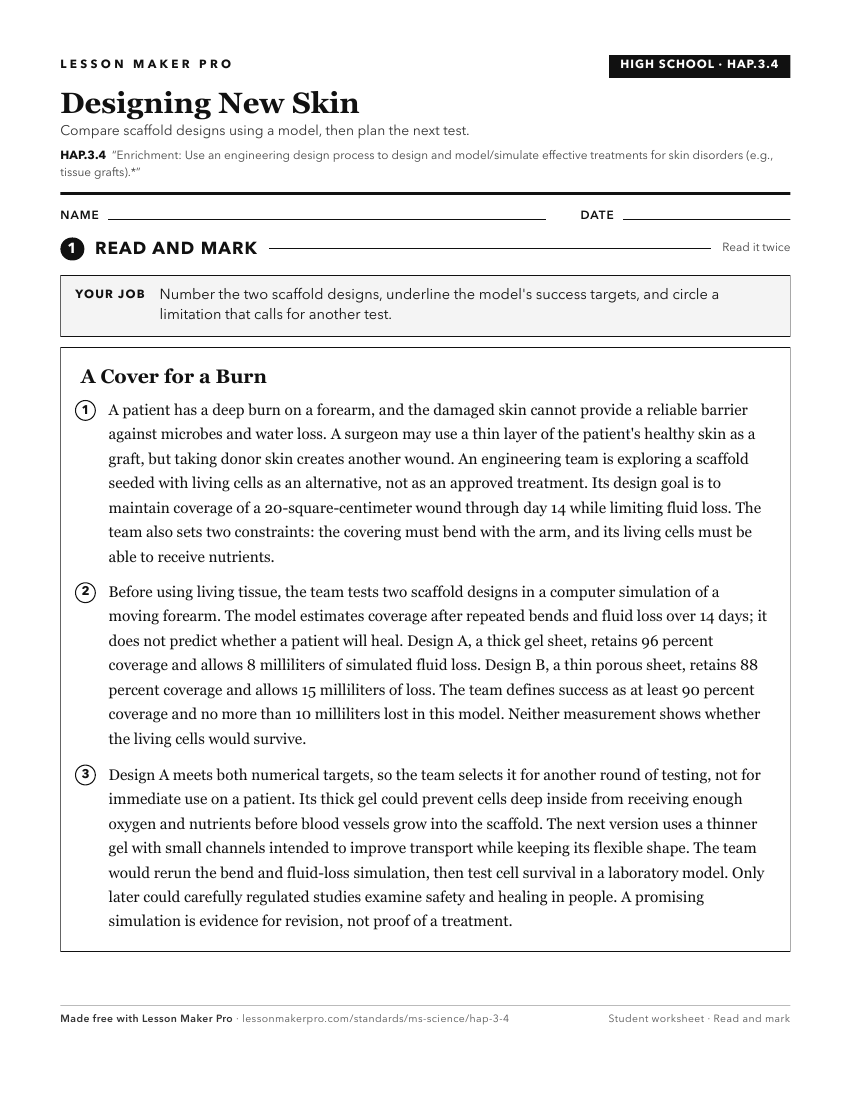
A ready-to-print activity worksheet aligned to HAP.3.4, with an answer key for the teacher on its own page. No account needed.
PDF, US Letter, prints cleanly in black and white.
Download the worksheetKeep exploring
Related Standards
- HAP.13.8
Enrichment: Use an engineering design process to develop effective treatments for gastrointestinal diseases (e.g., methods to regulate stomach acids or soothe u...
- HAP.4.7
Enrichment: Use an engineering design process to develop, model, and test effective treatments for bone disorders (i.e., prosthetics). *
- HAP.9.4
Enrichment: Use an engineering design process to develop effective treatments for blood disorders (e.g., methods to regulate blood cell counts or blood doping t...
- HAP.7.5
Enrichment: Use an engineering design process to develop effective treatments for endocrine disorders (e.g., methods to regulate hormonal imbalance). *
Turn this exact standard into a lesson
Grade, subject, topic, and the complete standard are prefilled. Create one free, no account needed.
Also for this standard:Make a WorksheetMake a QuizMake a Sub Lesson