Mississippi Science GEN.4.2
The Standard
- GEN.4
- Students will analyze and interpret data collected from probability calculations to explain the inheritance of traits within a population.
Illustrate Mendel’s law of independent assortment by analyzing multi-trait cross data sets for patterns and trends.
2026 Mississippi College- and Career-Readiness Standards for Science · Classic Mendelian Genetics
Teacher's field guide
What This Standard Means
What Students Need to Do
- Students count four trait combinations in offspring from parents heterozygous for two traits. They compare the counts with 9:3:3:1 and explain what the pattern shows about unlinked genes.
What Mastery Looks Like
- Given a tally of 160 offspring, a student predicts 90, 30, 30, and 10 in the four groups. They decide whether observed counts fit that pattern, allowing for small differences due to chance.
Common Misconceptions
- Some students expect exactly 9:3:3:1 in every group of 16 offspring. Others confuse the separation of alleles for one trait with the independent assortment of two traits. Some assume linked genes follow the same pattern.
How to Assess It
- Exit ticket: In 160 pea offspring, 91 are round yellow, 29 round green, 32 wrinkled yellow, and 8 wrinkled green. Compare the counts with 9:3:3:1 and say whether they support independent assortment.
Lesson moves
Ways to Teach It
Flip four coins labeled R/r, R/r, Y/y, and Y/y to model 40 offspring, then tally the four trait combinations.
Ask pairs, 'How can two round, yellow plants heterozygous for both traits produce wrinkled, green seeds?'
For two double-heterozygote parents, rank count cards (90,30,30,10; 86,34,31,9; 40,40,40,40) by fit to 9:3:3:1.
Use a seed breeder's harvest tally (87 round yellow, 33 round green, 28 wrinkled yellow, 12 wrinkled green) to check for independent assortment.
Free download
Printable GEN.4.2 Worksheet
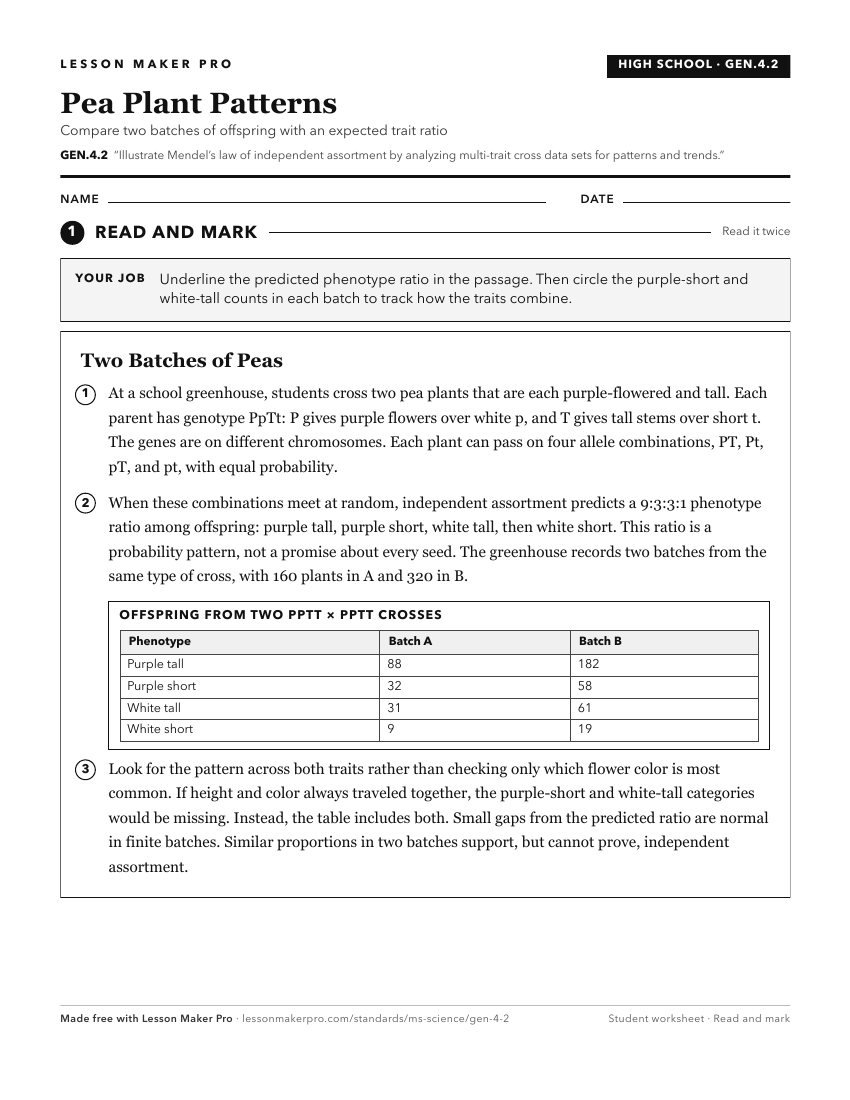
A ready-to-print activity worksheet aligned to GEN.4.2, with an answer key for the teacher on its own page. No account needed.
PDF, US Letter, prints cleanly in black and white.
Download the worksheetKeep exploring
Related Standards
- BIO.3B.2
Apply Mendel’s law of independent assortment to interpret dihybrid crosses.
- GEN.4.1
Demonstrate Mendel’s law of dominance and segregation using mathematics to predict phenotypic and genotypic ratios.
- GEN.4.3
Investigate traits that follow non-Mendelian inheritance patterns (e.g., incomplete dominance, codominance, multiple alleles, autosomal linkage, sexlinkage, pol...
- BIO.3B.1
Demonstrate Mendel’s law of dominance and segregation using mathematics to predict phenotypic and genotypic ratios by constructing Punnett squares with both hom...
Turn this exact standard into a lesson
Grade, subject, topic, and the complete standard are prefilled. Create one free, no account needed.
Also for this standard:Make a WorksheetMake a QuizMake a Sub Lesson