Maryland Math K.NOS.C.9
Standard Cluster
Understand 10 as a group, collection, or bundle of ten ones called a “ten.” Compose and decompose numbers from 11 to 19 into ten ones and some further ones by using objects or drawings, and equations (e.g., 13 = 10 + 3). Describe a given number as one ten and the correct number of ones (e.g., 13 is one ten and three ones).
Maryland College and Career Ready Standards for Mathematics (2025) · DEVELOP FOUNDATIONS FOR PLACE VALUE.
Cluster contents
Standards in This Cluster
K.NOS.C.9 is a cluster heading. These are the individual standards under it.
Teacher's field guide
What This Cluster Means
What Students Need to Do
- Students make one group of 10 from single objects. They show numbers 11 through 19 as one ten and extra ones. They draw what they made and write an equation such as 14 = 10 + 4.
What Mastery Looks Like
- Given 17 counters, a student groups 10 and leaves 7 loose. They draw both parts, write 17 = 10 + 7, and say, “one ten and seven ones.”
Common Misconceptions
- Some students count 13 objects but do not see a group of 10 and 3 extra ones. Others write 13 = 1 + 3 because they treat the digit 1 as one object.
How to Assess It
- Give each student 16 counters and ask: “Show 16 as one ten and extra ones. Draw it, write an equation, and tell me how many tens and ones you made.”
Lesson moves
Ways to Teach It
Have students bundle 10 craft sticks with a rubber band, add 4 loose sticks, and write 14 = 10 + 4.
Draw 10 dots inside a circle and 2 outside it, then ask, “Where do you see 10 + 2?”
Play a matching game with cards showing teen numbers, drawings of a ten and extra ones, and equations.
Put 10 pencils in a cup and 7 on the table, then have students record the total as 17 = 10 + 7.
Free download
Printable K.NOS.C.9 Worksheet
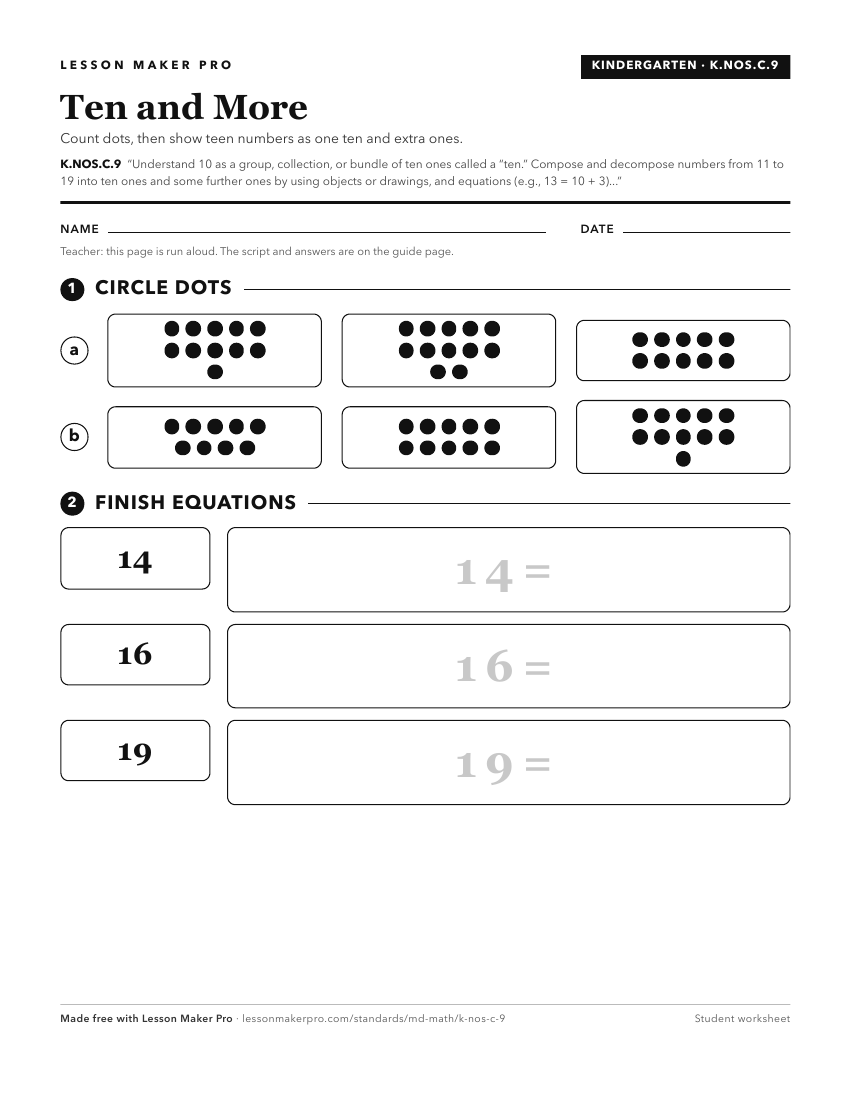
A ready-to-print activity worksheet aligned to K.NOS.C.9, with an answer key for the teacher on its own page. No account needed.
PDF, US Letter, prints cleanly in black and white.
Download the worksheetKeep exploring
Related Standards
- 2.NOS.A.1
Use understanding of 100 as a bundle of ten tens, called a “hundred,” and compose and decompose three-digit numbers.
- 1.NOS.B.3
Extend understanding of 10 as a group, collection, or bundle of ten ones, called a “ten,” to compose and decompose two-digit numbers.
- 1.NOS.B.3.b
Describe a given number as the correct number of tens and ones (e.g., 14 is one ten and four ones; 38 is three tens and eight ones).
Turn this cluster into a lesson
Grade, subject, topic, and the complete cluster are prefilled. Create one free, no account needed.
Also for this cluster:Make a WorksheetMake a QuizMake a Sub Lesson