Maryland Math K.AT.B.3
The Standard
Identify, extend, and create repeating patterns (AABAAB, ABCABC, or AABBCC) using concrete objects, drawings, sounds, or movements.
Maryland College and Career Ready Standards for Mathematics (2025) · UNDERSTAND REPEATING PATTERNS.
Teacher's field guide
What This Standard Means
What Students Need to Do
- Children spot the group that repeats in objects, pictures, sounds, or movements. They continue the pattern and make one of their own.
What Mastery Looks Like
- A child can point to the repeating group in red-red-blue-red-red-blue and tell what comes next. They can build a different pattern, repeat it twice, and explain the order.
Common Misconceptions
- Some children turn red-red-blue into red-blue and leave out the second red. Others copy the last object instead of starting the group again.
How to Assess It
- On an exit ticket, draw red-red-blue-red-red-blue counters. Ask children to circle the repeating group, draw the next three counters, and draw a different pattern twice below.
Lesson moves
Ways to Teach It
Give pairs red, blue, and yellow linking cubes; have them build red-red-blue twice, then invent and repeat a three-color pattern.
Clap, clap, stomp, clap, clap, stomp; ask, “What will we do next, and which actions keep repeating?”
Play pattern repair: draw circle-circle-square-circle-blank-square; partners fill the blank and say the repeating group.
Draw a scarf with red-red-blue stripes repeated twice; have children add the next three stripes to finish it.
Free download
Printable K.AT.B.3 Worksheet
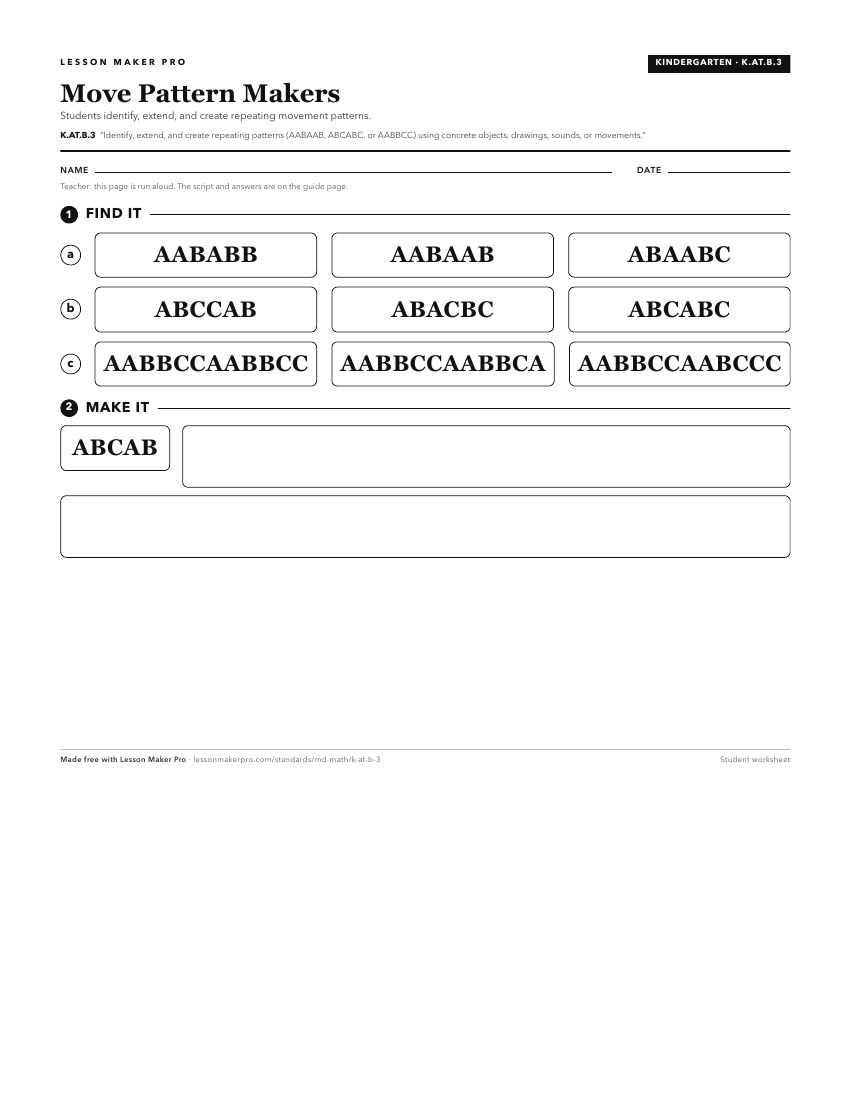
A ready-to-print activity worksheet aligned to K.AT.B.3, with an answer key for the teacher on its own page. No account needed.
PDF, US Letter, prints cleanly in black and white.
Download the worksheetKeep exploring
Related Standards
- 5.AT.B.3.a
Generate a number pattern that follows a given rule and identify relationships between the numbers within the pattern.
- K.NOS.B.8
Recognize the number of objects in a set without counting (subitizing) with both unfamiliar patterns within 6 and familiar patterns within 10.
- K.AT.A.1
Represent addition and subtraction situations (presented with numerals or mathematical symbols) within 10 with objects, fingers, drawings, sounds (e.g., claps),...
Turn this exact standard into a lesson
Grade, subject, topic, and the complete standard are prefilled. Create one free, no account needed.
Also for this standard:Make a WorksheetMake a QuizMake a Sub Lesson