Maryland Math F.IF.C.8.d
The Standard
- F.IF.C.8
- Write a function defined by an expression in different but equivalent forms to reveal and explain different properties of the function.
Estimate limits algebraically, numerically and graphically.
Maryland College and Career Ready Standards for Mathematics (2025) · Analyze functions using different representations.
Teacher's field guide
What This Standard Means
What Students Need to Do
- Students use a table, a graph, and a formula to find the value a function approaches near an input. They check values on both sides, even when the function is undefined at that input.
What Mastery Looks Like
- A student can use nearby values to make an estimate, then simplify a formula to check it. They can tell when the two sides approach different values, so there is no two-sided limit.
Common Misconceptions
- Students often plug in the target input and stop when they get 0/0. They may think a hole means there is no limit, or overlook different values on the two sides of a jump.
How to Assess It
- Exit ticket: For f(x)=(x²−4)/(x−2), use x=1.9 and 2.1, then simplify the formula to estimate the limit as x approaches 2. Sketch the graph near 2 and mark the hole.
Lesson moves
Ways to Teach It
Plot (x²−4)/(x−2) on graph paper using x=1.9, 1.99, 2.01, and 2.1; mark the hole.
Draw a graph with a jump at x=2 and ask, 'Can it have a two-sided limit there?' Have partners explain.
Race to simplify and find three limits: (x²−9)/(x−3) at 3, (x²−4)/(x−2) at 2, and (x²−1)/(x−1) at 1.
For distance s(t)=t² meters, calculate average speeds from 2 to 2.1 and 2 to 2.01 seconds; estimate the speed at 2.
Free download
Printable F.IF.C.8.d Worksheet
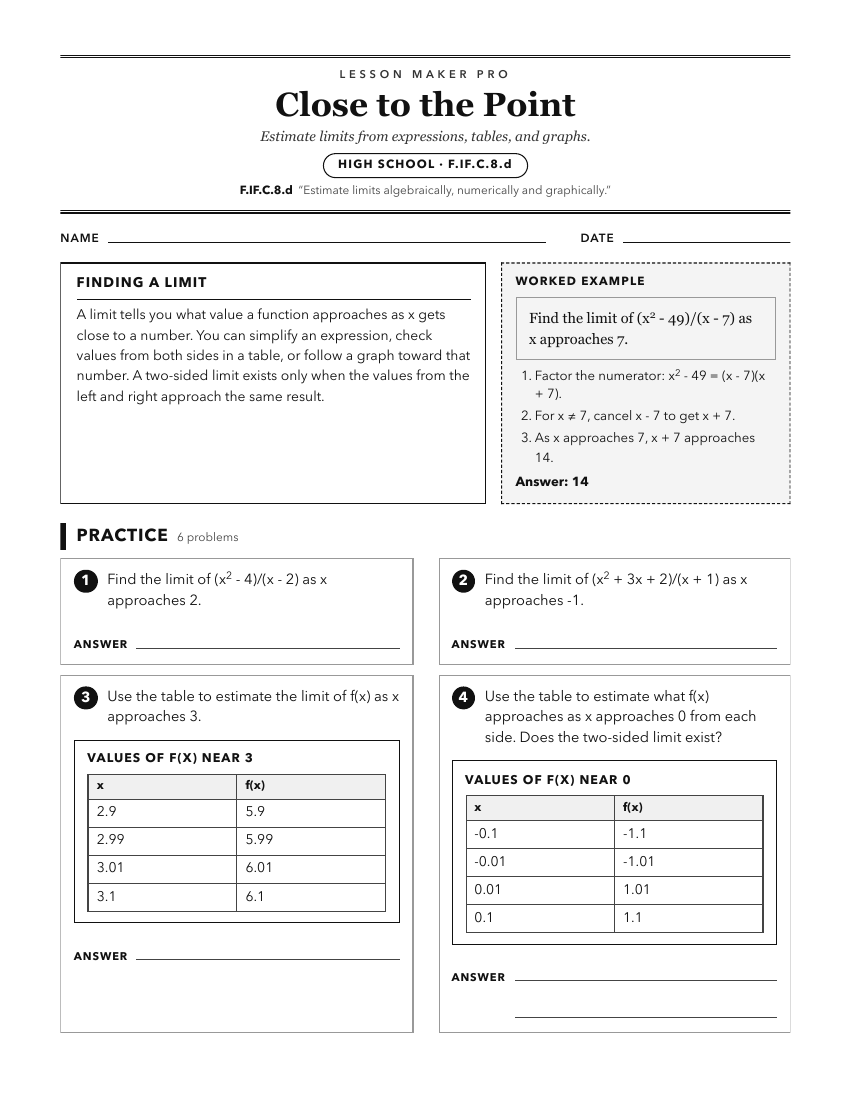
A ready-to-print activity worksheet aligned to F.IF.C.8.d, with an answer key for the teacher on its own page. No account needed.
PDF, US Letter, prints cleanly in black and white.
Download the worksheetKeep exploring
Related Standards
- 2.NOS.A.5
Estimate quantities by reasoning about their location on a number line, their relationship to benchmark numbers (e.g. 10, 50, 100), and to assess reasonableness...
- 6.NOS.C.6.a
Estimate quantities by reasoning about their location on a number line, their relationship to benchmark numbers, and by rounding.
- 3.NOS.A.1.c
Estimate quantities by reasoning about their location on a number line, their relationship to benchmark numbers, and rounding to nearest 10 or 100.
- F.IF.C.8.c
Interpret the behavior of the graph of a function using the concept of limits.
Turn this exact standard into a lesson
Grade, subject, topic, and the complete standard are prefilled. Create one free, no account needed.
Also for this standard:Make a WorksheetMake a QuizMake a Sub Lesson