Maryland Math F.IF.C.10
The Standard
Describe the behavior of a sequence.
Maryland College and Career Ready Standards for Mathematics (2025) · Analyze functions using different representations.
Teacher's field guide
What This Standard Means
What Students Need to Do
- Students read a list, table, or plot of sequence terms and describe how the values change. They explain the pattern from one term to the next and what happens as the term number grows.
What Mastery Looks Like
- Given 16, 8, 4, 2, a student identifies repeated halving and predicts 1 and 0.5. They explain that the terms keep getting closer to zero without reaching it.
Common Misconceptions
- Students may describe 2, 4, 8, 16 as adding 2 each time instead of doubling. They may also think a sequence that keeps halving will eventually equal zero.
How to Assess It
- Give students 40, 20, 10, 5. Ask them to write the next two terms, describe the rule, and say what happens as the sequence continues.
Lesson moves
Ways to Teach It
Build tile groups of 1, 2, 4, and 8, label their positions, and have students describe how each group changes.
Ask: Which sequence reaches 100 first, 3, 6, 9, 12 or 3, 6, 12, 24? Explain your prediction.
Sort printed sequence cards into increasing, decreasing, and alternating piles, then write the term-to-term rule on each card.
Take 20% off an $80 phone's remaining value each year for four years, then describe the pattern in its value.
Free download
Printable F.IF.C.10 Worksheet
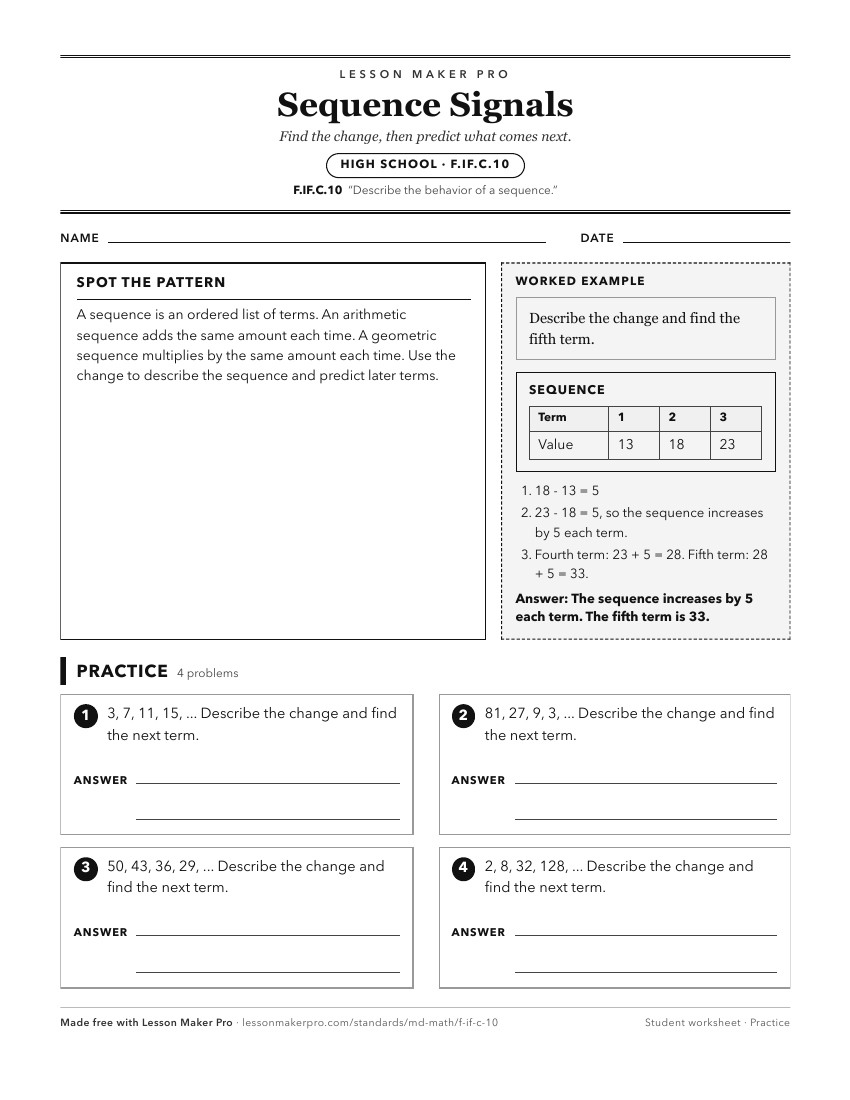
A ready-to-print activity worksheet aligned to F.IF.C.10, with an answer key for the teacher on its own page. No account needed.
PDF, US Letter, prints cleanly in black and white.
Download the worksheetKeep exploring
Related Standards
Turn this exact standard into a lesson
Grade, subject, topic, and the complete standard are prefilled. Create one free, no account needed.
Also for this standard:Make a WorksheetMake a QuizMake a Sub Lesson