Maryland Math A.SSE.B.5
The Standard
Determine the sum, if it exists, of an infinite geometric series.
Maryland College and Career Ready Standards for Mathematics (2025) · Write expressions in equivalent forms to solve problems.
Teacher's field guide
What This Standard Means
What Students Need to Do
- Students find the common ratio between terms of a geometric series. They decide whether the series has a finite sum and, if it does, calculate that sum.
What Mastery Looks Like
- A student can tell that 8 + 4 + 2 + ... has a ratio of 1/2 and a sum of 16. They can explain why 8 + 16 + 32 + ... has no finite sum.
Common Misconceptions
- Students may use the difference between terms instead of the ratio. They may assume every infinite series has a sum, or that a series with a negative ratio cannot have one.
How to Assess It
- Exit ticket: Does 12 + 6 + 3 + ... have a finite sum? Give its ratio and sum, then explain whether 12 + 24 + 48 + ... has a finite sum.
Lesson moves
Ways to Teach It
Give students a paper strip to shade one half, one quarter, and one eighth, then predict how much will eventually be shaded.
Ask: Why does 8 + 4 + 2 + ... approach 16, while 8 + 16 + 32 + ... does not?
Give pairs series cards to sort into finite sum or no finite sum, then have them calculate each finite sum.
A ball drops from 2 meters and rebounds to half its previous height; have students calculate its total vertical travel.
Free download
Printable A.SSE.B.5 Worksheet
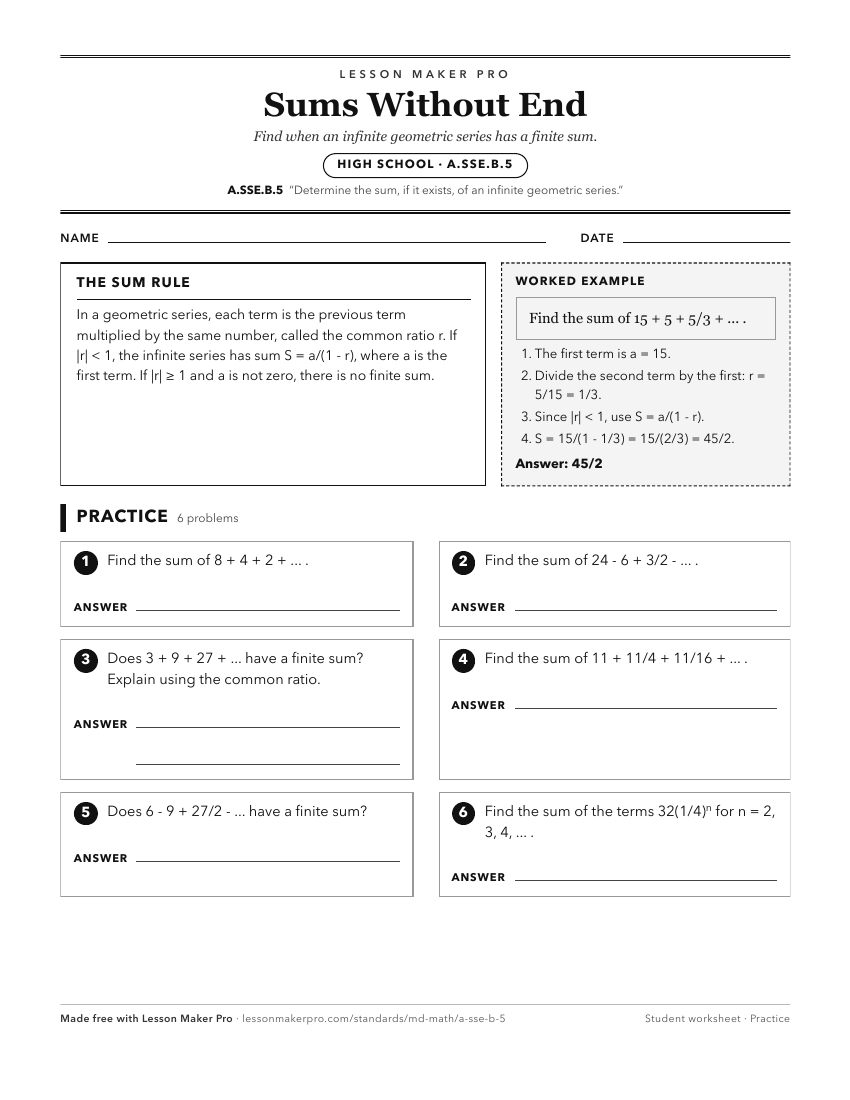
A ready-to-print activity worksheet aligned to A.SSE.B.5, with an answer key for the teacher on its own page. No account needed.
PDF, US Letter, prints cleanly in black and white.
Download the worksheetKeep exploring
Related Standards
Turn this exact standard into a lesson
Grade, subject, topic, and the complete standard are prefilled. Create one free, no account needed.
Also for this standard:Make a WorksheetMake a QuizMake a Sub Lesson