Maryland Math 8.NOS.A.1
The Standard
Identify a number as irrational when its decimal expansion neither terminates nor repeats, and explain that irrational numbers cannot be expressed as the ratio of two integers.
Maryland College and Career Ready Standards for Mathematics (2025) · REASON WITH IRRATIONAL NUMBERS.
Teacher's field guide
What This Standard Means
What Students Need to Do
- Students tell whether a decimal ends, repeats, or continues without repeating. They identify the last kind as irrational and explain why dividing one integer by another cannot produce it.
What Mastery Looks Like
- A student identifies 0.125 and 0.272727... as rational, but a decimal with ever more zeros between 1s as irrational. They explain that division has only finitely many possible remainders, so the digits must eventually end or repeat.
Common Misconceptions
- Students may call every decimal that goes on forever irrational, including 0.333.... They may also treat a calculator's short display of √2 as proof that its decimal ends.
How to Assess It
- Exit ticket: Classify 0.272727... and 0.101001000100001..., where the zeros between 1s keep increasing. Explain why only one can equal a fraction of integers.
Lesson moves
Ways to Teach It
Write remainders from 1 ÷ 7 and 1 ÷ 8 on sticky notes, then group matching remainders and zeros.
Ask: Could 0.121212... be irrational because it never ends? Explain your answer using 12/99.
Sort cards showing 0.125, 0.333..., and 0.1010010001... with growing zero gaps, then defend each choice to a partner.
Measure a 1 cm square's diagonal, label its exact length √2 cm, and compare it with a calculator's rounded display.
Free download
Printable 8.NOS.A.1 Worksheet
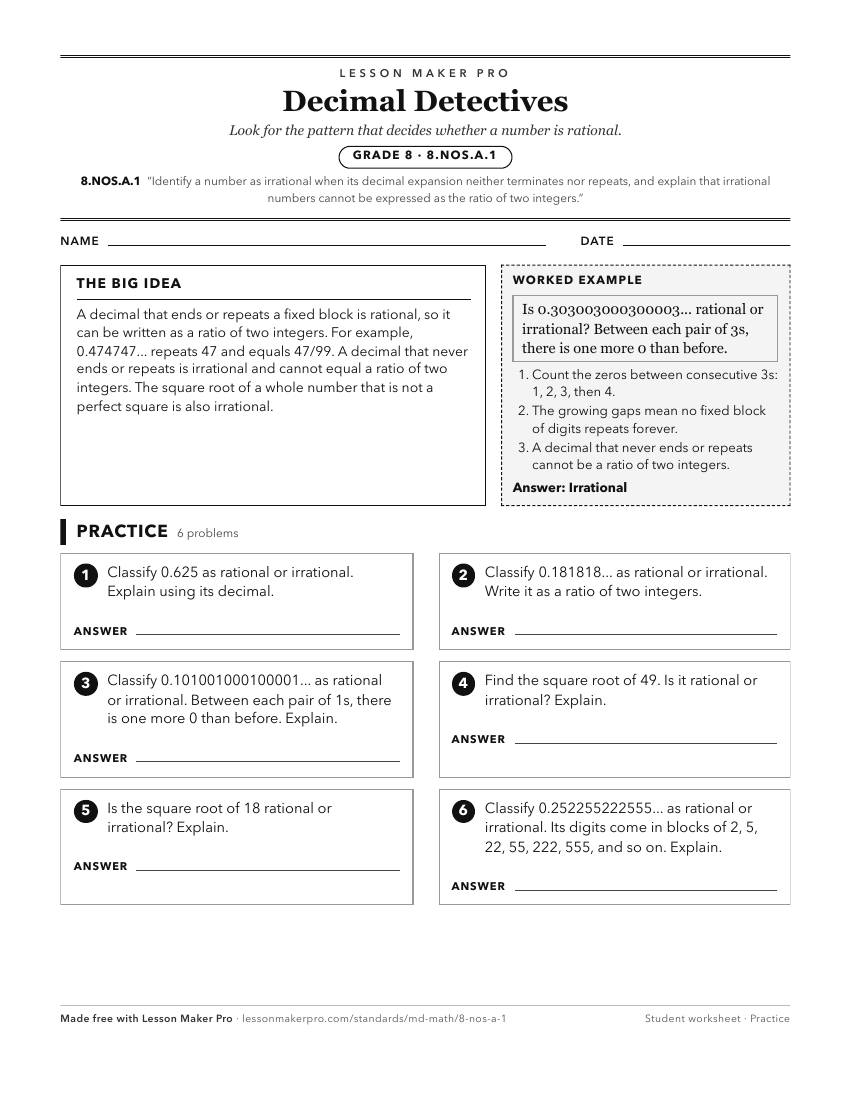
A ready-to-print activity worksheet aligned to 8.NOS.A.1, with an answer key for the teacher on its own page. No account needed.
PDF, US Letter, prints cleanly in black and white.
Download the worksheetKeep exploring
Related Standards
- 6.NOS.C.5
Use understanding of rational numbers as positive and negative numbers to describe quantities having opposite directions or values (e.g., temperature above/belo...
- 6.NOS.C.8
Order and identify the absolute value of rational numbers.
- 8.NOS.A.2
Use rational approximations of irrational numbers to estimate their locations on a number line, compare their size, and apply this understanding to estimate the...
- 7.NOS.A.2.d
Analyze the decimal representation of a quotient resulting from dividing rational numbers to determine whether it terminates or repeats and use this pattern to ...
Turn this exact standard into a lesson
Grade, subject, topic, and the complete standard are prefilled. Create one free, no account needed.
Also for this standard:Make a WorksheetMake a QuizMake a Sub Lesson