Maryland Math 8.GR.B.4
Standard Cluster
Understand and reason about the Pythagorean Theorem and its extensions. Use diagrams, examples, or informal reasoning to explain the Pythagorean Theorem and why it applies to all right triangles. Use the converse of the Pythagorean Theorem to determine whether a set of three side lengths forms a right triangle, and extend this reasoning to identify whether a triangle is acute or obtuse using Pythagorean inequalities.
Maryland College and Career Ready Standards for Mathematics (2025) · APPLY THE PYTHAGOREAN THEOREM TO REASON ABOUT RIGHT TRIANGLES.
Cluster contents
Standards in This Cluster
8.GR.B.4 is a cluster heading. These are the individual standards under it.
- 8.GR.B.4.a
Use diagrams, examples, or informal reasoning to explain the Pythagorean Theorem and why it applies to all right triangles.
- 8.GR.B.4.b
Use the converse of the Pythagorean Theorem to determine whether a set of three side lengths forms a right triangle, and extend this reasoning to identify wheth...
Teacher's field guide
What This Cluster Means
What Students Need to Do
- Use a diagram to explain why the squares on a right triangle’s shorter sides add to the square on its longest side. Compare squared side lengths to tell whether a triangle is right, acute, or obtuse.
What Mastery Looks Like
- Students can explain why rearranging the same four right triangles shows the rule works for any right triangle. They classify sides 3, 4, and 6 as obtuse because 6² is greater than 3² + 4².
Common Misconceptions
- Students may square the sides before identifying the longest one, or reverse the acute and obtuse comparisons. They may also classify three lengths without checking whether they can form a triangle.
How to Assess It
- Exit ticket: Draw two arrangements of four identical right triangles in a square, and label the uncovered areas to explain the right-triangle rule. Then classify sides 3, 4, and 6 by comparing squares.
Lesson moves
Ways to Teach It
Cut four 3-by-4 right triangles and rearrange them in a 7-by-7 square to uncover 5-by-5, then 3-by-3 and 4-by-4 squares.
Ask: Why do both arrangements leave the same uncovered area, and would that reasoning work for any right triangle?
Sort cards labeled 3, 4, 5; 4, 5, 6; and 3, 4, 6 into right, acute, and obtuse using squared lengths.
Mark a 3-foot, 4-foot, 5-foot triangle with masking tape on the floor and check its right angle against a sheet of paper.
Free download
Printable 8.GR.B.4 Worksheet
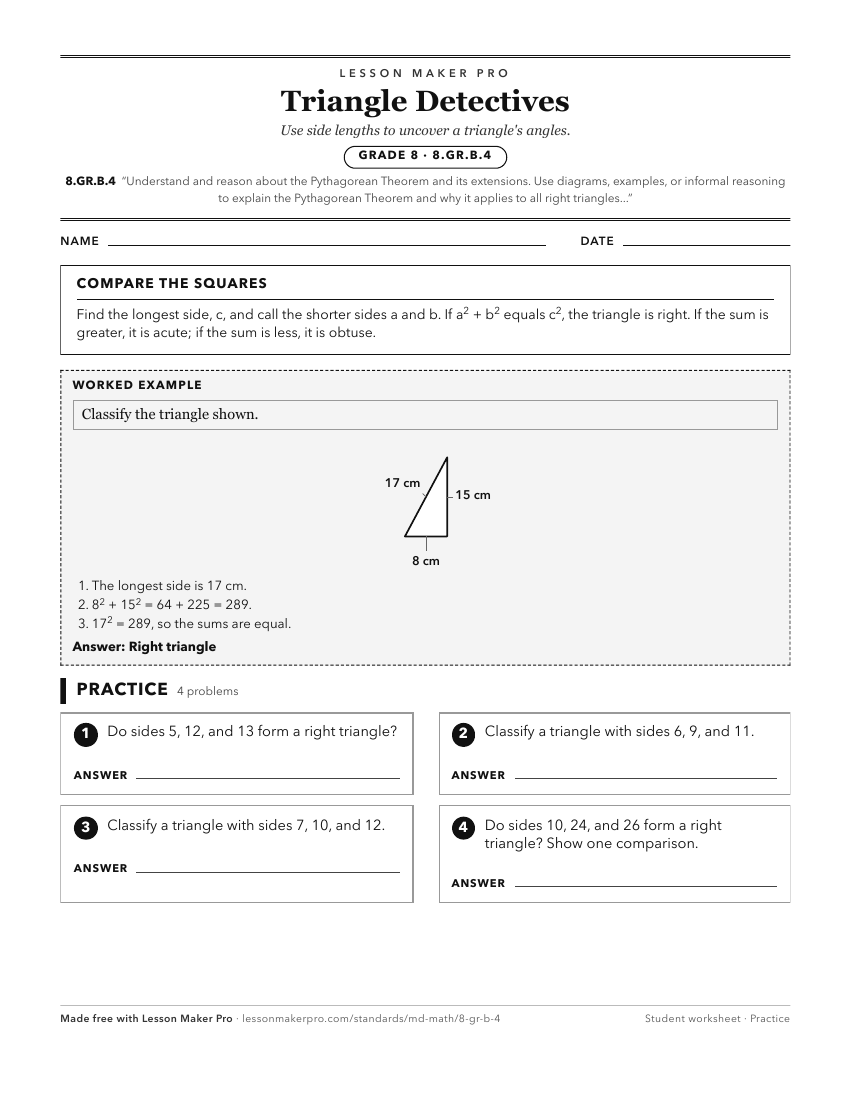
A ready-to-print activity worksheet aligned to 8.GR.B.4, with an answer key for the teacher on its own page. No account needed.
PDF, US Letter, prints cleanly in black and white.
Download the worksheetKeep exploring
Related Standards
Turn this cluster into a lesson
Grade, subject, topic, and the complete cluster are prefilled. Create one free, no account needed.
Also for this cluster:Make a WorksheetMake a QuizMake a Sub Lesson