Maryland Math 6.NOS.A.1
Standard Cluster
Divide fractions by fractions in context. Extend estimation strategies to estimate and assess the reasonableness of quotients. Use and connect concrete and visual fraction models (e.g., linear, regional/area, and set models) and equations to divide. Represent and explain the calculation by connecting fraction models, and/or equations to the meaning of division.
Maryland College and Career Ready Standards for Mathematics (2025) · APPLY AND EXTEND PREVIOUS UNDERSTANDINGS OF MULTIPLICATION AND DIVISION TO DIVIDE FRACTIONS BY FRACTIONS.
Cluster contents
Standards in This Cluster
6.NOS.A.1 is a cluster heading. These are the individual standards under it.
- 6.NOS.A.1.a
Extend estimation strategies to estimate and assess the reasonableness of quotients.
- 6.NOS.A.1.b
Use and connect concrete and visual fraction models (e.g., linear, regional/area, and set models) and equations to divide.
- 6.NOS.A.1.c
Represent and explain the calculation by connecting fraction models, and/or equations to the meaning of division.
Teacher's field guide
What This Cluster Means
What Students Need to Do
- Students find how many groups of one fraction fit in another, even when the answer includes part of a group. They use fraction strips, drawings, or number lines to show the groups, write a division equation, and check the answer with an estimate.
What Mastery Looks Like
- Given 3/4 cup of flour and 1/2 cup per batch, a student shows one full batch and half a batch. They write 3/4 ÷ 1/2 = 1 1/2 and explain why the answer is between 1 and 2.
Common Misconceptions
- Students may flip the first fraction instead of the divisor, or use the reciprocal rule without knowing what the answer counts. Some count only complete groups or assume division always makes a number smaller.
How to Assess It
- Exit ticket: A recipe needs 1/2 cup of oats per batch, and you have 3/4 cup. Estimate the number of batches, then draw a strip and write a division equation to find the exact amount.
Lesson moves
Ways to Teach It
Give pairs strips marked in fourths; have them build 3/4 and show how many 1/2-length groups it contains.
Ask, 'Why is 2/3 ÷ 1/4 greater than 2/3?' Have students sketch a number line and explain their estimate.
Play a card match: pair 3/4 ÷ 1/2 with a shaded area model and 1 1/2, then explain the match.
Post a smoothie recipe using 3/4 cup of yogurt per serving; with 1/2 cup available, students estimate and calculate servings.
Free download
Printable 6.NOS.A.1 Worksheet
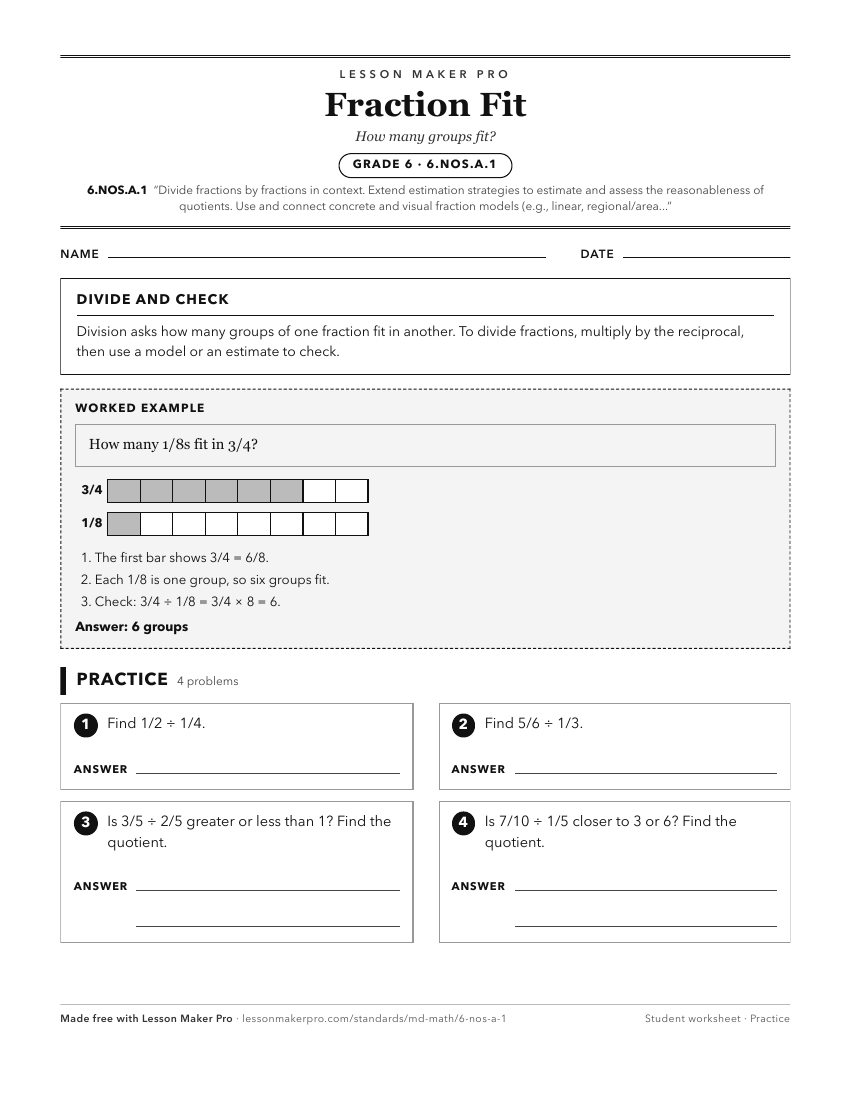
A ready-to-print activity worksheet aligned to 6.NOS.A.1, with an answer key for the teacher on its own page. No account needed.
PDF, US Letter, prints cleanly in black and white.
Download the worksheetKeep exploring
Related Standards
- 5.NOS.D.16.d
Represent and explain the computation by connecting visual fraction models and/or equations to the meaning of division with unit fractions.
- 5.NOS.D.10
Interpret a fraction as division of the numerator by the denominator (a/b = a ÷ b) in context using visual fraction models and equations to represent the proble...
- 5.NOS.D.16
Apply and extend previous understandings of division to divide unit fractions by whole numbers and whole numbers by unit fractions in context.
Turn this cluster into a lesson
Grade, subject, topic, and the complete cluster are prefilled. Create one free, no account needed.
Also for this cluster:Make a WorksheetMake a QuizMake a Sub Lesson