Maryland Math 5.AT.B.3
Standard Cluster
Generate and analyze number patterns. Generate a number pattern that follows a given rule and identify relationships between the numbers within the pattern. Generate two numerical patterns using two given rules and identify relationships between corresponding terms. Use tables, ordered pairs, and graphs to represent the relationship between quantities.
Maryland College and Career Ready Standards for Mathematics (2025) · ANALYZE PATTERNS AND RELATIONSHIPS.
Cluster contents
Standards in This Cluster
5.AT.B.3 is a cluster heading. These are the individual standards under it.
- 5.AT.B.3.a
Generate a number pattern that follows a given rule and identify relationships between the numbers within the pattern.
- 5.AT.B.3.b
Generate two numerical patterns using two given rules and identify relationships between corresponding terms.
- 5.AT.B.3.c
Use tables, ordered pairs, and graphs to represent the relationship between quantities.
Teacher's field guide
What This Cluster Means
What Students Need to Do
- Students build number patterns from given rules. They compare terms in two patterns and describe how the paired numbers relate. They show the pairs in a table and as points on a graph.
What Mastery Looks Like
- A student can make four terms for rules such as start at 1, add 3 and start at 2, add 6. They can pair the terms, plot (1, 2), (4, 8), (7, 14), and (10, 20), and explain that the second number is always twice the first.
Common Misconceptions
- Students may use the rule for one pattern to extend both patterns. Some plot the term number instead of pairing the values from the two patterns. Others spot a relationship in one pair but do not check the rest.
How to Assess It
- Exit ticket: Start at 1 and add 3; start at 2 and add 6. Make four terms for each, put the matching terms in a table, plot the pairs, and describe their relationship.
Lesson moves
Ways to Teach It
Build two counter rows starting at 1 and 2; add 3 and 6 counters each round, then pair the totals.
Write two sentences explaining why the second value is twice the first in (1, 2), (4, 8), and (7, 14).
Give pairs of students rule cards, blank tables, and graph paper; race to make four matching pairs and plot them correctly.
Compare $2 and $4 ticket booths: list costs for one to four tickets, then graph the paired costs.
Free download
Printable 5.AT.B.3 Worksheet
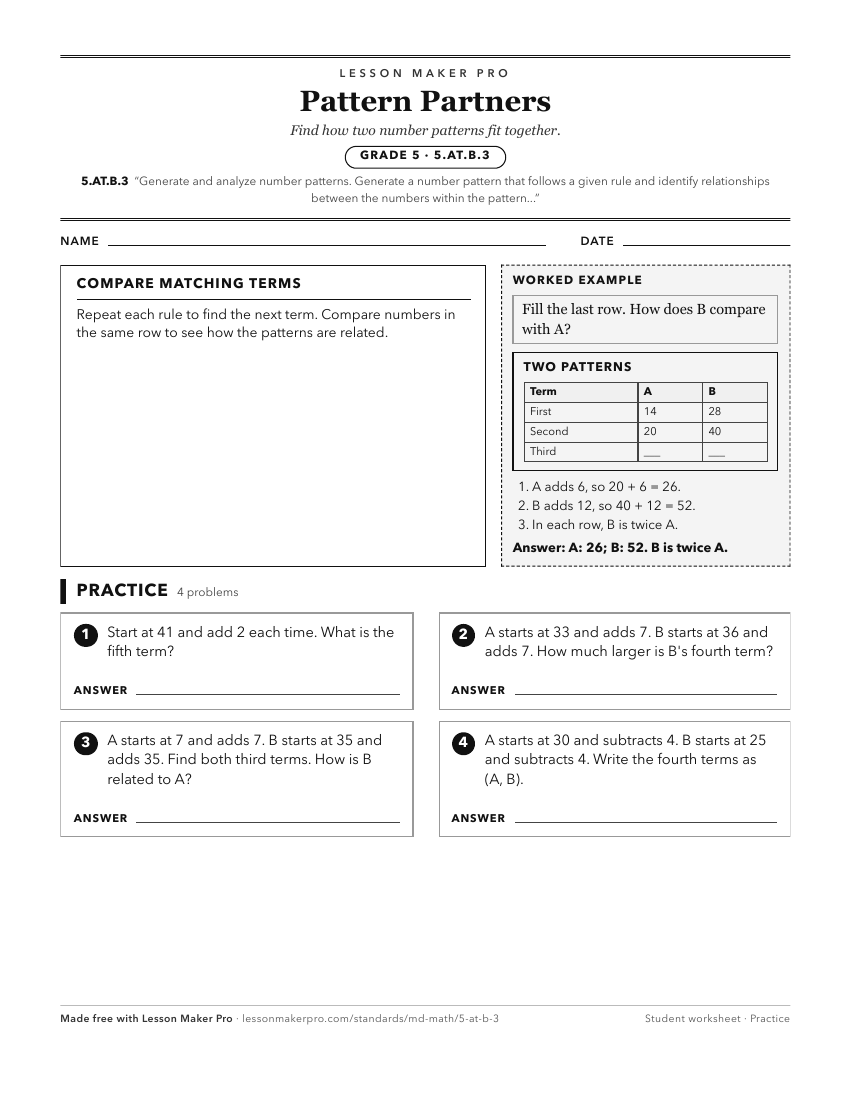
A ready-to-print activity worksheet aligned to 5.AT.B.3, with an answer key for the teacher on its own page. No account needed.
PDF, US Letter, prints cleanly in black and white.
Download the worksheetKeep exploring
Related Standards
Turn this cluster into a lesson
Grade, subject, topic, and the complete cluster are prefilled. Create one free, no account needed.
Also for this cluster:Make a WorksheetMake a QuizMake a Sub Lesson