Maryland Math 4.NOS.E.13.b
The Standard
- 4.NOS.E.13
- Apply and extend previous understandings of multiplication to multiply a fraction by a whole number (b × c/d).
Use understanding of multiplication as equal groups to multiply a unit fraction by whole number (e.g., interpret b × 1/d as b groups of 1/d).
Maryland College and Career Ready Standards for Mathematics (2025) · BUILD FRACTIONS FROM UNIT FRACTIONS BY APPLYING AND EXTENDING PREVIOUS UNDERSTANDINGS OF OPERATIONS ON WHOLE NUMBERS.
Teacher's field guide
What This Standard Means
What Students Need to Do
- Students make several equal groups with one unit fraction in each group. They count the pieces and write the total as a fraction.
What Mastery Looks Like
- Given 5 × 1/4, a student draws five fourth-sized pieces and labels the total 5/4. They explain why the denominator stays 4 and show 5/4 on a number line.
Common Misconceptions
- Students may multiply the denominator too, writing 5 × 1/4 = 5/20. Others stop at 4/4 because they think fractions cannot be greater than one, or draw pieces from different-sized wholes.
How to Assess It
- Exit ticket: Draw 6 groups of 1/4, write the total as a fraction, and explain why the denominator stays 4.
Lesson moves
Ways to Teach It
Give pairs five identical paper strips marked in sixths; cut one sixth from each, line up the pieces, and label the total 5/6.
Have students sketch five thirds and explain in writing why 5 × 1/3 equals 5/3, not 5/15.
Partners roll a die, make that many 1/4 hops on a 0-to-2 number line, and write the matching multiplication equation.
Have students pour six level 1/8-cup scoops of dry rice into a measuring cup and record the total as 6/8 cup.
Free download
Printable 4.NOS.E.13.b Worksheet
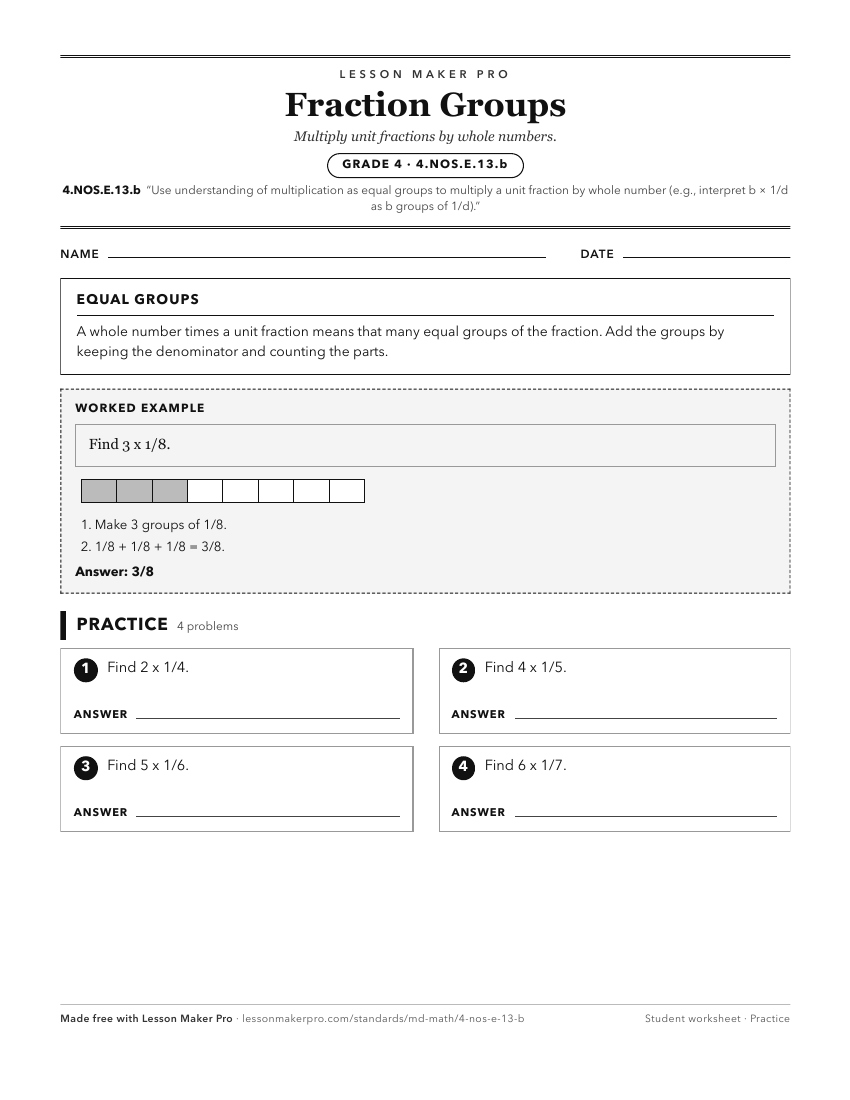
A ready-to-print activity worksheet aligned to 4.NOS.E.13.b, with an answer key for the teacher on its own page. No account needed.
PDF, US Letter, prints cleanly in black and white.
Download the worksheetKeep exploring
Related Standards
- 5.NOS.D.11.b
Multiply a whole number by a fraction (e.g., interpret c/d × b as c/d of b when c/d is greater than or less than 1).
- 5.NOS.D.11
Apply and extend previous understandings of multiplication to multiply a whole number by a fraction (c/d × b).
- 4.NOS.E.13.c
Use understanding of multiplication as equal groups to multiply a fraction by whole number (e.g., interpret b × c/d as b groups of c/d when c/d is greater than ...
Turn this exact standard into a lesson
Grade, subject, topic, and the complete standard are prefilled. Create one free, no account needed.
Also for this standard:Make a WorksheetMake a QuizMake a Sub Lesson