Maryland Math 4.NOS.C.8.a
The Standard
- 4.NOS.C.8
- Explain and apply concepts of factors, multiples, and prime and composite numbers for whole numbers in the range of 1-100.
Identify factor pairs for a whole number in the range of 1–100.
Maryland College and Career Ready Standards for Mathematics (2025) · GAIN FAMILIARITY WITH FACTORS AND MULTIPLES.
Teacher's field guide
What This Standard Means
What Students Need to Do
- Students find two whole numbers that multiply to make a given number. They list every distinct pair, including 1 and the number.
What Mastery Looks Like
- For 36, a student lists 1 and 36, 2 and 18, 3 and 12, 4 and 9, and 6 and 6. They test numbers in order until the factors meet to check that no pairs are missing.
Common Misconceptions
- Students may list multiples instead of factors. They may leave out 1 and the number, count a reversed pair twice, or stop before finding every pair.
How to Assess It
- Exit ticket: List every factor pair of 24. How do you know you found them all?
Lesson moves
Ways to Teach It
Give students 24 counters to arrange in equal rows, then have them record the rows and columns for each arrangement.
Ask: Why are 3 and 6 the same factor pair as 6 and 3? Have students explain in two sentences.
Place cards labeled 12, 18, 20, 24, and 36 face down; partners flip one and race to list every factor pair.
Ask students to sketch every way to arrange 30 chairs in equal rows and label the number of rows and chairs per row.
Free download
Printable 4.NOS.C.8.a Worksheet
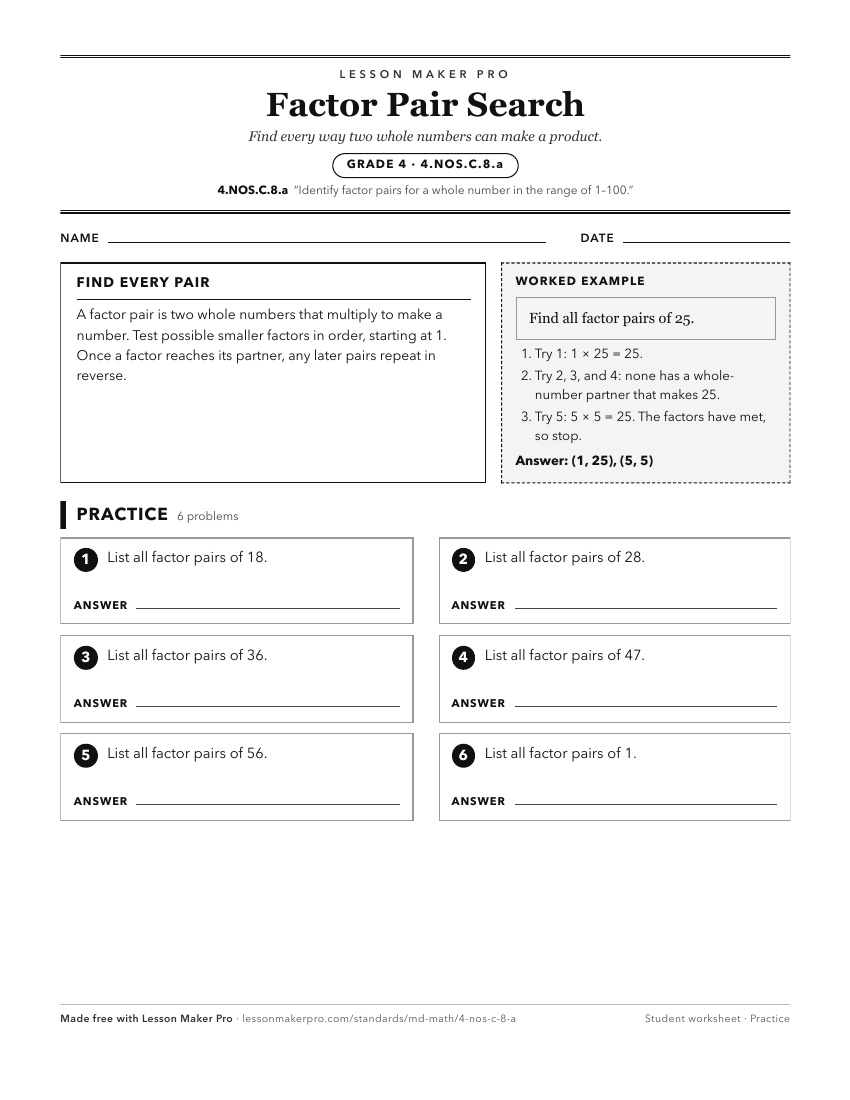
A ready-to-print activity worksheet aligned to 4.NOS.C.8.a, with an answer key for the teacher on its own page. No account needed.
PDF, US Letter, prints cleanly in black and white.
Download the worksheetKeep exploring
Related Standards
- 4.NOS.C.8.b
Determine whether a given whole number in the range of 1–100 is a multiple of a one-digit number.
- 6.NOS.B.4
Identify the common factors and multiples of two whole numbers.
- 6.NOS.B.4.a
Identify the greatest common factor of two whole numbers within 100.
- 4.NOS.C.8
Explain and apply concepts of factors, multiples, and prime and composite numbers for whole numbers in the range of 1-100.
Turn this exact standard into a lesson
Grade, subject, topic, and the complete standard are prefilled. Create one free, no account needed.
Also for this standard:Make a WorksheetMake a QuizMake a Sub Lesson