Maryland Math 4.GR.B.7
The Standard
Explain that when an angle is decomposed into non-overlapping parts, the angle measure of the whole is the sum of the angle measures of the parts. Solve addition and subtraction problems to find unknown angles on a diagram in context (e.g., by using an equation with a symbol for the unknown angle measure).
Maryland College and Career Ready Standards for Mathematics (2025) · UNDERSTAND CONCEPTS OF ANGLE AND MEASURE ANGLES.
Teacher's field guide
What This Standard Means
What Students Need to Do
- Students show that two angle parts that do not overlap add up to the whole angle. They use addition or subtraction to find a missing angle in a diagram.
What Mastery Looks Like
- Given a split angle, a student identifies which parts make up the whole. They write an equation such as 38° + x° = 90°, solve for x, and check that the parts add to 90°.
Common Misconceptions
- Some students add a known part to the whole instead of subtracting it to find the missing part. Others count overlapping angles twice or think a longer ray makes a larger angle.
How to Assess It
- Give students a diagram of a 120° angle split into 47° and x°. Ask them to write an equation, find x, and explain why they used subtraction.
Lesson moves
Ways to Teach It
Give pairs cardboard angle wedges and protractors; have them draw a dividing ray, measure both parts, and check against the whole.
Show a 90° corner split into 35° and an unknown angle, then ask students to explain why they would subtract 35°.
Give pairs cards with split-angle diagrams and number cards; have them match each diagram to its missing angle measure.
Sketch a rectangular garden corner with a path 32° from one edge, then find the angle between the path and the other edge.
Free download
Printable 4.GR.B.7 Worksheet
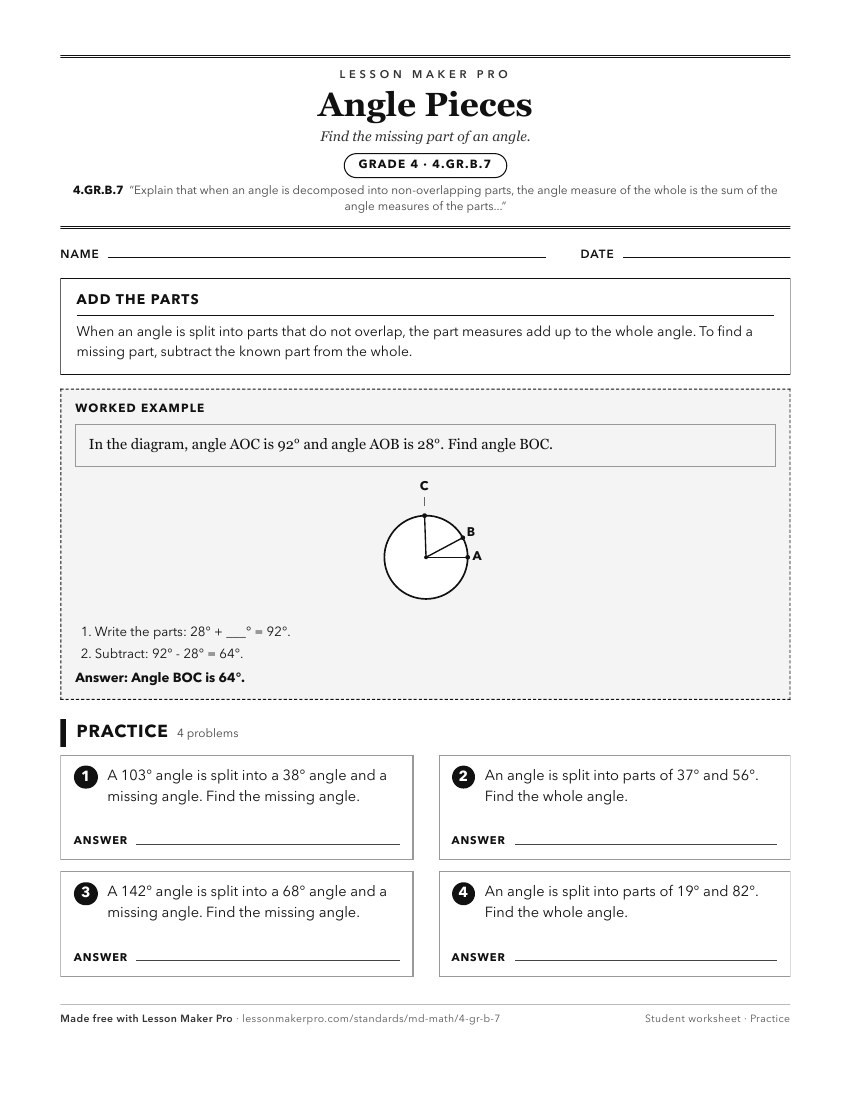
A ready-to-print activity worksheet aligned to 4.GR.B.7, with an answer key for the teacher on its own page. No account needed.
PDF, US Letter, prints cleanly in black and white.
Download the worksheetKeep exploring
Related Standards
- 8.GR.A.1
Use the relationships between supplementary, complementary, vertical, and adjacent angles to write and solve equations for an unknown angle.
- 4.GR.B.6
Measure angles in whole-number degrees using a protractor. Estimate and sketch angles of specified measures.
- K.NOS.D.11
Decompose numbers within 10 in more than one way, by using objects or drawings, and record each decomposition with a drawing or equation (e.g., 10 = 4 + 6 and 1...
- 5.GR.C.5.c
Determine the volumes of composite figures by decomposing them into non-overlapping right rectangular prisms and adding their volumes together to solve problems...
Turn this exact standard into a lesson
Grade, subject, topic, and the complete standard are prefilled. Create one free, no account needed.
Also for this standard:Make a WorksheetMake a QuizMake a Sub Lesson