Maryland Math 4.AT.A.1
The Standard
Interpret a multiplication situation as a comparison (e.g., interpret 35 = 5 × 7 as a statement that 35 is 5 times as many as 7 and 7 times as many as 5). Represent verbal statements of multiplicative comparisons as multiplication equations.
Maryland College and Career Ready Standards for Mathematics (2025) · REPRESENT AND SOLVE PROBLEMS INVOLVING MULTIPLICATION AND DIVISION.
Teacher's field guide
What This Standard Means
What Students Need to Do
- Students use multiplication to compare two amounts. They turn phrases like “three times as many” into equations and explain which amount is larger.
What Mastery Looks Like
- Given 6 cards in one pile and 4 times as many in another, a student writes 4 × 6 = 24 and identifies the pile with 24 cards. They can explain that 24 is four times as many as 6.
Common Misconceptions
- Students may add 4 instead of multiplying by 4 when they hear “four times as many.” They may also mix up which amount is being compared and which amount they start with.
How to Assess It
- Exit ticket: Ava has 8 marbles. Ben has 3 times as many. Write an equation, find Ben’s total, and explain what the 3 means.
Lesson moves
Ways to Teach It
Build a row of 5 counters, then a row with 3 times as many; label both rows and write an equation.
Ask: “Sam has 7 pencils. Lee has 4 times as many.” Have students write an equation and explain who has more.
Give pairs of students number cards and comparison cards; have them match each statement to an equation and check each other’s choices.
Compare 3 pencils in one cup with 12 in another; have students write how many times as many the second cup holds.
Free download
Printable 4.AT.A.1 Worksheet
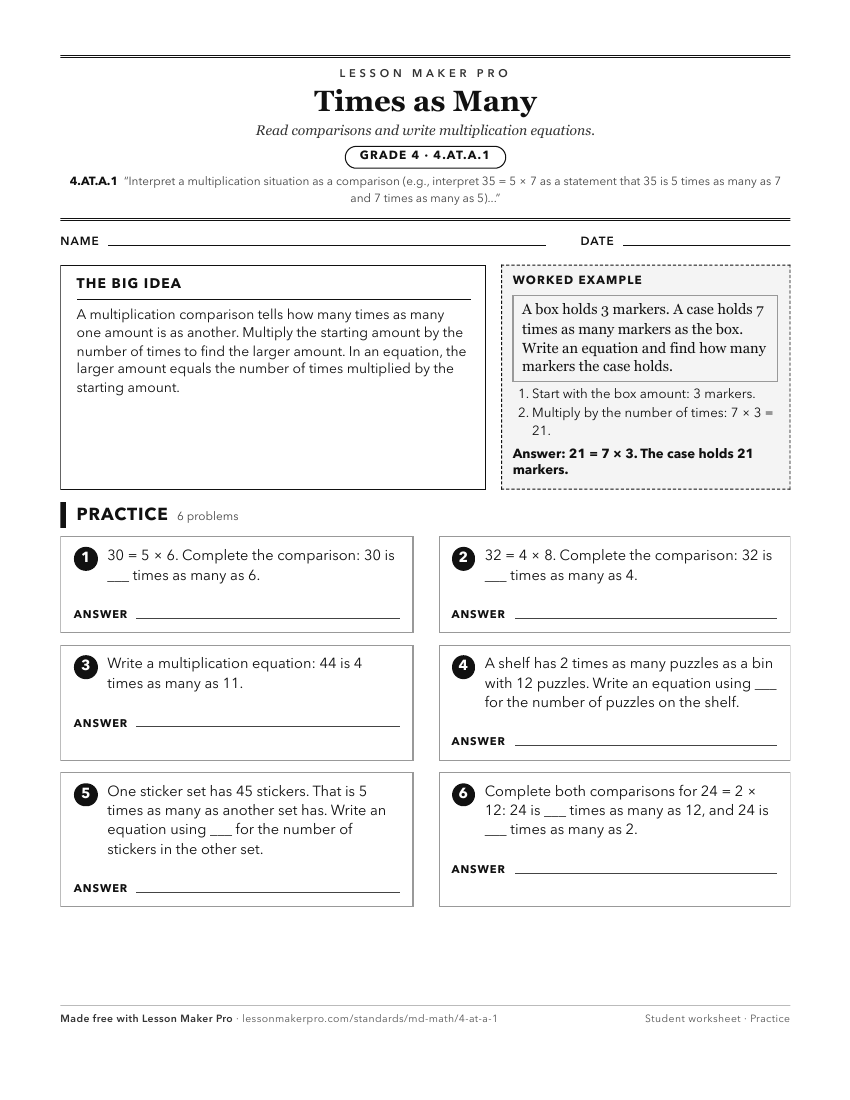
A ready-to-print activity worksheet aligned to 4.AT.A.1, with an answer key for the teacher on its own page. No account needed.
PDF, US Letter, prints cleanly in black and white.
Download the worksheetKeep exploring
Related Standards
- 4.NOS.C.7.c
Use properties of operations (e.g., to solve 8 × 7, think of (5 × 7 + (3 × 7)) to multiply.
- 4.AT.A.2
Multiply or divide to solve multiplicative comparison problems in context by using drawings and equations with a symbol for the unknown number to represent the ...
- 3.NOS.E.9.c
Use properties of operations (e.g., to solve 8 × 7, think of (5 × 7) + (3 × 7)) to multiply.
- 5.NOS.D.14
Interpret multiplication as scaling (sizing) in context.
Turn this exact standard into a lesson
Grade, subject, topic, and the complete standard are prefilled. Create one free, no account needed.
Also for this standard:Make a WorksheetMake a QuizMake a Sub Lesson