Maryland Math 3.NOS.D.7
Standard Cluster
Fluently add and subtract within 1,000. Use computational strategies efficiently (e.g., decomposition, partials sums, compensation, make ten/hundred/thousand) to add and subtract. Use properties of operations, and/or the inverse relationship between addition and subtraction. Determine and explain when a strategy is most efficient.
Maryland College and Career Ready Standards for Mathematics (2025) · USE PLACE VALUE UNDERSTANDING AND PROPERTIES OF OPERATIONS TO PERFORM MULTI-DIGIT ARITHMETIC.
Cluster contents
Standards in This Cluster
3.NOS.D.7 is a cluster heading. These are the individual standards under it.
- 3.NOS.D.7.a
Use computational strategies efficiently (e.g., decomposition, partials sums, compensation, make ten/hundred/thousand) to add and subtract.
- 3.NOS.D.7.b
Use properties of operations, and/or the inverse relationship between addition and subtraction.
- 3.NOS.D.7.c
Determine and explain when a strategy is most efficient.
Teacher's field guide
What This Cluster Means
What Students Need to Do
- Students add and subtract within 1,000 by breaking numbers apart, regrouping addends, or making a friendly number. They choose a method that fits the numbers and explain why.
What Mastery Looks Like
- A student solves 398 + 247 as 400 + 245 and 602 − 298 as 604 − 300. They explain why those changes make the work easier and check an answer with the opposite operation.
Common Misconceptions
- Students may change only one number when adjusting a subtraction problem, which changes the difference. Others mix up hundreds and tens in partial sums or try to subtract through a zero without regrouping.
How to Assess It
- Exit ticket: Solve 602 − 298. Explain why you chose your method, then check your answer with addition.
Lesson moves
Ways to Teach It
Use base-ten blocks to show 452 − 178; trade a hundred and a ten, then write matching subtraction steps.
Ask students whether making 400 or using partial sums is quicker for 398 + 247, and have them explain their choice.
Give pairs cards labeled 298, 304, 398, 402, 602, and 745; draw two, subtract smaller from larger, then verify with addition.
Post a goal of 1,000 library books and 683 already collected; students find how many remain and explain their method.
Free download
Printable 3.NOS.D.7 Worksheet
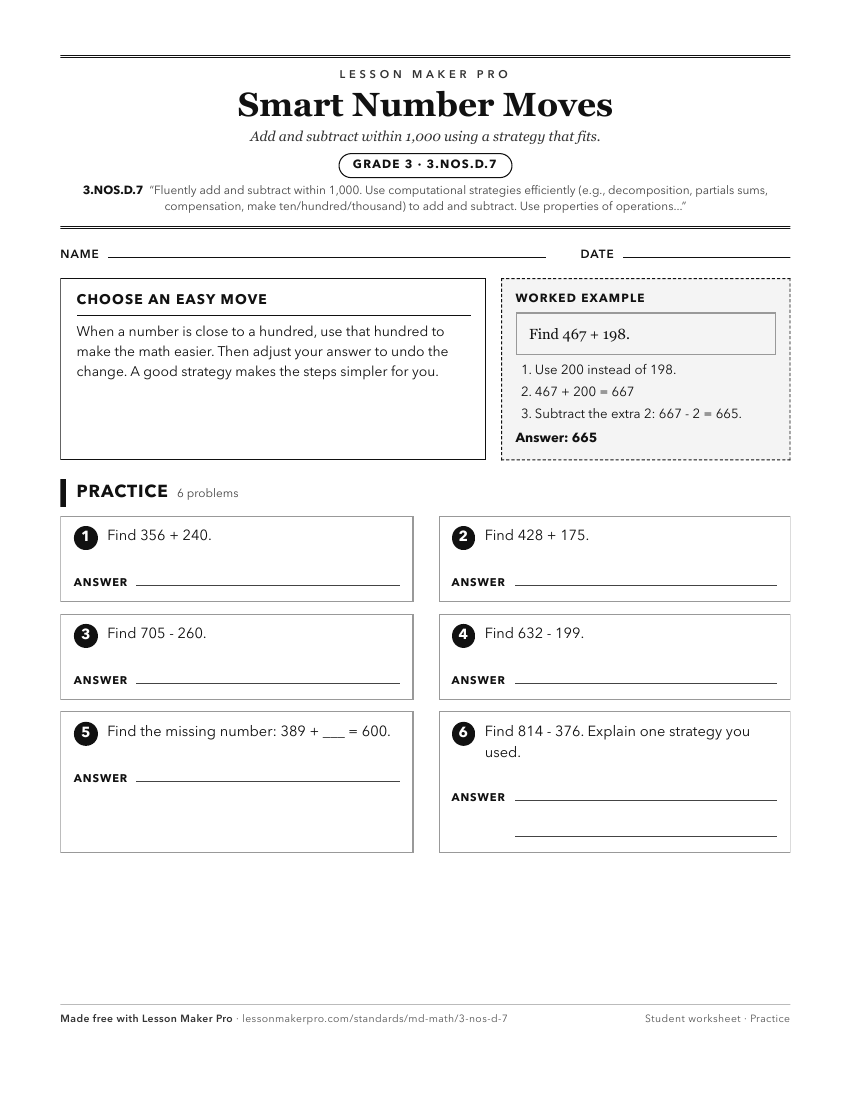
A ready-to-print activity worksheet aligned to 3.NOS.D.7, with an answer key for the teacher on its own page. No account needed.
PDF, US Letter, prints cleanly in black and white.
Download the worksheetKeep exploring
Related Standards
- 6.NOS.B.3
Fluently multiply and divide multi-digit decimals to the thousandths in context.
- 4.NOS.B.3
Fluently add and subtract multi-digit whole numbers within 1,000,000.
- 2.NOS.C.9
Add and subtract within 1000, recognizing that when adding or subtracting three-digit numbers, one adds or subtracts hundreds and hundreds, tens and tens, ones ...
- 2.NOS.C.8
Fluently add and subtract within 100.
Turn this cluster into a lesson
Grade, subject, topic, and the complete cluster are prefilled. Create one free, no account needed.
Also for this cluster:Make a WorksheetMake a QuizMake a Sub Lesson