Maryland Math 2.NOS.D.11
The Standard
Partition circles and rectangles into equal shares (halves, thirds, and fourths) recognizing that equal shares do not need to have the same shape. Determine how many equal shares are needed to make a whole (e.g., three thirds).
Maryland College and Career Ready Standards for Mathematics (2025) · UNDERSTAND EQUAL PARTS OF A WHOLE.
Teacher's field guide
What This Standard Means
What Students Need to Do
- Students split circles and rectangles into halves, thirds, and fourths with equal areas. They tell how many shares make one whole, even when equal shares have different shapes.
What Mastery Looks Like
- A student can draw and label equal shares in a circle or rectangle. They can show that three thirds fill a whole and explain why differently shaped pieces can still be equal shares.
Common Misconceptions
- Students may call any three pieces thirds, even when one piece is larger. They may think equal shares must have the same shape.
How to Assess It
- Exit ticket: Divide a circle into fourths and a 3-by-4 grid rectangle into three equal shares with at least two different shapes. Label the shares and write how many fill each whole.
Lesson moves
Ways to Teach It
Cut a 3-by-4 grid rectangle into one four-square row and two 2-by-2 squares, then fit the three thirds back together.
Show a circle cut into three uneven pieces and ask, “Are these thirds? What would you change?”
Give pairs circle and rectangle cards to sort into halves, thirds, fourths, and unequal parts.
Draw a rectangular pan of brownies and ask students to mark four equal shares for four friends.
Free download
Printable 2.NOS.D.11 Worksheet
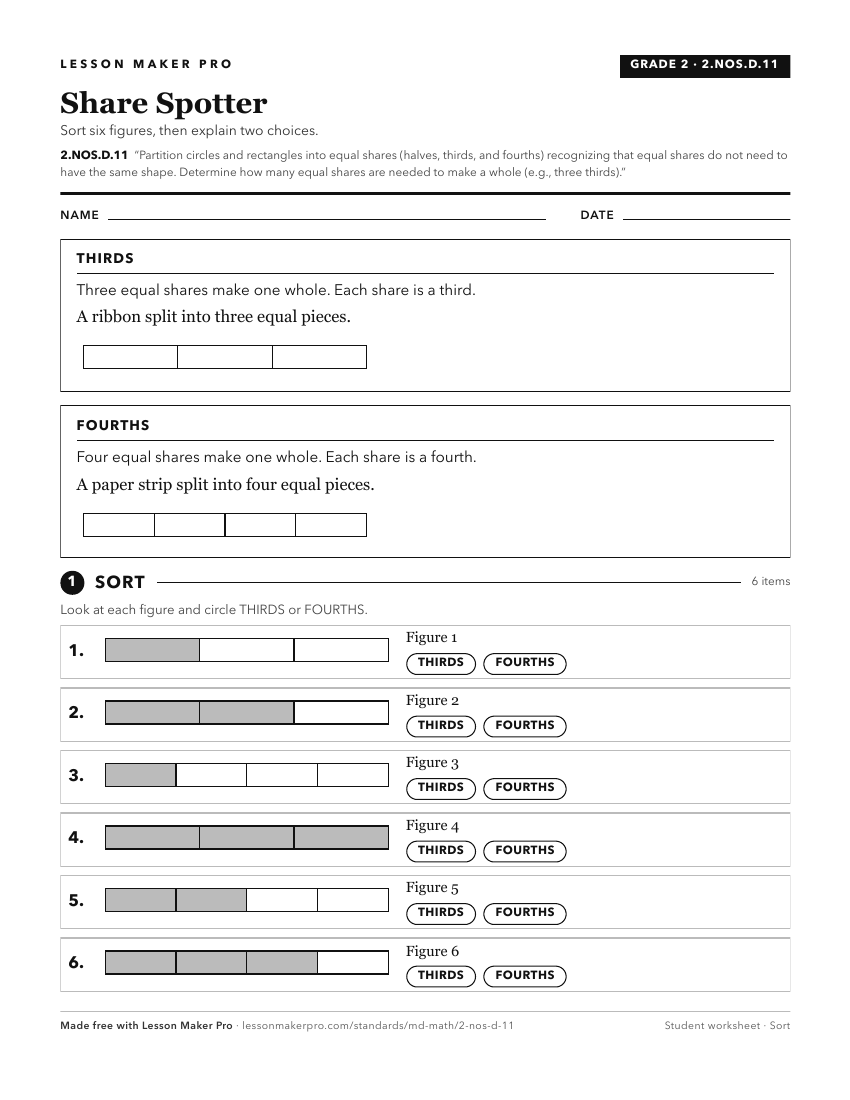
A ready-to-print activity worksheet aligned to 2.NOS.D.11, with an answer key for the teacher on its own page. No account needed.
PDF, US Letter, prints cleanly in black and white.
Download the worksheetKeep exploring
Related Standards
- 1.NOS.F.14
Partition circles and rectangles into equal shares (halves and fourths) recognizing that decomposing into more equal shares creates smaller shares. Determine ho...
- 3.NOS.F.10
Recognize and explain that a fraction represents a part of a whole.
- 3.NOS.B.3
Represent and interpret whole-number quotients (0-10) as dividing an amount into known number of groups (partitive) or as dividing an amount into groups of know...
Turn this exact standard into a lesson
Grade, subject, topic, and the complete standard are prefilled. Create one free, no account needed.
Also for this standard:Make a WorksheetMake a QuizMake a Sub Lesson