Maryland Math 2.NOS.A.1.c
The Standard
- 2.NOS.A.1
- Use understanding of 100 as a bundle of ten tens, called a “hundred,” and compose and decompose three-digit numbers.
Compose and decompose three-digit numbers in more than one way (e.g., 439 = 400 + 39 or 439 = 435 + 4).
Maryland College and Career Ready Standards for Mathematics (2025) · UNDERSTAND PLACE VALUE AND REPRESENTATIONS OF NUMBERS.
Teacher's field guide
What This Standard Means
What Students Need to Do
- Students split a three-digit number into parts in more than one way. They put the parts back together and show that the total stays the same.
What Mastery Looks Like
- Given 426, a student can write 400 + 26, 420 + 6, and 410 + 16. They can use blocks, a drawing, or addition to show why each sum equals 426.
Common Misconceptions
- Some students think 400 + 20 + 6 is the only way to split 426. Others trade a ten for ten ones but forget to reduce the number of tens.
How to Assess It
- Exit ticket: Write 426 as two different sums of two numbers. Check both sums with a drawing or addition.
Lesson moves
Ways to Teach It
Build 246 with base-ten blocks, trade one ten rod for ten ones, and record both splits as addition sentences.
Ask, 'Are 300 + 74 and 360 + 14 both 374?' Have students explain their answer with a sketch.
Give pairs of students cards showing 438, 400 + 38, 420 + 18, and 430 + 8 to match and check.
Show a 365-cent receipt and use play money to group the amount as 300 + 65 cents, then 360 + 5 cents.
Free download
Printable 2.NOS.A.1.c Worksheet
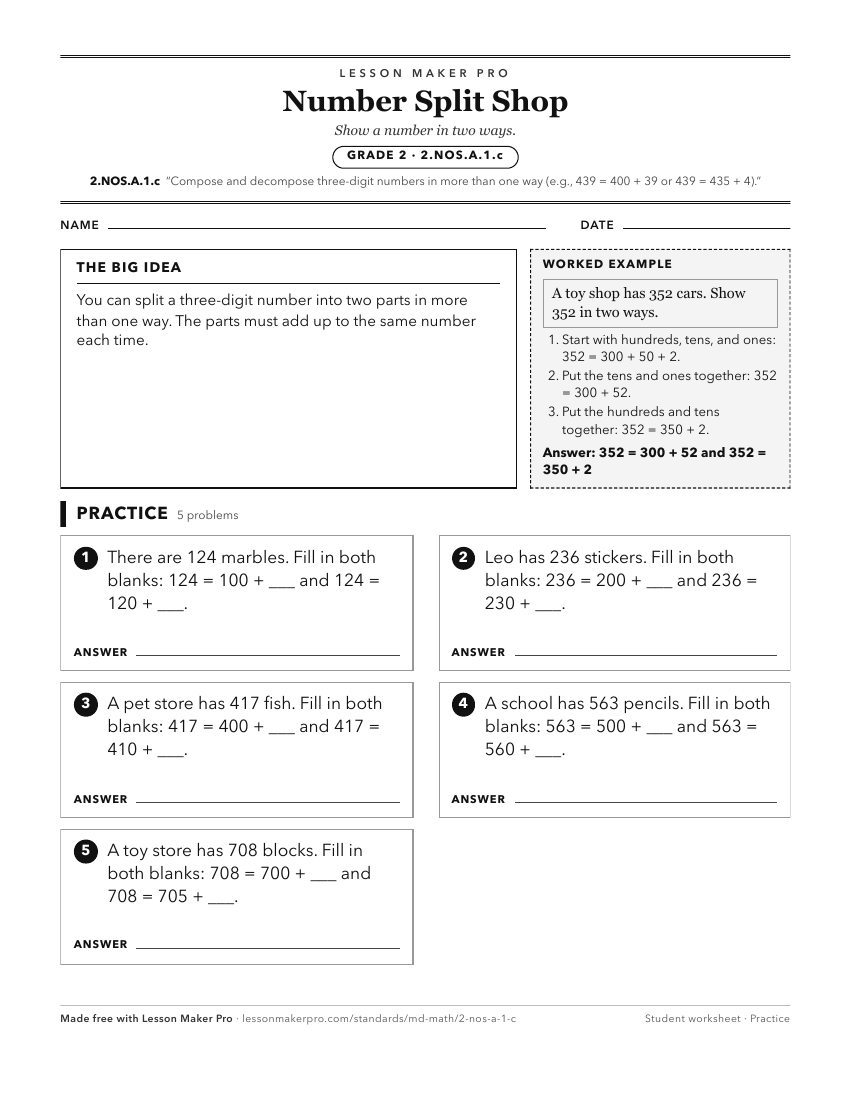
A ready-to-print activity worksheet aligned to 2.NOS.A.1.c, with an answer key for the teacher on its own page. No account needed.
PDF, US Letter, prints cleanly in black and white.
Download the worksheetKeep exploring
Related Standards
- K.NOS.C.9.a
Compose and decompose numbers from 11 to 19 into ten ones and some further ones by using objects or drawings, and equations (e.g., 13 = 10 + 3).
- 2.NOS.A.1.a
Compose and decompose three-digit numbers into hundreds, tens, and ones by using objects, drawings, and/or equations (e.g., 328 = 300 + 20 + 8 or 328 is thirty-...
- 1.NOS.B.3.a
Compose and decompose two-digit numbers into tens and ones using objects or drawings, and equations (e.g., 10 + 4 = 14; 38 = 30 + 8).
- 1.NOS.B.3.c
Compose and decompose two-digit numbers in more than one way (e.g. 46 = 41 + 5 or 46 = 23 + 23).
Turn this exact standard into a lesson
Grade, subject, topic, and the complete standard are prefilled. Create one free, no account needed.
Also for this standard:Make a WorksheetMake a QuizMake a Sub Lesson