Maryland Math 2.GR.C.7
The Standard
Tell and represent time to the nearest minute using multiple representations (e.g., digital clocks, analog clocks, number lines).
Maryland College and Career Ready Standards for Mathematics (2025) · WORK WITH TIME AND MONEY.
Teacher's field guide
What This Standard Means
What Students Need to Do
- Students read time to the minute on analog clocks. They show the same time on a digital clock and a number line.
What Mastery Looks Like
- A student can read an analog clock showing 3:18 and write 3:18. They can mark 18 minutes past 3:00 on a number line and draw the hour hand a little past 3.
Common Misconceptions
- Students may read the minute hand at 3 as 3 minutes instead of 15. They may count by fives but miss the extra minute ticks. They may name the next hour when the hour hand is close to it.
How to Assess It
- Show an analog clock set to 2:17. Ask students to write the digital time and mark it on a number line from 2:00 to 3:00.
Lesson moves
Ways to Teach It
Give students paper clocks to set to 9:22, then have them write the digital time and mark it on a number line.
Show clocks set to 4:15 and 4:51; ask, "How can you prove which is which using the hands?"
Play a matching game with analog clocks, digital times, and marked number lines, including 7:06 and 7:43.
Give students a class schedule showing lunch at 11:37; have them draw that time on a clock and number line.
Free download
Printable 2.GR.C.7 Worksheet
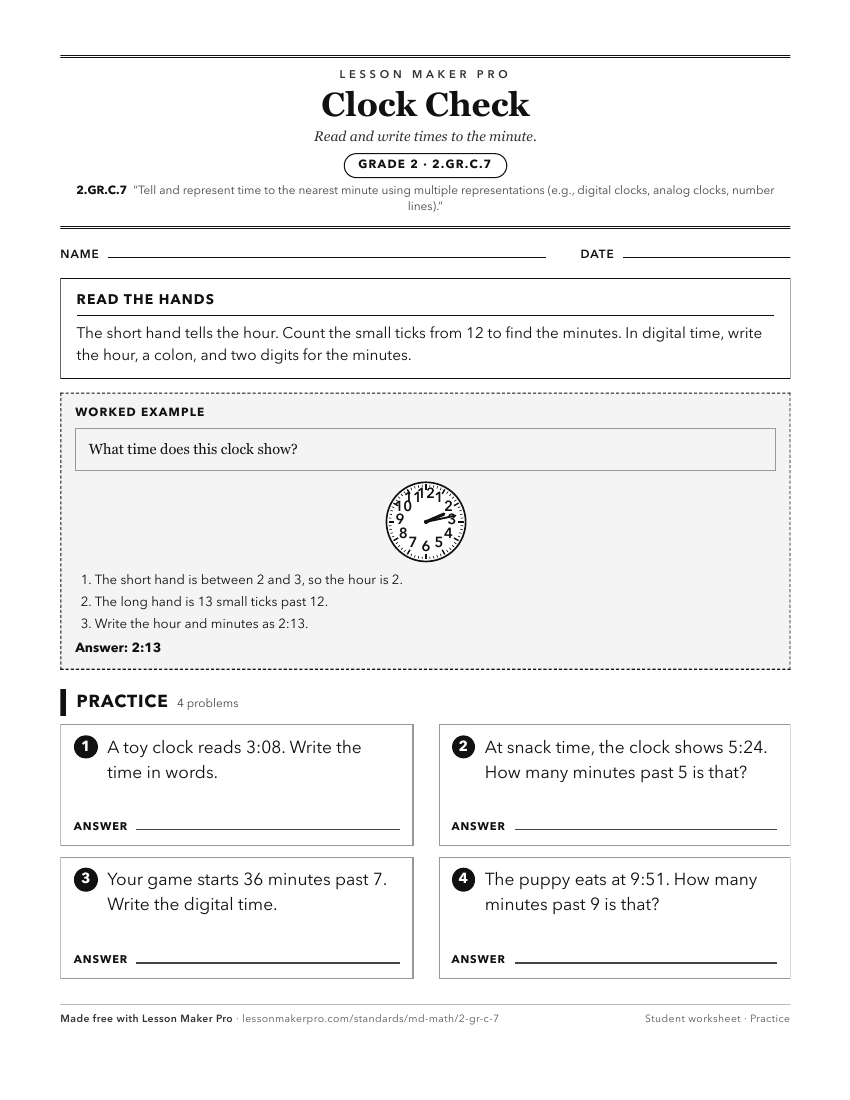
A ready-to-print activity worksheet aligned to 2.GR.C.7, with an answer key for the teacher on its own page. No account needed.
PDF, US Letter, prints cleanly in black and white.
Download the worksheetKeep exploring
Related Standards
- 1.GR.C.5
Tell time in hours, half hours, and quarter hours using a digital clock or analog clock. Estimate time intervals (1 hour, 30 minutes, 15 minutes, 1 minute) for ...
- 1.NOS.B.4
Represent whole numbers as lengths from 0 on a number line (horizontal and vertical) with equally spaced points corresponding to whole numbers.
- 3.GR.A.2
Solve problems in context that involve addition and subtraction of time intervals in minutes (e.g., represent and solve using a number line).
Turn this exact standard into a lesson
Grade, subject, topic, and the complete standard are prefilled. Create one free, no account needed.
Also for this standard:Make a WorksheetMake a QuizMake a Sub Lesson