Maryland Math 1.GR.C.6
The Standard
Identify and know the value of coins (penny, nickel, dime, and quarter) and bills ($1, $5, $10, and $20).
Maryland College and Career Ready Standards for Mathematics (2025) · WORK WITH TIME AND MONEY.
Teacher's field guide
What This Standard Means
What Students Need to Do
- Students name pennies, nickels, dimes, and quarters and tell their values: 1¢, 5¢, 10¢, and 25¢. They also name $1, $5, $10, and $20 bills and tell their values.
What Mastery Looks Like
- Given mixed coins and play bills, students name each piece and state its value. They know a dime is worth more than a nickel, even though it is smaller.
Common Misconceptions
- Some students think the biggest coin is worth the most, so they choose a nickel over a dime. Others read 25¢ as $25 or mistake a $10 bill for $1 because they miss the zero.
How to Assess It
- Show pictures of the four coins and four bills. Ask students to write each name and value.
Lesson moves
Ways to Teach It
Sort real coins and play bills onto mats labeled 1¢, 5¢, 10¢, 25¢, $1, $5, $10, and $20.
Hold up a nickel and a dime. Ask, "Which is worth more? Why might someone guess wrong?"
Play memory with money picture cards and value cards; students name each coin or bill when they make a match.
Show a $5 book tag and a 25¢ garage-sale sticker; ask students to choose a matching play bill and coin.
Free download
Printable 1.GR.C.6 Worksheet
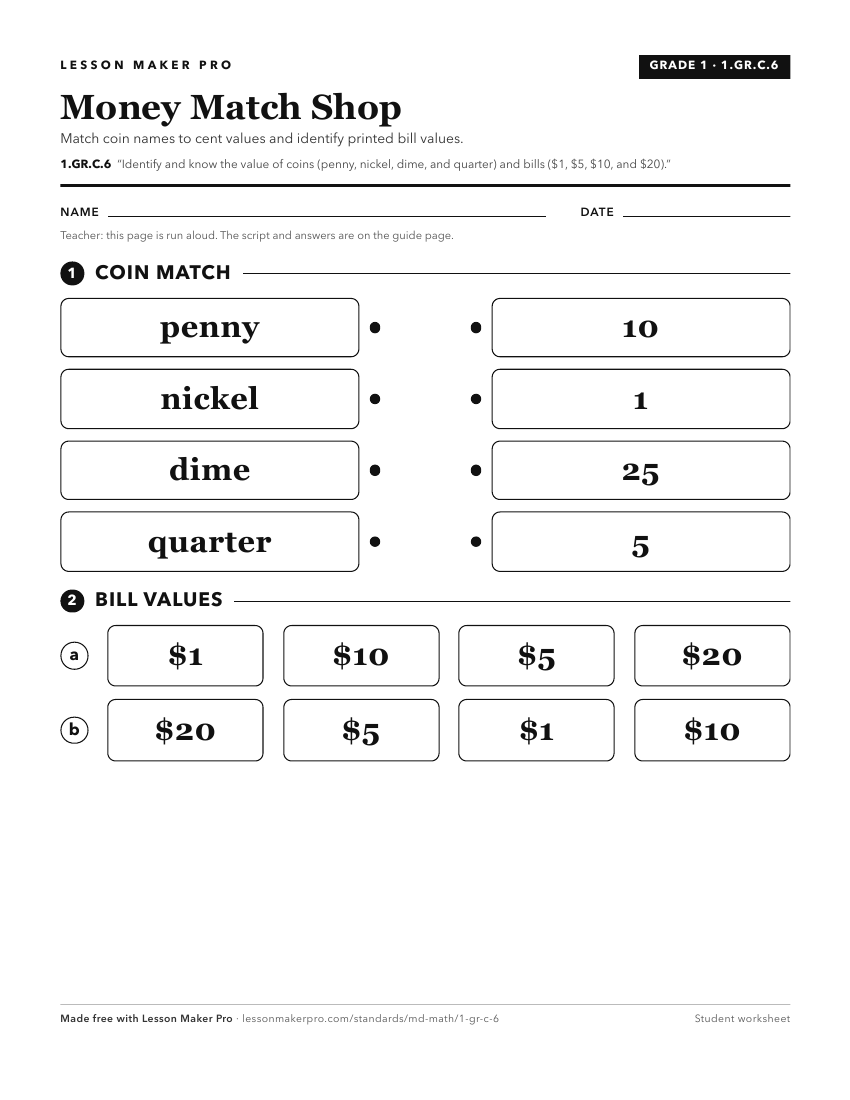
A ready-to-print activity worksheet aligned to 1.GR.C.6, with an answer key for the teacher on its own page. No account needed.
PDF, US Letter, prints cleanly in black and white.
Download the worksheetKeep exploring
Related Standards
- 2.GR.C.9
Count mixed sets of coins and bills to solve problems in context (within $20.00) involving bills, quarters, dimes, nickels, and pennies, using $ and ¢ symbols a...
- 2.NOS.C.8.a
Use strategies based on counting (e.g., counting on, counting back) and place value (e.g., partial sums, making tens, etc.) to add and subtract.
- 2.NOS.A.1.a
Compose and decompose three-digit numbers into hundreds, tens, and ones by using objects, drawings, and/or equations (e.g., 328 = 300 + 20 + 8 or 328 is thirty-...
- 1.NOS.B.3.a
Compose and decompose two-digit numbers into tens and ones using objects or drawings, and equations (e.g., 10 + 4 = 14; 38 = 30 + 8).
Turn this exact standard into a lesson
Grade, subject, topic, and the complete standard are prefilled. Create one free, no account needed.
Also for this standard:Make a WorksheetMake a QuizMake a Sub Lesson