Maryland ELA W.9-10.2.a
The Standard
- W.9-10.2
- Write informative / explanatory texts to examine and convey complex ideas, concepts, and information clearly and accurately through the effective selection, organization, and analysis of content. Introduce a topic; organize complex ideas, concepts, and information so that each new element builds on that which precedes it to create a unified whole; include formatting (e.g., headings), graphics (e.g., figures, tables), and multimedia when useful to aiding comprehension. Develop the topic with well-chosen, relevant, and sufficient facts, extended definitions, concrete details, quotations, or other information and examples appropriate to the audience’s knowledge of the topic. Use appropriate and varied transitions to link the major sections of the text, create cohesion, and clarify the relationships among complex ideas and concepts. Use precise language and domain-specific vocabulary to manage the complexity of the topic. Establish and maintain a formal style and objective tone while attending to the norms and conventions of the discipline in which they are writing. Provide a concluding statement or section that follows from and supports the information or explanation presented (e.g., articulating implications or the significance of the topic).
Introduce a topic; organize complex ideas, concepts, and information so that each new element builds on that which precedes it to create a unified whole; include formatting (e.g., headings), graphics (e.g., figures, tables), and multimedia when useful to aiding comprehension.
Maryland College and Career Ready Standards for English Language Arts (2025)
Teacher's field guide
What This Standard Means
What Students Need to Do
- Students introduce a topic so readers know what the piece will explain. They put ideas in an order that builds understanding and use headings, visuals, or media when these help readers follow along.
What Mastery Looks Like
- A student can open with a clear topic, then move from background to causes and effects without making readers backtrack. Their headings show how sections fit together, and any visual makes a point easier to understand.
Common Misconceptions
- Students may list facts in the order they found them, even when a later point needs an earlier explanation. They may add headings that repeat the topic or use a chart that shows nothing the text has not already made clear.
How to Assess It
- Exit ticket: Give students these notes: trees provide shade, nearby air warms, pavement absorbs sunlight. Ask them to write a one-sentence introduction, put the notes in a clear order, and name a diagram that would help explain them.
Lesson moves
Ways to Teach It
Give pairs six index cards about urban heat islands; have them sort causes, effects, and solutions, then write an opening and section headings.
Ask, 'Why explain how pavement absorbs heat before describing shade trees?' Have students write a two-sentence answer.
Give pairs a short article with one paragraph out of place; have them race to move it and explain their choice.
Have students draft a school newsletter piece on lunch waste using a cafeteria tally, with headings and a table if it clarifies the numbers.
Free download
Printable W.9-10.2.a Worksheet
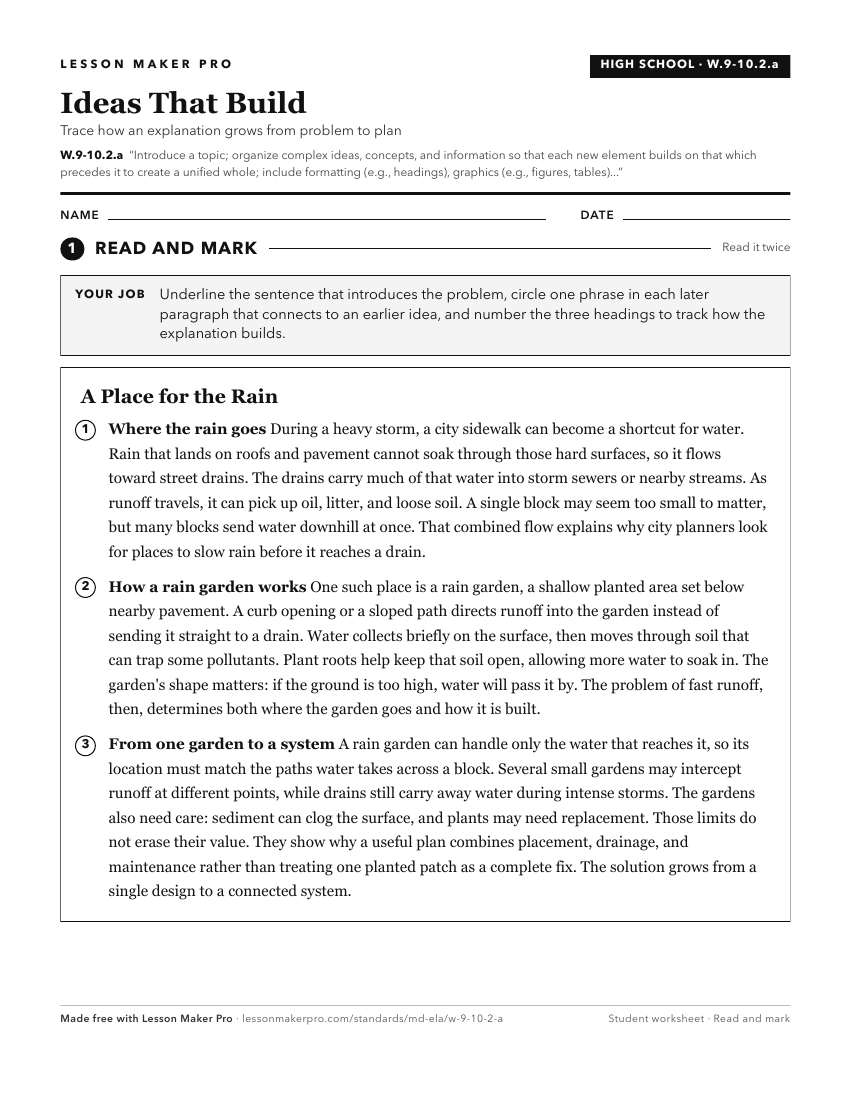
A ready-to-print activity worksheet aligned to W.9-10.2.a, with an answer key for the teacher on its own page. No account needed.
PDF, US Letter, prints cleanly in black and white.
Download the worksheetTurn this exact standard into a lesson
Grade, subject, topic, and the complete standard are prefilled. Create one free, no account needed.
Also for this standard:Make a WorksheetMake a QuizMake a Sub Lesson