Maryland ELA W.9-10.1.c
The Standard
- W.9-10.1
- Write arguments to support claims in an analysis of substantive topics or texts, using valid reasoning and relevant and sufficient evidence. Introduce precise claim(s), distinguish the claim(s) from alternate or opposing claims, and create an organization that establishes clear relationships among claim(s), counterclaims, reasons, and evidence. Develop claim(s) and counterclaims fairly, supplying evidence for each while pointing out the strengths and limitations of both in a manner that anticipates the audience’s knowledge level and concerns. Use words, phrases, and clauses as well as varied syntax to link the major sections of the text, create cohesion, and clarify the relationships between claim(s) and reasons, between reasons and evidence, and between claim(s) and counterclaims. Establish and maintain a formal style and objective tone while attending to the norms and conventions of the discipline in which they are writing. Provide a concluding statement or section that follows from and supports the argument presented.
Use words, phrases, and clauses as well as varied syntax to link the major sections of the text, create cohesion, and clarify the relationships between claim(s) and reasons, between reasons and evidence, and between claim(s) and counterclaims.
Maryland College and Career Ready Standards for English Language Arts (2025)
Teacher's field guide
What This Standard Means
What Students Need to Do
- Students connect the parts of an argument so readers can follow the logic. They use words, clauses, and different sentence shapes to show how reasons support a claim, evidence backs reasons, and a counterclaim challenges the claim.
What Mastery Looks Like
- A reader can tell why each piece of evidence supports a reason and how the writer answers a counterclaim. The student uses specific links and does not start every sentence the same way.
Common Misconceptions
- Students may add “also” or “however” without making the connection clear. They may place evidence after a reason and assume readers will know why it matters.
How to Assess It
- Exit ticket: Give students four notes: start school later, students need more sleep, 38 of 50 students surveyed sleep under eight hours, and buses would cost more. Ask them to write four linked sentences that answer the bus-cost objection and use at least two different sentence openings.
Lesson moves
Ways to Teach It
Give pairs sentence strips for a claim, reason, evidence, and counterclaim; have them arrange the strips and write links between them.
Ask students: “How does the bus-cost objection challenge a later school start?” Have them write a sentence that makes the connection clear.
Play a link swap: teams replace vague words like “also” in a short argument with clauses that show the exact relationship.
Read a sample email asking the principal for a longer lunch; students rewrite one sentence to connect survey evidence to a reason.
Free download
Printable W.9-10.1.c Worksheet
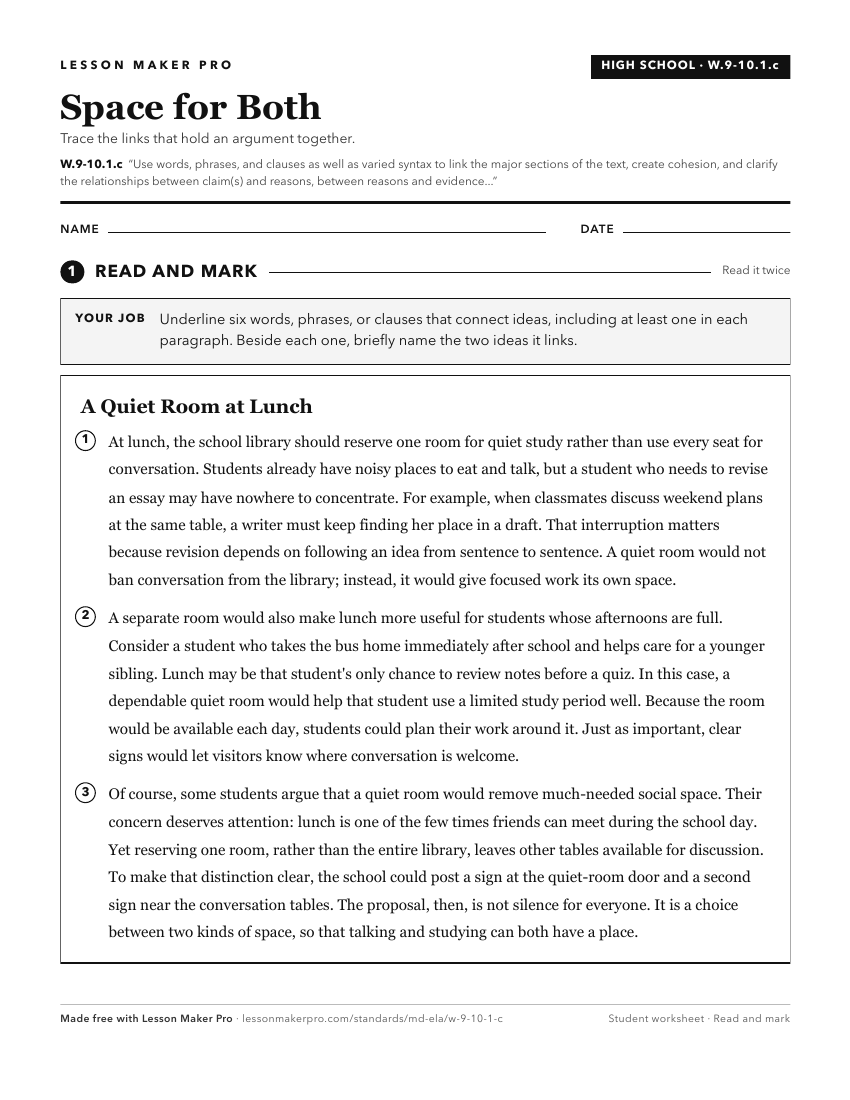
A ready-to-print activity worksheet aligned to W.9-10.1.c, with an answer key for the teacher on its own page. No account needed.
PDF, US Letter, prints cleanly in black and white.
Download the worksheetTurn this exact standard into a lesson
Grade, subject, topic, and the complete standard are prefilled. Create one free, no account needed.
Also for this standard:Make a WorksheetMake a QuizMake a Sub Lesson