Maryland ELA W.6.3.e
The Standard
- W.6.3
- Write narratives to develop real or imagined experiences or events using effective technique, relevant descriptive details, and well-structured event sequences. Engage and orient the reader by establishing a context and point of view and introducing a narrator and/or characters; organize an event sequence that unfolds naturally and logically. Use narrative techniques, such as dialogue, pacing, and description to develop experiences, events, and/or characters. Use a variety of transition words, phrases, and clauses to convey sequence and signal shifts from one time frame to setting to another. Use precise words and phrases, relevant descriptive details, and sensory language to capture the action and convey experiences and events. Provide a conclusion that follows from and reflects on the narrated experiences or events.
Provide a conclusion that follows from and reflects on the narrated experiences or events.
Maryland College and Career Ready Standards for English Language Arts (2025)
Teacher's field guide
What This Standard Means
What Students Need to Do
- Students end a story in a way that fits what happened. They show what the experience means to a character, not just what happened last.
What Mastery Looks Like
- A student connects the ending to a key moment in the story. The character's final thought or feeling makes sense after the events, without a new problem appearing.
Common Misconceptions
- Students may stop after the last event or add “The End” without looking back on it. Others tack on an unrelated lesson or introduce a surprise that pulls the story in a new direction.
How to Assess It
- Give students this setup: “Mia froze during her first solo. She practiced all week, tried again, and finished the song.” Ask them to write a two-sentence ending that closes the story and shows how Mia feels about trying again.
Lesson moves
Ways to Teach It
Give pairs three event cards from a short story and a blank ending card; have them write a final thought that fits the events.
After a story about a nervous performer, compare “I went home” with “I still shook, but I wanted to sing again.” Ask which ending fits and why.
Put two short stories and four ending strips on desks; students match endings, then rewrite one that does not fit.
Ask students to end a true story about a changed plan at home or school with what they felt then and think now.
Free download
Printable W.6.3.e Worksheet
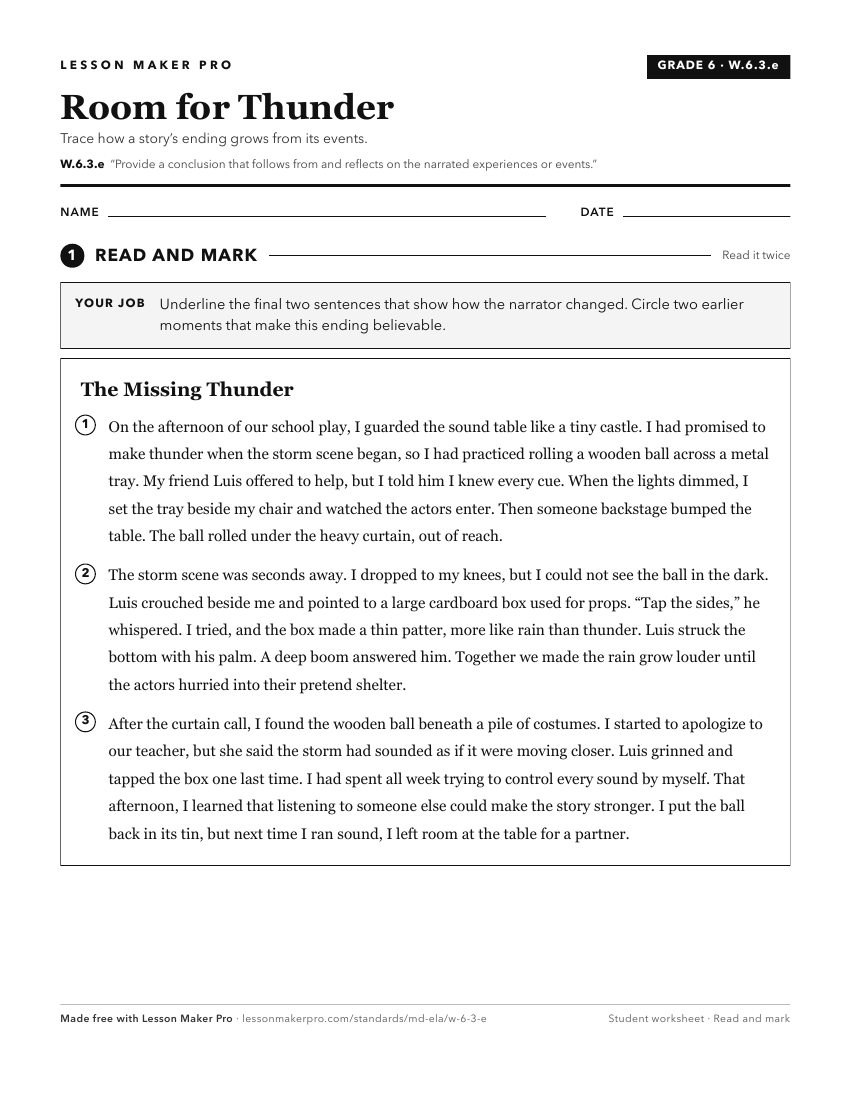
A ready-to-print activity worksheet aligned to W.6.3.e, with an answer key for the teacher on its own page. No account needed.
PDF, US Letter, prints cleanly in black and white.
Download the worksheetTurn this exact standard into a lesson
Grade, subject, topic, and the complete standard are prefilled. Create one free, no account needed.
Also for this standard:Make a WorksheetMake a QuizMake a Sub Lesson