Maryland ELA W.11-12.2.c
The Standard
- W.11-12.2
- Write informative / explanatory texts to examine and convey complex ideas, concepts, and information clearly and accurately through the effective selection, organization, and analysis of content. Introduce a topic; organize complex ideas, concepts, and information so that each new element builds on that which precedes it to create a unified whole; include formatting (e.g., headings), graphics (e.g., figures, tables), and multimedia when useful to aiding comprehension. Develop the topic thoroughly by selecting the most significant and relevant facts, extended definitions, concrete details, quotations, or other information and examples appropriate to the audience’s knowledge of the topic. Use appropriate and varied transitions to link the major sections of the text, create cohesion, and clarify the relationships among complex ideas and concepts. Use precise language and domain-specific vocabulary and techniques such as metaphor, simile, and analogy to manage the complexity of the topic. Establish and maintain a formal style and objective tone while attending to the norms and conventions of the discipline in which they are writing. Provide a concluding statement or section that follows from and supports the information or explanation presented (e.g., articulating implications or the significance of the topic).
Use appropriate and varied transitions to link the major sections of the text, create cohesion, and clarify the relationships among complex ideas and concepts.
Maryland College and Career Ready Standards for English Language Arts (2025)
Teacher's field guide
What This Standard Means
What Students Need to Do
- Students write links between sections of an explanatory piece, not just between nearby sentences. They choose words that show how one idea adds to, contrasts with, or qualifies another.
What Mastery Looks Like
- In an essay on school start times, a student connects sleep research to bus scheduling with a sentence that signals the trade-off. Their links make the relationships clear without repeating the same transition each time.
Common Misconceptions
- Students may put “however” between sections that do not actually disagree. They may use “first, next, finally” to mark order without explaining how the ideas connect.
How to Assess It
- Give students three section claims: “Remote work reduces commuting emissions,” “Home energy use may offset some savings,” and “The total impact depends on local electricity.” Ask for two different transition sentences that connect the sections and explain each relationship.
Lesson moves
Ways to Teach It
Print three section cards about school start times, sleep, and bus schedules; have pairs arrange them and write a bridge between each pair.
Ask students to write a transition explaining how unreliable internet qualifies a prior section on online learning access.
Give pairs section cards on lunch prices, meal participation, and cafeteria waste; have them race to write two distinct transitions.
Use cafeteria food-waste tallies and lunch menus to write a bridge between sections on leftovers and menu choices.
Free download
Printable W.11-12.2.c Worksheet
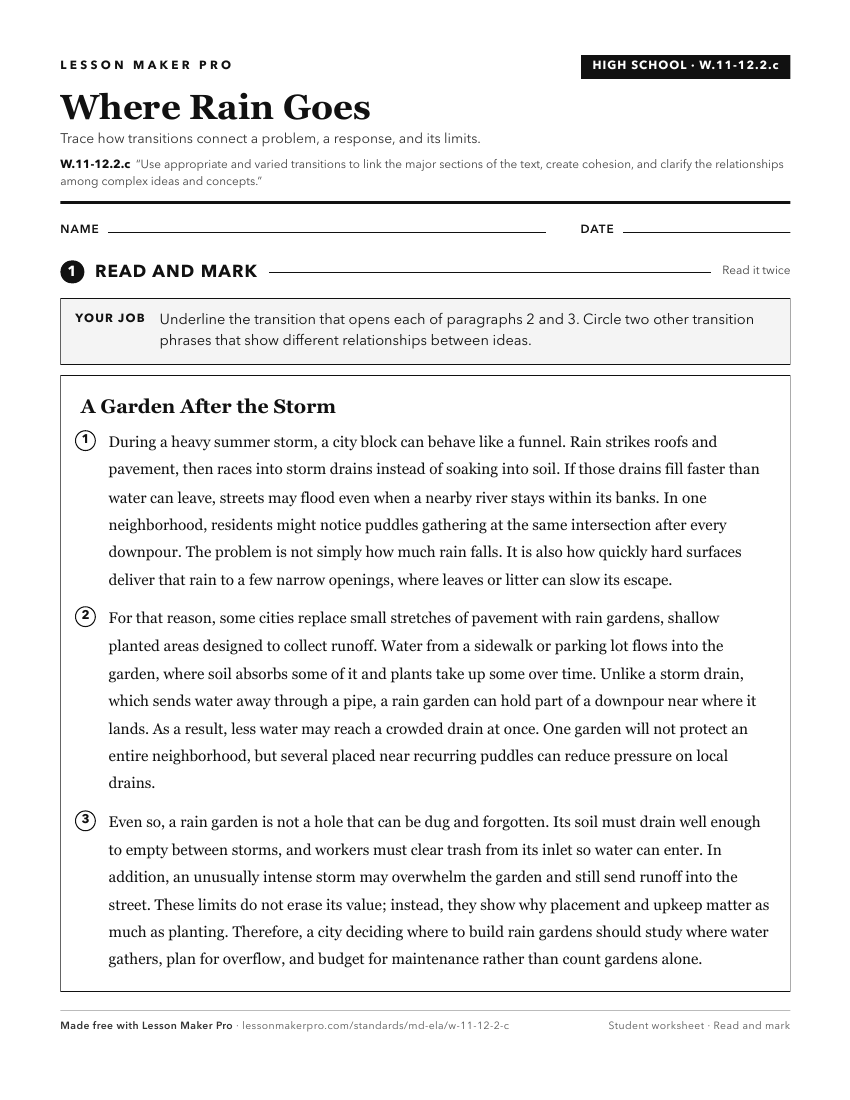
A ready-to-print activity worksheet aligned to W.11-12.2.c, with an answer key for the teacher on its own page. No account needed.
PDF, US Letter, prints cleanly in black and white.
Download the worksheetTurn this exact standard into a lesson
Grade, subject, topic, and the complete standard are prefilled. Create one free, no account needed.
Also for this standard:Make a WorksheetMake a QuizMake a Sub Lesson