Maryland ELA W.11-12.1.b
The Standard
- W.11-12.1
- Write arguments to support claims in an analysis of substantive topics or texts, using valid reasoning and relevant and sufficient evidence. Introduce precise, knowledgeable claim(s), establish the significance of the claim(s), distinguish the claim(s) from alternate or opposing claims, and create an organization that logically sequences claim(s), counterclaims, reasons, and evidence. Develop claim(s) and counterclaims fairly and thoroughly, supplying the most relevant evidence for each while pointing out Use words, phrases, and clauses as well as varied syntax to link the major sections of the text, create cohesion, and clarify the relationships between claim(s) and reasons, between reasons and evidence, and between claim(s) and counterclaims. Establish and maintain a formal style and objective tone while attending to the norms and conventions of the discipline in which they are writing. Provide a concluding statement or section that follows from and supports the argument presented.
Develop claim(s) and counterclaims fairly and thoroughly, supplying the most relevant evidence for each while pointing out
Maryland College and Career Ready Standards for English Language Arts (2025)
Teacher's field guide
What This Standard Means
What Students Need to Do
- Students make a claim and explain a reasonable opposing view. They use relevant evidence for both sides, point out limits in that evidence, and consider what readers may question.
What Mastery Looks Like
- A student presents the opposing view without twisting it. Their writing explains what the evidence supports, where it falls short, and why their claim still holds.
Common Misconceptions
- Students may invent a weak counterclaim that is easy to dismiss. They may list facts without explaining what those facts prove, or assume all readers share their concerns.
How to Assess It
- Exit ticket: In a fictional school, 18 of 25 surveyed students want phones at lunch, but staff recorded 12 phone-related lunch disruptions last week. Argue for a lunch rule, address the other side, and name a limit of each fact.
Lesson moves
Ways to Teach It
Give pairs printed pro-ban and anti-ban paragraphs; students mark evidence with highlighters and write one limit beside each paragraph.
Ask: 'Why might a parent support a lunch phone ban while a student opposes it?' Write each argument without mocking either side.
Teams draft from six evidence cards about lunch phone rules, then trade cards and explain why their new evidence may be less convincing.
Use a school board public comment on phone rules; students write a two-sentence reply that answers one concern and concedes one fair point.
Free download
Printable W.11-12.1.b Worksheet
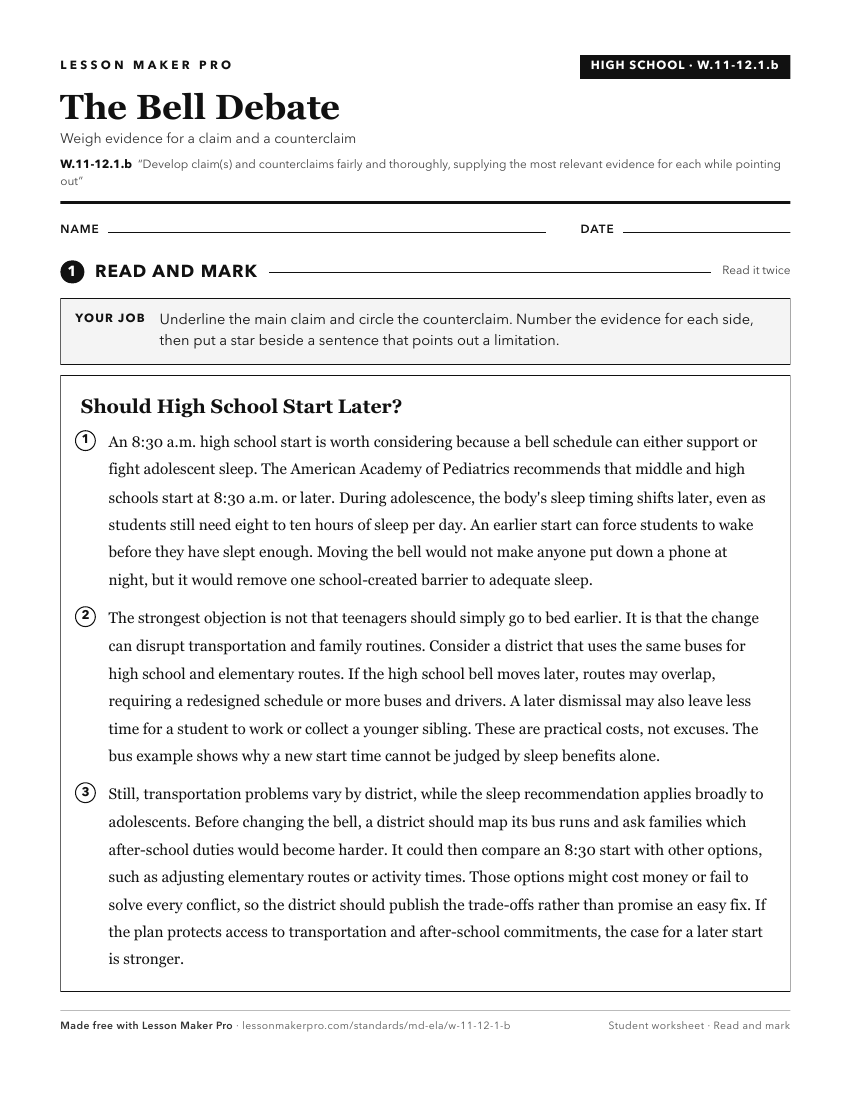
A ready-to-print activity worksheet aligned to W.11-12.1.b, with an answer key for the teacher on its own page. No account needed.
PDF, US Letter, prints cleanly in black and white.
Download the worksheetTurn this exact standard into a lesson
Grade, subject, topic, and the complete standard are prefilled. Create one free, no account needed.
Also for this standard:Make a WorksheetMake a QuizMake a Sub Lesson