Maryland ELA RF.K.3
Standard Cluster
Know and apply phonics and word analysis skills in decoding and encoding words. Demonstrate knowledge of the alphabetic principle. Form/print all upper and lowercase letters correctly, using a common path of movement. Associate the long and short sounds with common spellings (graphemes) for the five major vowels. Know and apply phonics skills in order to decode and encode one-syllable words. Read common high-frequency words by sight. Decode and encode words that are minimal pairs. Decode words with the most common inflectional suffixes.
Maryland College and Career Ready Standards for English Language Arts (2025)
Cluster contents
Standards in This Cluster
RF.K.3 is a cluster heading. These are the individual standards under it.
- RF.K.3.a
Demonstrate knowledge of the alphabetic principle.
- RF.K.3.b
Form/print all upper and lowercase letters correctly, using a common path of movement.
- RF.K.3.d
Know and apply phonics skills in order to decode and encode one-syllable words.
- RF.K.3.f
Decode and encode words that are minimal pairs.
- RF.K.3.g
Decode words with the most common inflectional suffixes.
Teacher's field guide
What This Cluster Means
What Students Need to Do
- Students print uppercase and lowercase letters with consistent strokes. They use letter patterns to read and spell one-syllable words, including words with short and long vowels and words that differ by one sound. They read common words by sight and read endings such as -s and -ing.
What Mastery Looks Like
- A student forms uppercase and lowercase letters using the taught stroke order. They read and spell cat, cot, and cake, and can tell what changed between the words. They read the ending in cats and recognize the and said at a glance.
Common Misconceptions
- Some students reverse b and d or start letters at the bottom. Others use the short a sound in cake or leave off the s when reading cats. Some guess a familiar word from its first letter instead of looking at the whole word.
How to Assess It
- Dictate map, mop, made, and maps. Have students write and read each word, then read said and print A and a while you watch their strokes.
Lesson moves
Ways to Teach It
Use letter tiles to build cat, swap t for p to make cap, then add s and read caps.
Write cap and cape on the board; ask, "What changed, and how did the a sound change?"
Play word-card bingo with cat, cot, cake, made, the, and said; students read each card before covering it.
Show a milk carton; have students read milk and write it on a pretend grocery list.
Free download
Printable RF.K.3 Worksheet
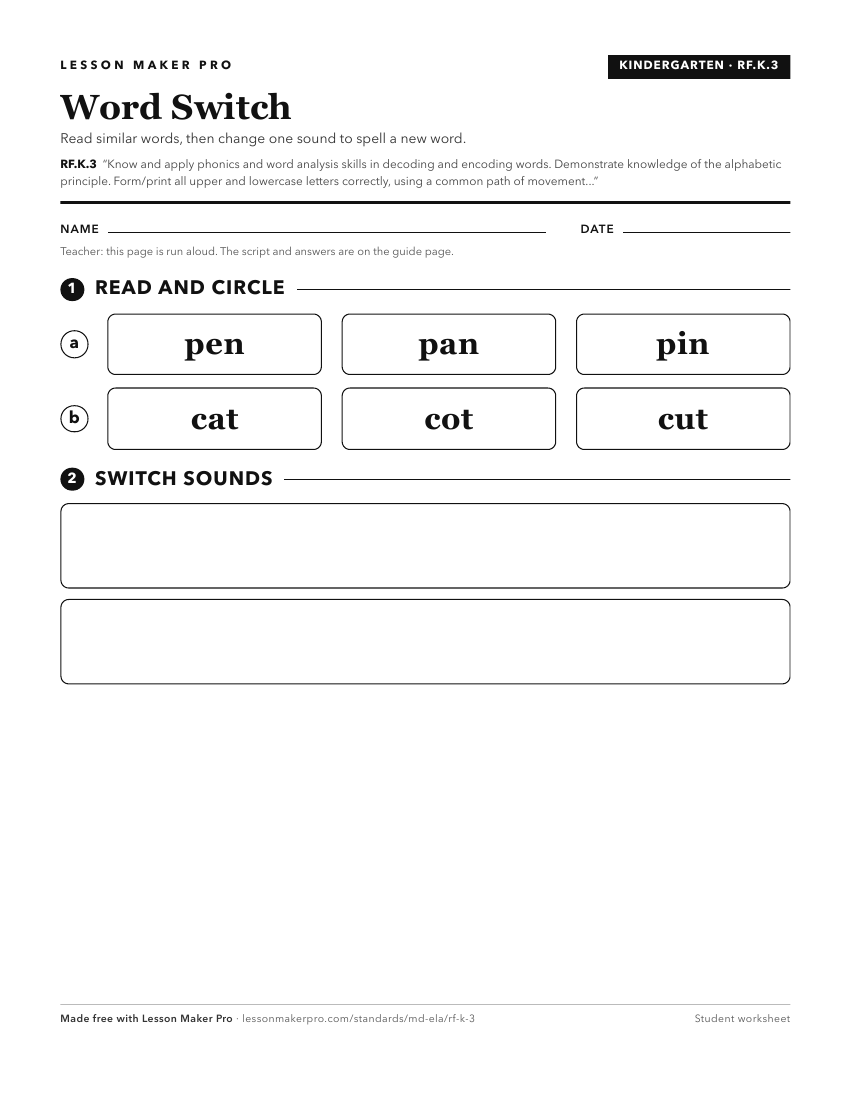
A ready-to-print activity worksheet aligned to RF.K.3, with an answer key for the teacher on its own page. No account needed.
PDF, US Letter, prints cleanly in black and white.
Download the worksheetKeep exploring
Related Standards
- RF.2.3
Know and apply phonics and word analysis skills in reading (decoding) and writing (encoding) words. Know and apply phonics skills to read (decode) and write (en...
- RF.4-5.3
Know and apply phonics and word analysis skills in reading (decoding) and writing (encoding) words. Know and apply phonics skills to read (decode) and write (en...
- RF.4-5.3.a
Know and apply phonics skills to read (decode) and write (encode) words.
- RF.3.3
Know and apply phonics and word analysis skills in reading (decoding) and writing (encoding) words. Know and apply phonics skills to read (decode) and write (en...
Turn this cluster into a lesson
Grade, subject, topic, and the complete cluster are prefilled. Create one free, no account needed.
Also for this cluster:Make a WorksheetMake a QuizMake a Sub Lesson