Maryland ELA L.11-12.4.c
The Standard
- L.11-12.4
- Determine or clarify the meaning of unknown and multiple-meaning words or phrases based on grades 11- 12 reading and content, choosing flexibly from a range of strategies. Use context (e.g., the overall meaning of a sentence, paragraph, or text; a word’s position or function in a sentence) as a clue to the meaning of a word or phrase. Identify and correctly use patterns of word changes that indicate different meanings or parts of speech (e.g., conceive, conception, conceivable). Consult general and specialized reference materials (e.g., dictionaries, glossaries, thesauruses) both print and digital, to find the pronunciation of a word or determine or clarify its precise meaning, its part of speech, or its etymology. Verify the preliminary determination of the meaning of a word or phrase (e.g., by checking the inferred meaning in context or in a dictionary).
Consult general and specialized reference materials (e.g., dictionaries, glossaries, thesauruses) both print and digital, to find the pronunciation of a word or determine or clarify its precise meaning, its part of speech, or its etymology.
Maryland College and Career Ready Standards for English Language Arts (2025)
Teacher's field guide
What This Standard Means
What Students Need to Do
- Students use print and digital references to check how a word is said, what it means, its part of speech, and where it came from. They choose the meaning that fits the sentence, including when a field uses the word differently.
What Mastery Looks Like
- A student can use a dictionary and a subject glossary to explain why “equity” means ownership in a finance article but fairness in a school policy. They can also find its pronunciation, part of speech, and origin.
Common Misconceptions
- Students often pick the first dictionary definition without checking the sentence. They may treat thesaurus suggestions as exact substitutes or mistake a word’s origin for its current meaning.
How to Assess It
- Give students this sentence: “The startup raised equity funding.” Ask them to use a dictionary and finance glossary to find the pronunciation, part of speech, origin, and meaning of “equity,” then explain why “fairness” does not fit.
Lesson moves
Ways to Teach It
Give pairs a print dictionary and a finance glossary; have them mark the entry for “equity” that fits a short startup article.
Ask, “Why does equity mean ownership in this headline but fairness in a school policy?” Have students support each answer with a reference entry.
Run a reference relay: teams use a dictionary to find the pronunciation, part of speech, and origin of three words from a news headline.
Give students a sample lease; have them use a legal glossary and dictionary to explain “security deposit” in plain language.
Free download
Printable L.11-12.4.c Worksheet
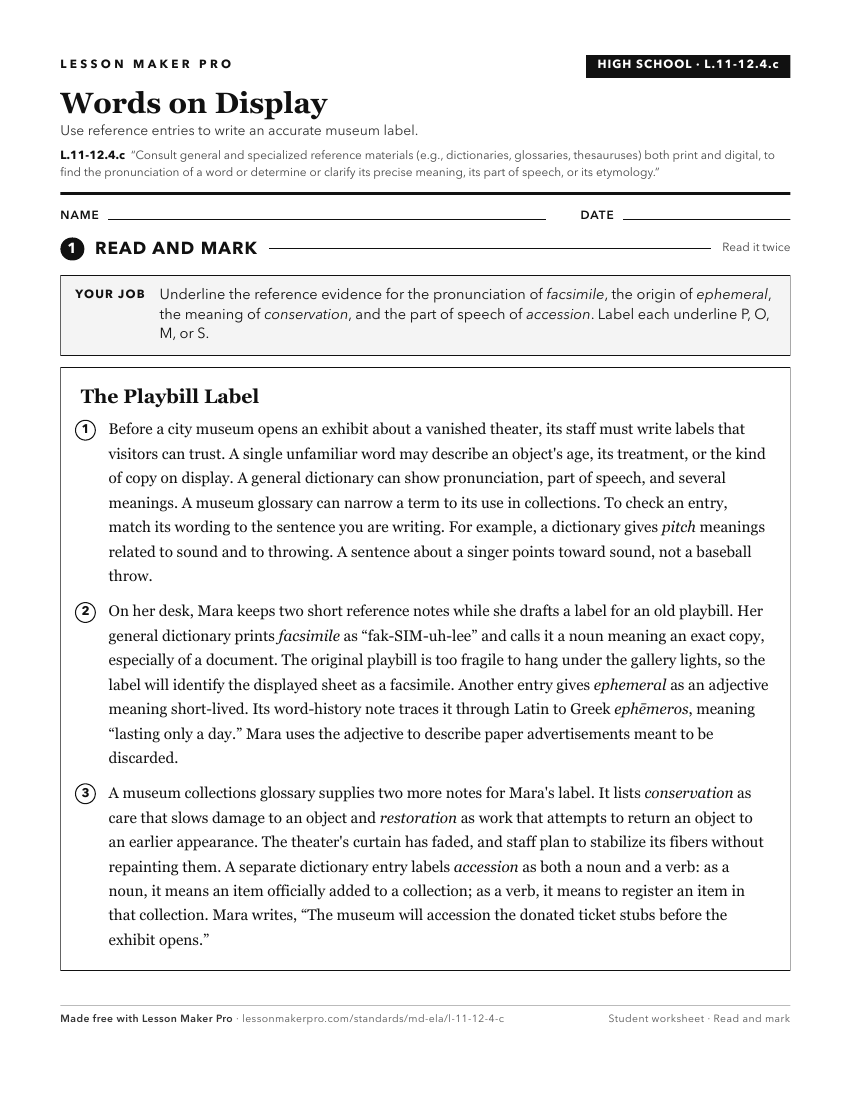
A ready-to-print activity worksheet aligned to L.11-12.4.c, with an answer key for the teacher on its own page. No account needed.
PDF, US Letter, prints cleanly in black and white.
Download the worksheetTurn this exact standard into a lesson
Grade, subject, topic, and the complete standard are prefilled. Create one free, no account needed.
Also for this standard:Make a WorksheetMake a QuizMake a Sub Lesson