Indiana ELA K.RF
Standard Cluster
Students develop word recognition by building on print concepts, phonological awareness, and phonics to decode.
Indiana Academic Standards for English/Language Arts (2023)
Cluster contents
Standards in This Cluster
K.RF is a cluster heading. These are the individual standards under it.
- K.RF.1
Demonstrate understanding that print moves from left to right across the page and from top to bottom.
- K.RF.2
Recognize that written words are made up of sequences of letters.
- K.RF.5
Orally pronounce, blend, and segment words into syllables. (E)
- K.RF.6
Identify and produce the beginning, middle (medial), and final sounds in three and four phoneme words.
- K.RF.8
Use letter-sound knowledge to decode words, including open and closed syllables, consonant digraphs, and blends. (E)
- K.RF.9
Orally read decodable texts with appropriate accuracy and automaticity.
- K.RF.1aIdentify the front and back of a book.
- K.RF.1bDemonstrate understanding that print moves from left to right across the page and/or from top to bottom.
- K.RF.1cDistinguish between words and illustrations in a text.
- K.RF.2aRecognize that written words are made up of individual letters.
- K.RF.3aIdentify or name uppercase (capital) letters of the alphabet. (E)
- K.RF.3bIdentify or name lowercase letters of the alphabet. (E)
- K.RF.4aIdentify two one-syllable words that rhyme (e.g., cat/bat, fed/bed, dog/log).
- K.RF.4bIdentify and/or produce a rhyming word for a presented word.
- K.RF.5aBlend and segment words into syllables. (E)
- K.RF.6aIdentify and produce beginning, middle, and final sounds in three-phoneme (CVC) words. (E)
- K.RF.7aUse letter-sound knowledge to identify the sound of individual initial and final consonants not including blends. (E)
- K.RF.8aUse letter-sound knowledge to decode words. (E)
- K.RF.9aRead short, decodable texts (i.e., one to three sentences) including common or CVC words (e.g., man) and single syllable open words (e.g., he) with appropriate accuracy and automaticity.
Teacher's field guide
What This Cluster Means
What Students Need to Do
- Students follow print from left to right and notice where one word ends and another begins. They hear sounds in spoken words, connect those sounds to letters, and blend the sounds to read short words.
What Mastery Looks Like
- A student points to each word as you read a short sentence. Given the letters s, a, and t, they say each sound and blend them to read sat without guessing from a picture.
Common Misconceptions
- Some students name letters instead of saying their sounds. Others guess a word from the picture or skip a sound when blending.
How to Assess It
- Write “Sam sat” on a card. Say “sat” and ask the student to tap its sounds, point to both printed words, and sound out sat.
Lesson moves
Ways to Teach It
Give students letter tiles for s, a, t, and m; have them build sat, swap s for m, and read mat.
Show a cat picture beside the printed word cap; ask, “Why does the word say cap, not cat?”
Place c, a, and t cards on the floor; students hop to each card, say its sound, then blend cat.
Use a name tag labeled Sam; students point to each letter, say its sound, and read the name aloud.
Free download
Printable K.RF Worksheet
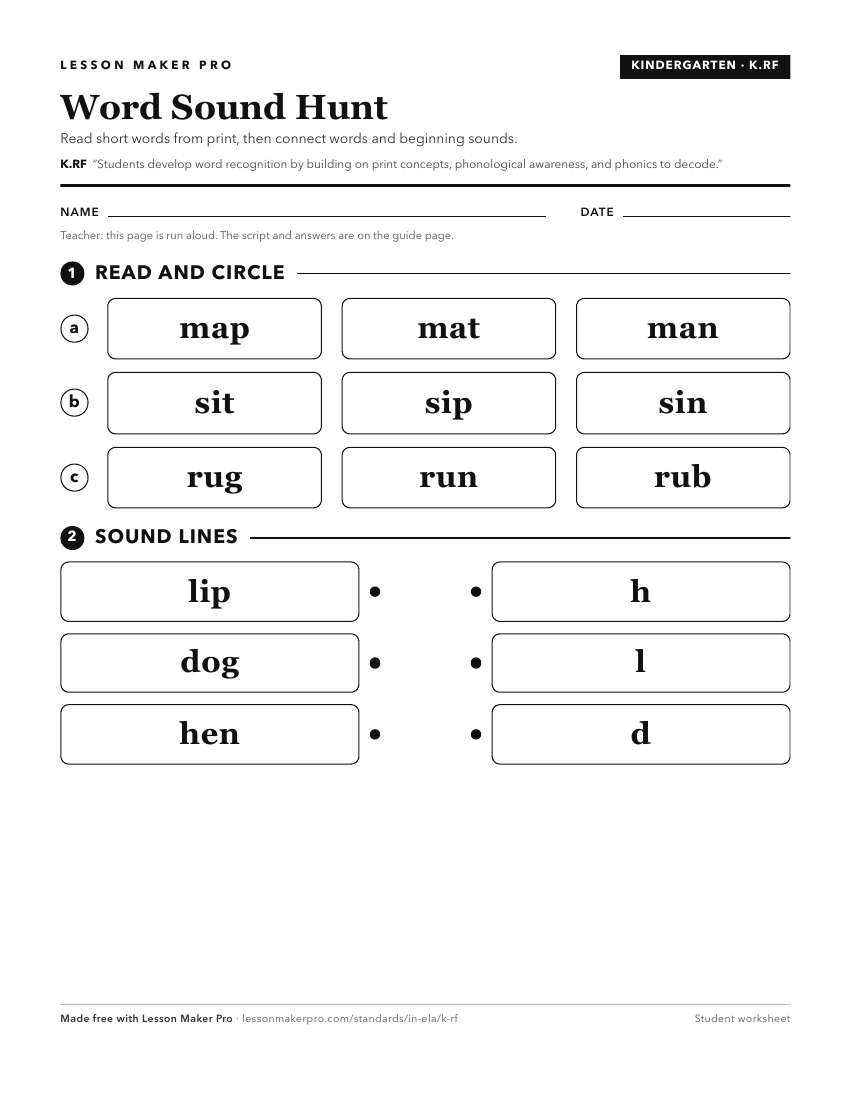
A ready-to-print activity worksheet aligned to K.RF, with an answer key for the teacher on its own page. No account needed.
PDF, US Letter, prints cleanly in black and white.
Download the worksheetKeep exploring
Related Standards
- 1.RF
Students develop word recognition by building on print concepts, phonemic awareness, and phonics to decode.
- 2.RF
Students develop word recognition by building on print concepts, phonemic awareness, and phonics to decode.
- K.W.8.c
Encoding – Spelling simple words phonetically, drawing on phonemic awareness.
Turn this cluster into a lesson
Grade, subject, topic, and the complete cluster are prefilled. Create one free, no account needed.
Also for this cluster:Make a WorksheetMake a QuizMake a Sub Lesson