Indiana ELA 9-10.W.3.b
The Standard
- 9-10.W
- Students compose writing and presentations for various genres which demonstrate a command of English grammar and usage through the writing and research processes; compositions will include correct use of standard formatting (e.g., MLA, APA) with correctly cited sources.
- 9-10.W.3
- Write narrative compositions in a variety of forms that: a. Engage and orient the reader by setting out a problem, situation, or observation, establishing one or multiple point(s) of view, and introducing a narrator and/or characters. b. Create a smooth progression of experiences or events. c. Use narrative techniques, such as dialogue, pacing, description, reflection, and multiple plotlines to develop experiences, events, and/or characters. d. Use a variety of techniques to sequence events so that they build on one another to create a coherent whole. e. Use precise words and phrases, telling details, and sensory language to convey a vivid picture of the experiences, events, setting, and/or characters. f. Provide an ending that follows and reflects on what is experienced, observed, or resolved over the course of the narrative. (E)
Create a smooth progression of experiences or events.
Indiana Academic Standards for English/Language Arts (2023)
Teacher's field guide
What This Standard Means
What Students Need to Do
- Students put a story’s events in an order readers can follow. They connect scenes so readers understand when things happen and why one event leads to another.
What Mastery Looks Like
- A reader can follow the action without stopping to work out what happened in between. Time shifts and changes in place are clear, and each event builds on the last.
Common Misconceptions
- Students may list events with repeated words like “then” but leave out why events happen. They may also jump to a new time or place without giving the reader a clue.
How to Assess It
- Exit ticket: Put these events in order and write four connected sentences: Maya spots a key, the lights go out, her phone lights the stairwell, Maya reaches for her phone.
Lesson moves
Ways to Teach It
Give students four event cards from a lost-phone story; have them order the cards and note what connects each pair.
Ask pairs what belongs between “Lee hid the note at breakfast” and “The principal called at midnight,” then write one bridging sentence.
Run a transition swap: partners replace repeated uses of “then” in a five-sentence chase scene with clues about time, cause, or place.
Have students write a four-sentence account of missing a bus, linking each decision to what happened next.
Free download
Printable 9-10.W.3.b Worksheet
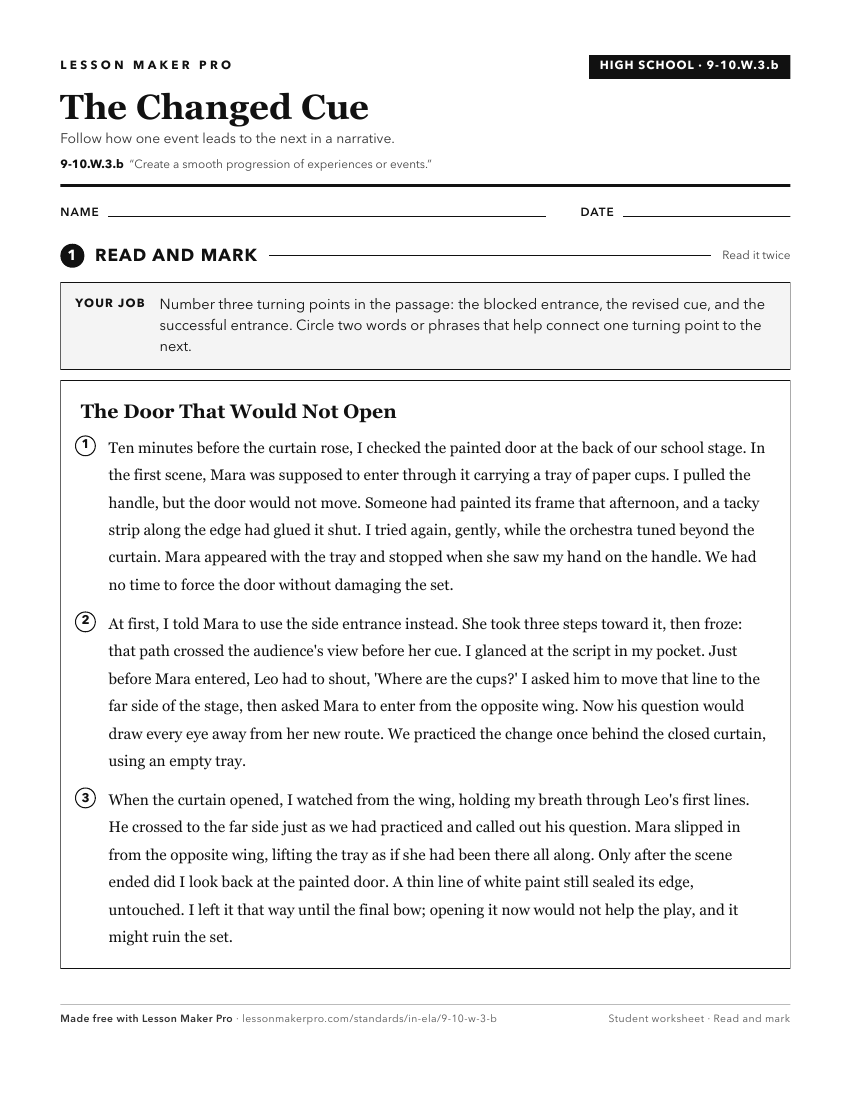
A ready-to-print activity worksheet aligned to 9-10.W.3.b, with an answer key for the teacher on its own page. No account needed.
PDF, US Letter, prints cleanly in black and white.
Download the worksheetKeep exploring
Related Standards
Turn this exact standard into a lesson
Grade, subject, topic, and the complete standard are prefilled. Create one free, no account needed.
Also for this standard:Make a WorksheetMake a QuizMake a Sub Lesson