Indiana ELA 9-10.W.1.b
The Standard
- 9-10.W
- Students compose writing and presentations for various genres which demonstrate a command of English grammar and usage through the writing and research processes; compositions will include correct use of standard formatting (e.g., MLA, APA) with correctly cited sources.
- 9-10.W.1
- Write arguments in a variety of forms that: a. Introduce claim(s), distinguish the claim(s) from alternate or opposing claims, and create an organization that establishes clear relationships among claim(s), counterclaims, reasons, and evidence. b. Use rhetorical strategies to enhance the effectiveness of the claim. c. Develop claim(s) and counterclaims fairly, supplying evidence for each while pointing out the strengths and limitations of both in a manner that anticipates the audience’s knowledge level and concerns. d. Use effective transitions to link the major sections of the text, create cohesion, and clarify the relationships between claim(s) and reasons, between reasons and evidence, and between claim(s) and counterclaims. e. Establish and maintain a consistent style and tone appropriate for the purpose and audience. f. Provide a concluding statement or section that follows from and supports the argument presented. (E)
Use rhetorical strategies to enhance the effectiveness of the claim.
Indiana Academic Standards for English/Language Arts (2023)
Teacher's field guide
What This Standard Means
What Students Need to Do
- Students choose words and structure that make a claim more convincing to a specific audience. They might acknowledge an objection, use an analogy, or repeat a key phrase for emphasis.
What Mastery Looks Like
- A student can explain why a chosen move fits the audience and claim. Their draft uses that move to strengthen a reason without taking the place of evidence.
Common Misconceptions
- Students may think a rhetorical question counts as proof or that strong feelings replace evidence. They may repeat a claim without adding a reason or attack readers who disagree.
How to Assess It
- Exit ticket: Give students these facts: 'The school bus arrives at 7:10. Class starts at 7:15.' Ask them to write three sentences persuading the principal to start class later, then label one rhetorical move and explain its effect.
Lesson moves
Ways to Teach It
Give pairs sentence strips with a claim, evidence, and an objection about phone rules; have them arrange the strips and add a concession.
Ask students to write two sentences explaining whether a concession or an analogy would better persuade parents to support a phone-free lunch.
Run a revision relay: teams draw a claim card and an audience card, then rewrite one sentence using a concession, analogy, or repetition.
Draft a three-sentence email to the principal about cafeteria lines, using a specific observation and a repeated phrase to stress the problem.
Free download
Printable 9-10.W.1.b Worksheet
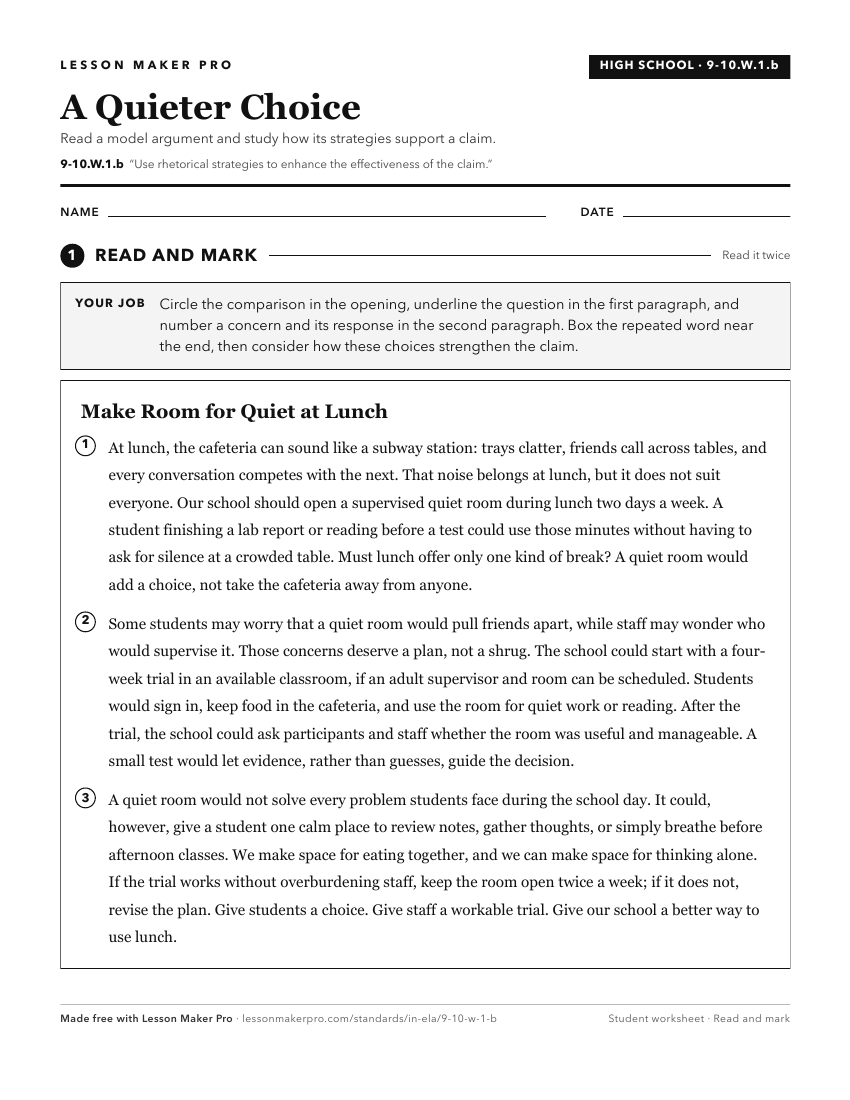
A ready-to-print activity worksheet aligned to 9-10.W.1.b, with an answer key for the teacher on its own page. No account needed.
PDF, US Letter, prints cleanly in black and white.
Download the worksheetKeep exploring
Related Standards
- 11-12.W.1.b
The Grades 11–12 version of this standard.
- 6.W.1.a
Introduce claim(s) using strategies such as textual analysis, comparison/contrast, and cause/effect.
- 7.W.1.a
Introduce claim(s), acknowledge alternate or opposing claims, and use appropriate organizational structures.
- 11-12.W.1.a
Introduce precise claim(s), establish the significance of the claim(s), distinguish the claim(s) from alternate or opposing claims, and create an organization t...
Turn this exact standard into a lesson
Grade, subject, topic, and the complete standard are prefilled. Create one free, no account needed.
Also for this standard:Make a WorksheetMake a QuizMake a Sub Lesson