Indiana ELA 2.W.8.b
Standard Cluster
- 2.W
- Students produce writing for a variety of purposes, applying their knowledge of language and sentence structure.
- 2.W.8
- Demonstrate command of capitalization, punctuation, and spelling, focusing on: a. Capitalization – Capitalizing greetings, months and days of the week, titles and initials in names, and proper nouns, including holidays and geographic names. b. Punctuation – I. Correctly using a period, question mark, or exclamation mark at the end of a sentence. II. Using an apostrophe to form contractions and singular possessive nouns. III. Using commas in greetings and closings of letters, dates, and to separate items in a series. c. Encoding – I. Correctly spelling words with short and long vowel sounds, r-controlled vowels, and consonant-blend patterns. II. Generalizing learned spelling patterns (e.g., word families) when writing words. III. Correctly spelling common irregularly-spelled, grade-appropriate words (e.g., said, does, gone). (E)
Punctuation – Correctly using a period, question mark, or exclamation mark at the end of a sentence. Using an apostrophe to form contractions and singular possessive nouns. Using commas in greetings and closings of letters, dates, and to separate items in a series.
Indiana Academic Standards for English/Language Arts (2023)
Cluster contents
Standards in This Cluster
2.W.8.b is a cluster heading. These are the individual standards under it.
Teacher's field guide
What This Cluster Means
What Students Need to Do
- Students choose a period, question mark, or exclamation mark to end a sentence. They use apostrophes in contractions and to show that one person or thing owns something. They put commas in letter greetings and closings, dates, and lists.
What Mastery Looks Like
- A student can punctuate a short letter with a date, greeting, closing, and list. They can write “can’t” for “cannot” and “Mia’s coat” to show ownership. They choose an end mark that fits each sentence.
Common Misconceptions
- Students may end every sentence with a period, even when asking a question. They may write “Mias coat” without an apostrophe or put the apostrophe in the wrong place in “cant.” They may leave commas out of dates, letter greetings, or lists.
How to Assess It
- Give students this note to punctuate: “November 8 2026 / Dear Sam / I cant find Mias red blue and green crayons / Where are they / Hooray I found them / Your friend Leo.” Check for all three end marks, both apostrophes, and commas in the date, greeting, closing, and list.
Lesson moves
Ways to Teach It
Give pairs a paper note and punctuation stickers. Have them add missing marks, then read the note aloud.
Write “Where is my dog’s ball” and “My dog’s ball is here” on the board. Ask partners which end marks fit and why.
Play punctuation relay with sentence strips showing “dont,” “Lias hat,” a date, a list, and a letter closing.
Have students write a thank-you card to a school helper with a date, greeting, list of three things, and closing.
Free download
Printable 2.W.8.b Worksheet
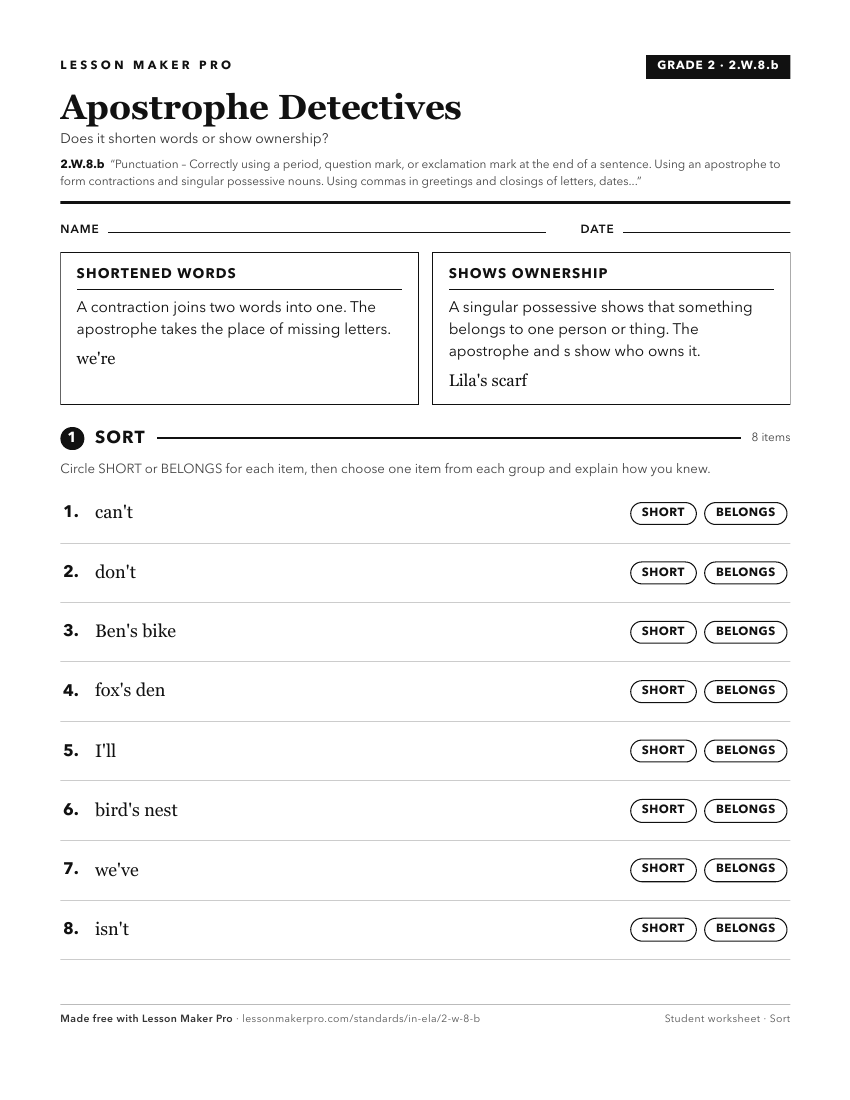
A ready-to-print activity worksheet aligned to 2.W.8.b, with an answer key for the teacher on its own page. No account needed.
PDF, US Letter, prints cleanly in black and white.
Download the worksheetKeep exploring
Related Standards
Turn this cluster into a lesson
Grade, subject, and topic are prefilled; the lesson picks the standards under this heading. Create one free, no account needed.
Also for this cluster:Make a WorksheetMake a QuizMake a Sub Lesson