Georgia 1.NR.2.5
The Standard
Use the meaning of the equal sign to determine whether equations involving addition and subtraction are true or false.
Georgia's K-12 Mathematics Standards · Explain the relationship between addition and subtraction and apply the properties of operations to solve real-life addition and subtraction problems within 20.
Teacher's field guide
What This Standard Means
What Students Need to Do
- Students find the value on each side of an equation and decide whether the values match. They read the equal sign as a comparison, not a signal to write an answer.
What Mastery Looks Like
- A student correctly labels equations such as 7 = 5 + 2 and 9 - 3 = 4 + 2. The student finds both values and explains why they match or do not match.
Common Misconceptions
- Students may think the equal sign means “write the answer next.” They may compare the numbers they see instead of finding the value on each side.
How to Assess It
- Give students three equations: 8 = 5 + 3, 9 - 2 = 6, and 4 + 5 = 12 - 3. Have them label each true or false and explain one choice.
Lesson moves
Ways to Teach It
Build both sides of equation cards with linking cubes, then place a True or False card beside each equation.
Ask, “Is 7 + 3 = 12 - 2 true? How can you prove your answer?”
In pairs, draw equation cards, find both side values, and keep each card answered correctly.
Set out two snack plates described by number sentences, then have students decide whether the plates hold equal totals.
Free download
Printable 1.NR.2.5 Worksheet
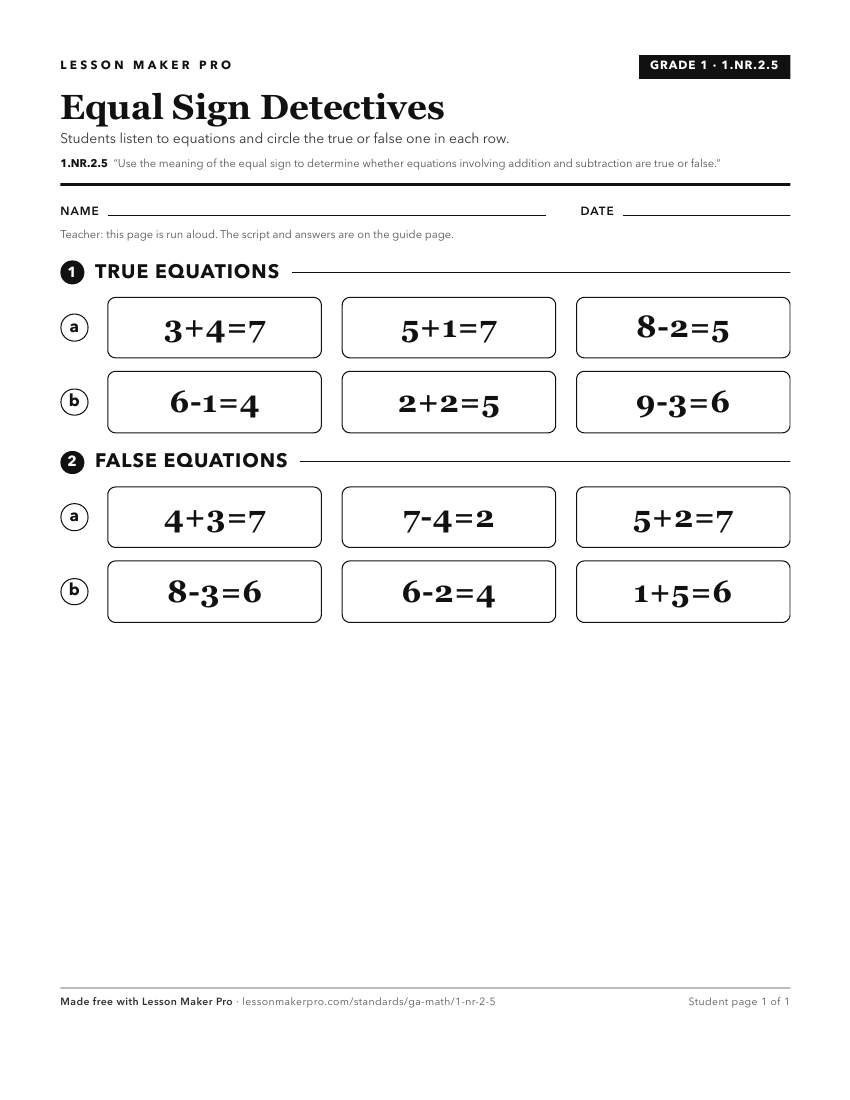
A ready-to-print activity worksheet aligned to 1.NR.2.5, with an answer key for the teacher on its own page. No account needed.
PDF, US Letter, prints cleanly in black and white.
Download the worksheetKeep exploring
Related Standards
- K.NR.5
Explain the concepts of addition, subtraction, and equality and use these concepts to solve real-life problems within 10.
- 7.PAR.3
Represent authentic situations using equations and inequalities with variables; solve equations and inequalities symbolically, using the properties of equality.
- 3.PAR.3.4
Use the meaning of the equal sign to determine whether expressions involving addition, subtraction, and multiplication are equivalent.
- 6.PAR.7.1
Solve one-step equations and inequalities involving variables when values for the variables are given. Determine whether an equation and inequality involving a ...
Turn this exact standard into a lesson
Grade, subject, topic, and the complete standard are prefilled. Create one free, no account needed.
Also for this standard:Make a WorksheetMake a QuizMake a Sub Lesson