Georgia 5.T.T.4.b
The Standard
Apply poetic techniques (e.g., rhyme, rhyme scheme, structure) to produce different types of poetry (e.g., free verse, rhymed verse, haiku, limerick). (C)
Georgia's K-12 English Language Arts Standards · Texts (T) · Techniques
Teacher's field guide
What This Standard Means
What Students Need to Do
- Students write poems in several forms using planned rhyme, rhyme schemes, syllable patterns, and line or stanza breaks. They choose techniques that fit the poem’s subject, mood, and form.
What Mastery Looks Like
- A student can write a haiku, limerick, rhymed poem, and free verse poem that follow the chosen form. The student can label a rhyme scheme and revise forced rhymes or weak line breaks.
Common Misconceptions
- Students often think every poem must rhyme or that rhyme and rhythm mean the same thing. They may call any three-line poem a haiku without checking syllables. They may also treat free verse as writing with no planned structure.
How to Assess It
- Ask students to write and label a four-line ABAB poem about weather. Then have them rewrite the same idea in free verse using purposeful line breaks.
Lesson moves
Ways to Teach It
Give pairs word cards and sentence strips to build a four-line ABAB poem, then move strips to test a new structure.
Compare a haiku and a limerick about rain, then write which form better matches a calm mood and cite one technique.
Play Rhyme Scheme Relay: teams label patterns in short poems, then earn a point by adding a line that keeps each pattern.
Create a poem for a greeting card, school announcement, or community event, choosing rhyme or free verse to suit the audience.
Free download
Printable 5.T.T.4.b Worksheet
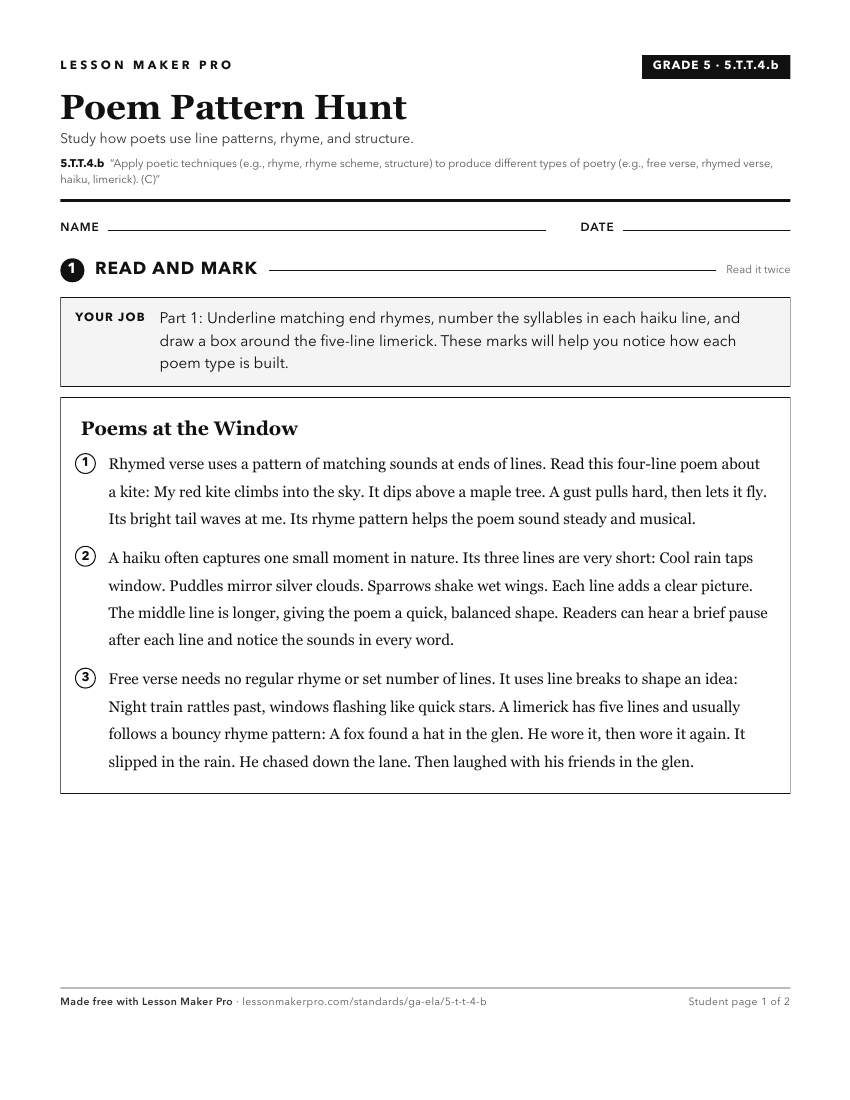
A ready-to-print activity worksheet aligned to 5.T.T.4.b, with an answer key for the teacher on its own page. No account needed.
PDF, US Letter, prints cleanly in black and white.
Download the worksheetKeep exploring
Related Standards
- 8.T.T.4.b
Apply poetic techniques (e.g., stanzas, rhyme/rhyme scheme, imagery, figurative language, sound devices) to produce poetry and engage audiences. (C)
- 4.T.T.4.b
Apply poetic techniques to produce poetry and engage audiences that use a predetermined rhyme scheme to achieve an intended effect. (C)
- 6.T.T.4.b
Apply poetic techniques (e.g., stanzas, rhyme/rhyme scheme, imagery, figurative language, sound devices) to produce poetry and engage audiences. (C)
- 7.T.T.4.b
Apply poetic techniques (e.g., stanzas, rhyme/rhyme scheme, imagery, figurative language, sound devices) to produce poetry and engage audiences. (C)
Turn this exact standard into a lesson
Grade, subject, topic, and the complete standard are prefilled. Create one free, no account needed.
Also for this standard:Make a WorksheetMake a QuizMake a Sub Lesson