Georgia 3.T.T.4.b
The Standard
Apply poetic techniques to produce poetry and engage audiences that use rhyme in at least two stanzas to achieve an intended effect. (C)
Georgia's K-12 English Language Arts Standards · Texts (T) · Techniques
Teacher's field guide
What This Standard Means
What Students Need to Do
- Students write a poem with at least two stanzas and use rhyme on purpose. They choose rhyming words and patterns that help create a clear mood or response.
What Mastery Looks Like
- A student writes two or more clear stanzas with rhyming words placed in a consistent pattern. The rhyme supports a chosen mood, such as humor, excitement, or calm.
Common Misconceptions
- Students may think every line must rhyme, or choose rhyming words that weaken the poem’s meaning. They may confuse a stanza with a sentence or change rhyme patterns by accident.
How to Assess It
- Exit ticket: Write an eight-line poem in two four-line stanzas that makes a reader laugh. Circle the rhyming words and explain how they create humor.
Lesson moves
Ways to Teach It
Give pairs word cards to sort into rhyme families, then use selected pairs to build a two-stanza poem.
Compare two short poems with different rhyme patterns, then discuss which sounds funnier, calmer, or more exciting and why.
Play a rhyme relay where teams add lines to a shared poem while keeping the chosen rhyme pattern and meaning.
Examine rhymes in a greeting card or advertising jingle, then write a two-stanza poem for a birthday card or school event.
Free download
Printable 3.T.T.4.b Worksheet
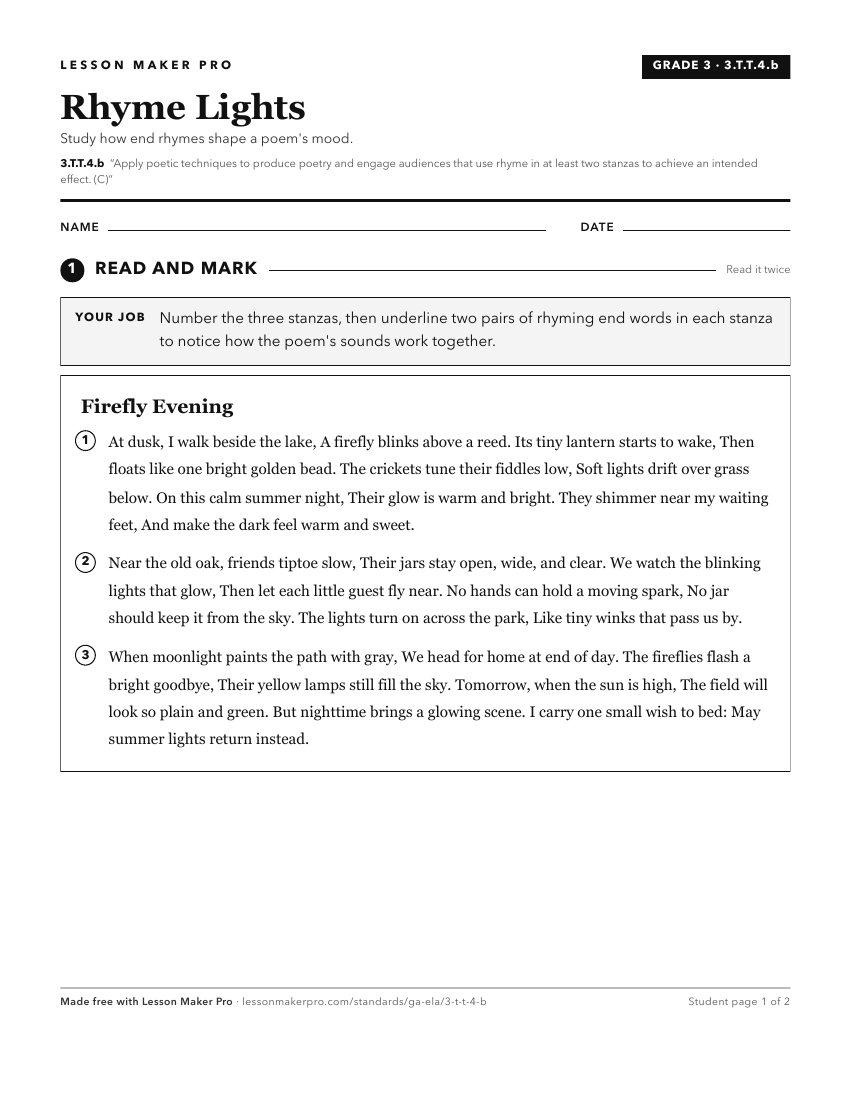
A ready-to-print activity worksheet aligned to 3.T.T.4.b, with an answer key for the teacher on its own page. No account needed.
PDF, US Letter, prints cleanly in black and white.
Download the worksheetKeep exploring
Related Standards
- 8.T.T.4.b
Apply poetic techniques (e.g., stanzas, rhyme/rhyme scheme, imagery, figurative language, sound devices) to produce poetry and engage audiences. (C)
- 4.T.T.4.b
Apply poetic techniques to produce poetry and engage audiences that use a predetermined rhyme scheme to achieve an intended effect. (C)
- 6.T.T.4.b
Apply poetic techniques (e.g., stanzas, rhyme/rhyme scheme, imagery, figurative language, sound devices) to produce poetry and engage audiences. (C)
- 7.T.T.4.b
Apply poetic techniques (e.g., stanzas, rhyme/rhyme scheme, imagery, figurative language, sound devices) to produce poetry and engage audiences. (C)
Turn this exact standard into a lesson
Grade, subject, topic, and the complete standard are prefilled. Create one free, no account needed.
Also for this standard:Make a WorksheetMake a QuizMake a Sub Lesson