Georgia 12.T.RA.2.c
The Standard
Follow Modern Language Association (MLA) or American Psychological Association (APA) guidelines when responding to inferential questions about texts or when integrating and citing textual evidence, ensuring each source is accompanied by a basic entry on a works cited page. (C)
Georgia's K-12 English Language Arts Standards · Texts (T) · Research & Analysis
Teacher's field guide
What This Standard Means
What Students Need to Do
- Students support an inference with relevant quotations or paraphrases from a text. They use MLA or APA in-text citations and create matching entries on a source list.
What Mastery Looks Like
- Students select evidence that clearly supports an inference, introduce it smoothly, and explain its meaning. Their in-text citations match complete source-list entries and follow one assigned style consistently.
Common Misconceptions
- Students may add a citation without explaining how the evidence supports their inference. They may also mix MLA and APA rules, omit page numbers, or list sources that do not match their in-text citations.
How to Assess It
- Give students one paragraph and one source. Ask them to write an inference, support it with a cited quotation, and add the matching source-list entry.
Lesson moves
Ways to Teach It
Give pairs cut-up citation cards and have them assemble a correct MLA Works Cited entry or APA reference entry.
Ask students to write two sentences explaining why a selected quotation supports an inference, then add the correct in-text citation.
Run a citation correction race using short paragraphs with missing citations, mixed styles, and unmatched source-list entries.
Compare citations in a news article and a research report, then discuss how source details help readers verify each claim.
Free download
Printable 12.T.RA.2.c Worksheet
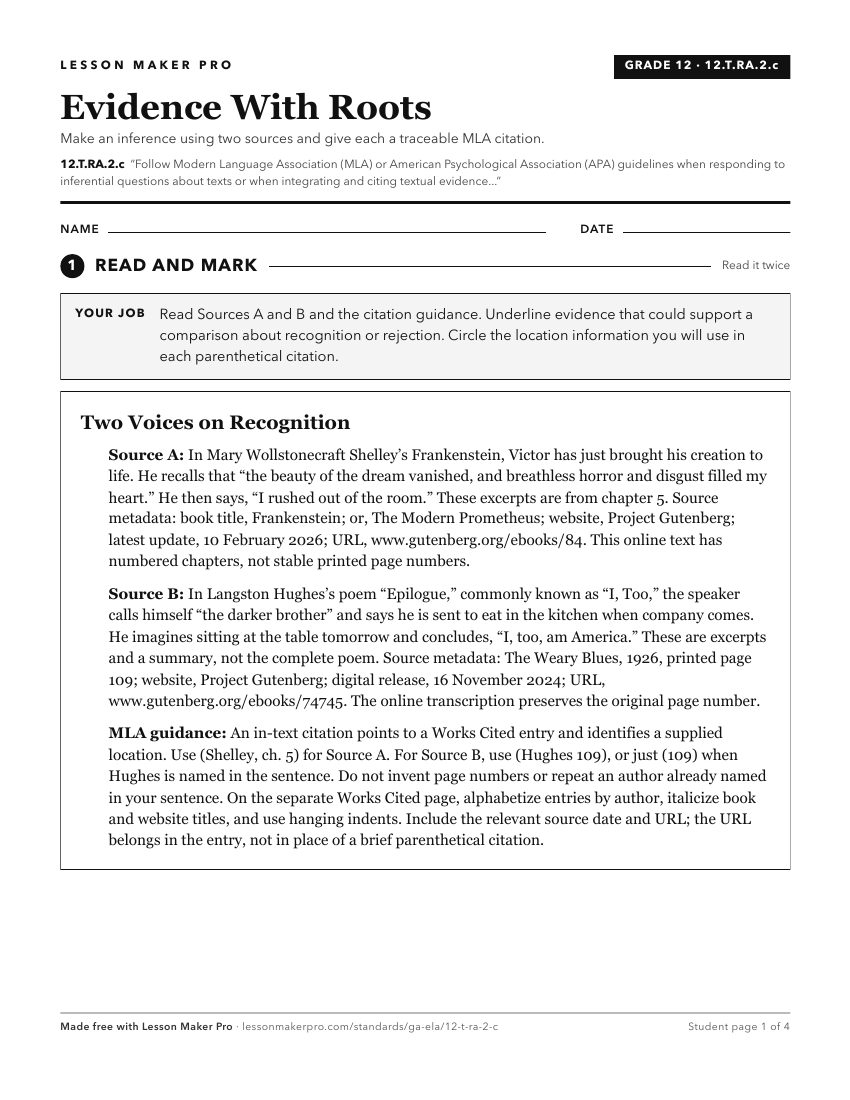
A ready-to-print activity worksheet aligned to 12.T.RA.2.c, with an answer key for the teacher on its own page. No account needed.
PDF, US Letter, prints cleanly in black and white.
Download the worksheetKeep exploring
Related Standards
- 9.T.RA.2.c
Follow Modern Language Association (MLA) guidelines when responding to inferential questions about texts or when integrating and citing textual evidence, ensuri...
- 8.T.RA.2.c
Follow Modern Language Association (MLA) guidelines when integrating textual evidence, clearly identifying and citing the ideas and information of others and en...
- 11.T.RA.2.c
The 11th Grade version of this standard.
- 10.T.RA.2.c
Follow Modern Language Association (MLA) guidelines when responding to inferential questions about texts or when integrating and citing textual evidence, ensuri...
Turn this exact standard into a lesson
Grade, subject, topic, and the complete standard are prefilled. Create one free, no account needed.
Also for this standard:Make a WorksheetMake a QuizMake a Sub Lesson