Florida B.E.S.T. MA.912.NSO.3.1
The Standard
Apply appropriate notation and symbols to represent vectors in the plane as directed line segments. Determine the magnitude and direction of a vector in component form.
Florida B.E.S.T. Standards for Mathematics
Teacher's field guide
What This Standard Means
What Students Need to Do
- Students use arrow and component notation to show a vector's length, direction, and orientation in the coordinate plane. From an initial and terminal point, they find horizontal and vertical change, then calculate magnitude and direction angle.
What Mastery Looks Like
- Given A(x₁, y₁) and B(x₂, y₂), a student writes ⟨x₂ − x₁, y₂ − y₁⟩ for the vector from A to B. The student finds its magnitude with the distance formula and gives a direction angle in the correct quadrant.
Common Misconceptions
- Students often subtract coordinates in the wrong order, switch horizontal and vertical components, or ignore negative signs. They may use tan⁻¹(y/x) without checking the quadrant, or confuse a vector's endpoint with its component form.
How to Assess It
- Exit ticket: For A(−2, 1) and B(4, −3), write the vector from A to B in component notation, then find its magnitude and direction angle measured counterclockwise from the positive x-axis.
Lesson moves
Ways to Teach It
On grid paper, students draw arrows from given initial points, label components, then measure each arrow's length and angle.
Ask, “How can two vectors have equal magnitudes but different directions?” Students sketch examples and explain their notation.
Run a vector match game pairing directed segments, component forms, magnitudes, and direction angles.
Map a drone flight as horizontal and vertical change, then calculate the flight distance and compass direction.
Free download
Printable MA.912.NSO.3.1 Worksheet
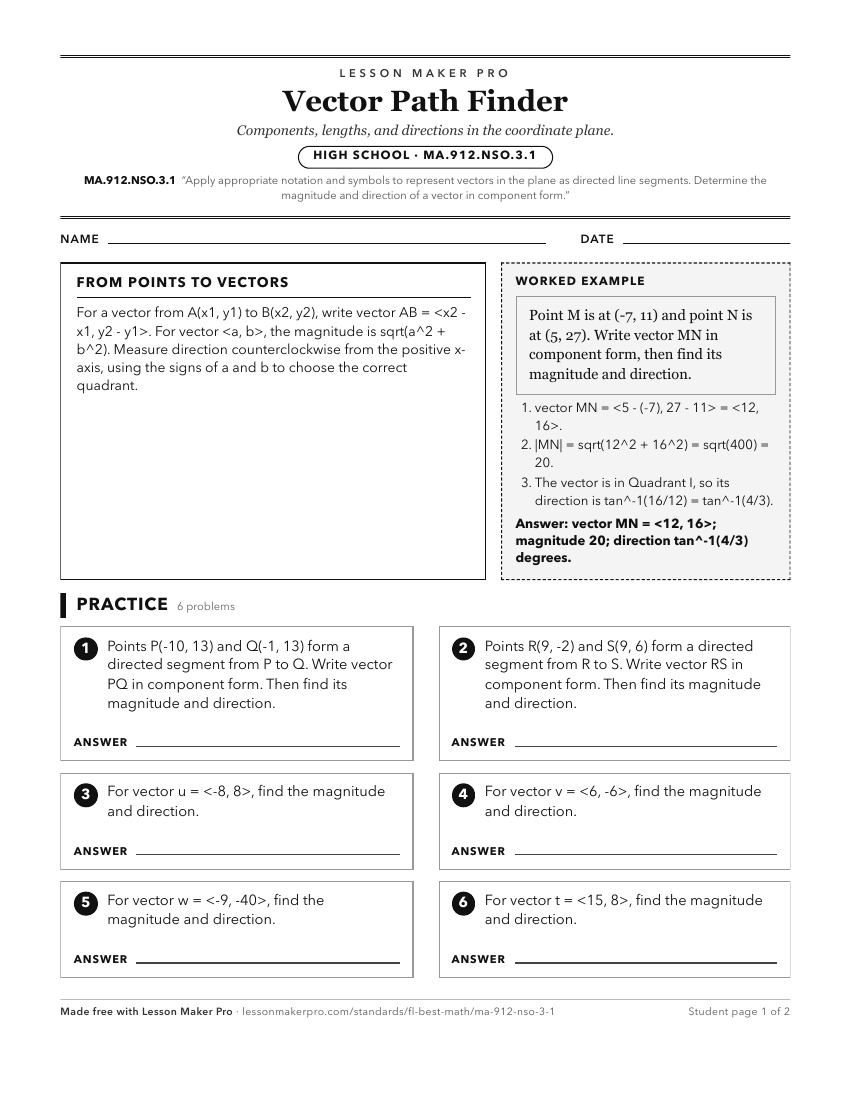
A ready-to-print activity worksheet aligned to MA.912.NSO.3.1, with an answer key for the teacher on its own page. No account needed.
PDF, US Letter, prints cleanly in black and white.
Download the worksheetKeep exploring
Related Standards
- MA.912.NSO.3.7
Compute the magnitude and direction of a vector scalar multiple.
- MA.912.NSO.3.9
Given the magnitude and direction of two or more vectors, determine the magnitude and direction of their sum.
- MA.912.NSO.3.3
Solve mathematical and real-world problems involving velocity and other quantities that can be represented by vectors.
- MA.912.NSO.3.2
Represent vectors in component form, linear form or trigonometric form. Rewrite vectors from one form to another.
Turn this exact standard into a lesson
Grade, subject, topic, and the complete standard are prefilled. Create one free, no account needed.
Also for this standard:Make a WorksheetMake a QuizMake a Sub Lesson