Florida B.E.S.T. MA.912.F.1.8
The Standard
Determine whether a linear, quadratic or exponential function best models a given real-world situation.
Florida B.E.S.T. Standards for Mathematics
Teacher's field guide
What This Standard Means
What Students Need to Do
- Students examine a context, table, or graph and track how the output changes as the input increases. They choose a model type using constant differences, constant second differences, or constant ratios.
What Mastery Looks Like
- A student can distinguish steady additive change, constant second differences, and steady multiplicative change. They can defend one model and reject the other two using data, graph features, and units.
Common Misconceptions
- Students often call any rising graph linear or choose exponential whenever values grow quickly. They may confuse constant differences with constant ratios, or check changes across unequal input intervals. They may also ignore limits from the context, such as a quantity that cannot become negative.
How to Assess It
- Exit ticket: For inputs 0, 1, 2, 3, the outputs are 3, 8, 15, 24. Choose the model type and support your choice with calculations.
Lesson moves
Ways to Teach It
Build three cube patterns by adding three cubes, adding successive odd numbers, and doubling, then record tables and name each growth pattern.
Write which model fits a taxi fare, a tossed ball's height, and a bacteria culture, citing one clue for each choice.
Run a card sort matching nine situation, table, and graph cards, then have pairs explain each match before checking answers.
Compare a phone's purchase price with yearly resale values, then decide whether equal dollar loss or equal percent loss fits better.
Free download
Printable MA.912.F.1.8 Worksheet
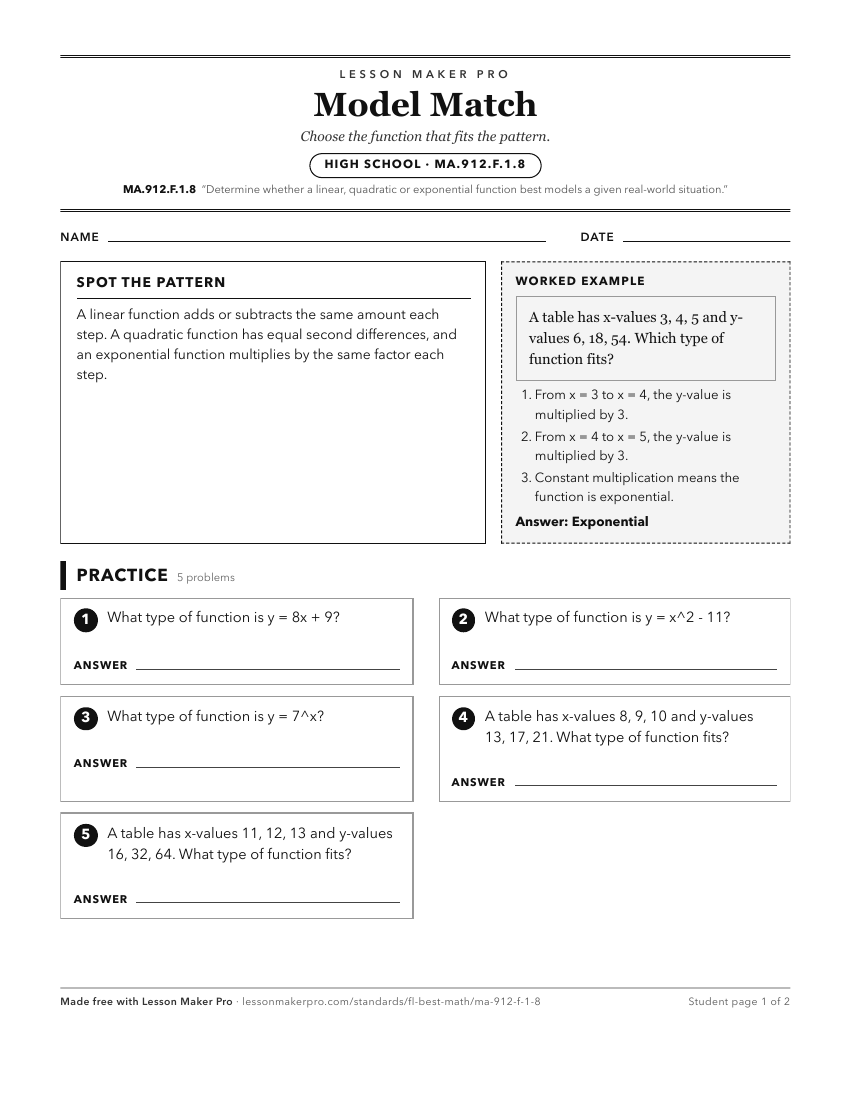
A ready-to-print activity worksheet aligned to MA.912.F.1.8, with an answer key for the teacher on its own page. No account needed.
PDF, US Letter, prints cleanly in black and white.
Download the worksheetKeep exploring
Related Standards
- MA.912.AR.3.8
Solve and graph mathematical and real-world problems that are modeled with quadratic functions. Interpret key features and determine constraints in terms of the...
- MA.912.AR.5.3
Given a mathematical or real-world context, classify an exponential function as representing growth or decay.
- MA.912.AR.5.7
Solve and graph mathematical and real-world problems that are modeled with exponential functions. Interpret key features and determine constraints in terms of t...
- MA.912.DP.2.9
Fit an exponential function to bivariate numerical data that suggests an exponential association. Use the model to solve real-world problems in terms of the con...
Turn this exact standard into a lesson
Grade, subject, topic, and the complete standard are prefilled. Create one free, no account needed.
Also for this standard:Make a WorksheetMake a QuizMake a Sub Lesson