Florida B.E.S.T. MA.912.DP.6.3
The Standard
Develop a probability distribution for a discrete random variable using empirical probabilities. Find the expected value and interpret it as the mean of the discrete distribution.
Florida B.E.S.T. Standards for Mathematics
Teacher's field guide
What This Standard Means
What Students Need to Do
- Students use results from repeated trials to assign probabilities to each possible value of a discrete variable. They calculate a weighted mean and explain it as the long-run average result.
What Mastery Looks Like
- A student can make a table of outcomes and empirical probabilities that sum to 1. They can calculate the weighted mean and explain it as a long-run average in context.
Common Misconceptions
- Students may assume all outcomes are equally likely or use frequencies instead of relative frequencies. They may average outcome values without weighting them, or expect the calculated mean to be a possible outcome.
How to Assess It
- Give this exit ticket: A game paid $0 in 12 trials, $2 in 6 trials, and $5 in 2 trials. Build the empirical distribution, calculate the expected payout, and interpret it.
Lesson moves
Ways to Teach It
Roll two dice 30 times, record each sum, build an empirical distribution, and calculate the expected sum from the class data.
Ask students to explain why an expected value of 3.4 can be meaningful when 3.4 is not a possible game result.
Give teams cards showing outcomes, frequencies, probabilities, and expected values, then have them assemble matching sets and check each calculation.
Use prize data from a school raffle to estimate each prize probability and the expected value of one ticket.
Free download
Printable MA.912.DP.6.3 Worksheet
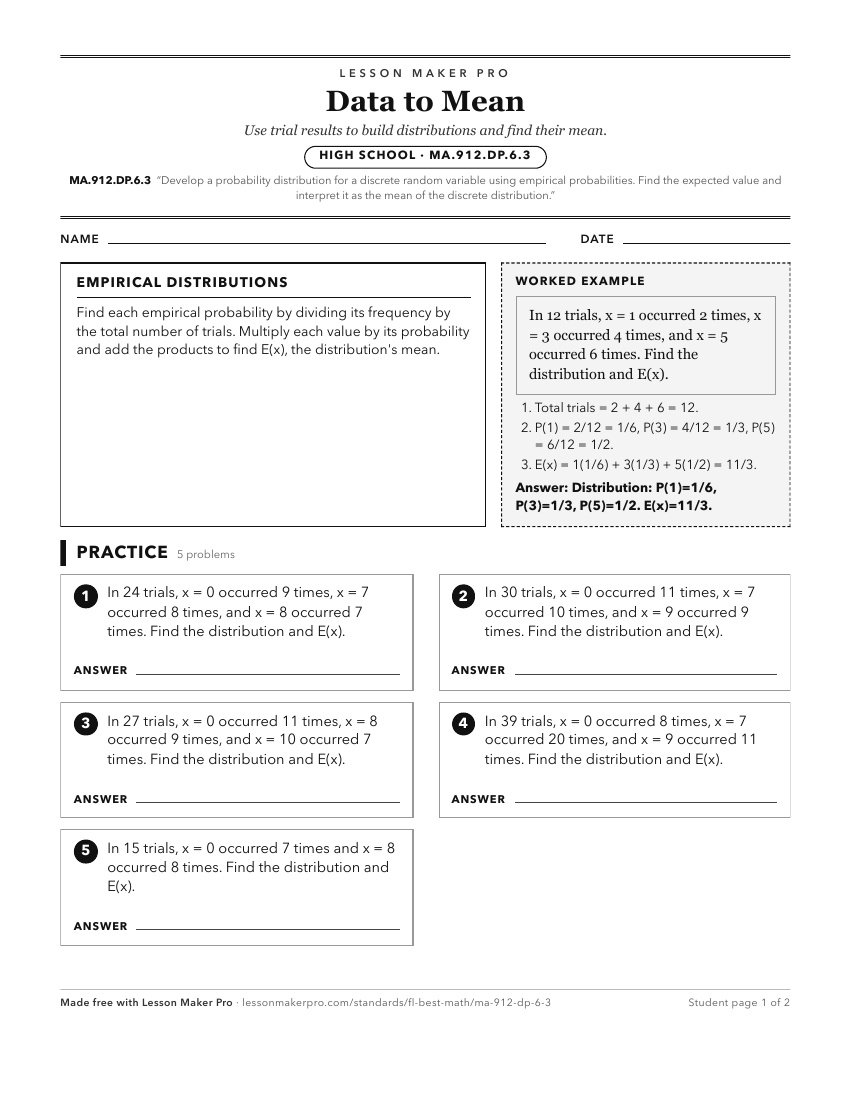
A ready-to-print activity worksheet aligned to MA.912.DP.6.3, with an answer key for the teacher on its own page. No account needed.
PDF, US Letter, prints cleanly in black and white.
Download the worksheetKeep exploring
Related Standards
- MA.912.DP.6.4
Given a binomial distribution, calculate and interpret the expected value. Solve real-world problems involving binomial distributions.
- MA.912.DP.6.1
Define a random variable for a quantity of interest by assigning a numerical value to each individual outcome in a sample space; graph the corresponding probabi...
- MA.912.DP.6.2
Develop a probability distribution for a discrete random variable using theoretical probabilities. Find the expected value and interpret it as the mean of the d...
- MA.7.DP.2
Develop an understanding of probability. Find and compare experimental and theoretical probabilities.
Turn this exact standard into a lesson
Grade, subject, topic, and the complete standard are prefilled. Create one free, no account needed.
Also for this standard:Make a WorksheetMake a QuizMake a Sub Lesson