Florida B.E.S.T. MA.1.GR.1.3
The Standard
Compose and decompose two- and three-dimensional figures. Figures are limited to semi-circles, triangles, rectangles, squares, trapezoids, hexagons, cubes, rectangular prisms, cones and cylinders.
Florida B.E.S.T. Standards for Mathematics
Teacher's field guide
What This Standard Means
What Students Need to Do
- Students join smaller flat shapes or solids to make a named larger figure. They also separate figures into named parts and show more than one possible arrangement.
What Mastery Looks Like
- A student can make a hexagon from two pattern-block trapezoids and a rectangle from two matching triangles, then name the parts and wholes. They can join cubes into a rectangular prism, take it apart, and sketch where the pieces meet.
Common Misconceptions
- Students may think turning a triangle or solid changes its name. They may believe a figure can be built or split in only one way. They may leave gaps or overlaps, or misname the outer figure.
How to Assess It
- Give each student two matching right triangles and four connecting cubes. Say, "Make a rectangle and a rectangular prism, then sketch each whole, show the joining lines, and label the parts."
Lesson moves
Ways to Teach It
Give pairs paper triangles, squares, trapezoids, and semicircles, plus cubes and cylinders, to build and split named figures.
Ask, "Can the same hexagon be made in two ways?" Students build examples, then explain which pieces they used.
Play Shape Build Bingo: students draw a target card, combine the listed pieces, and cover the matching whole.
Use blocks to design a small playground with cones, cylinders, cubes, and rectangular prisms, then label each solid.
Free download
Printable MA.1.GR.1.3 Worksheet
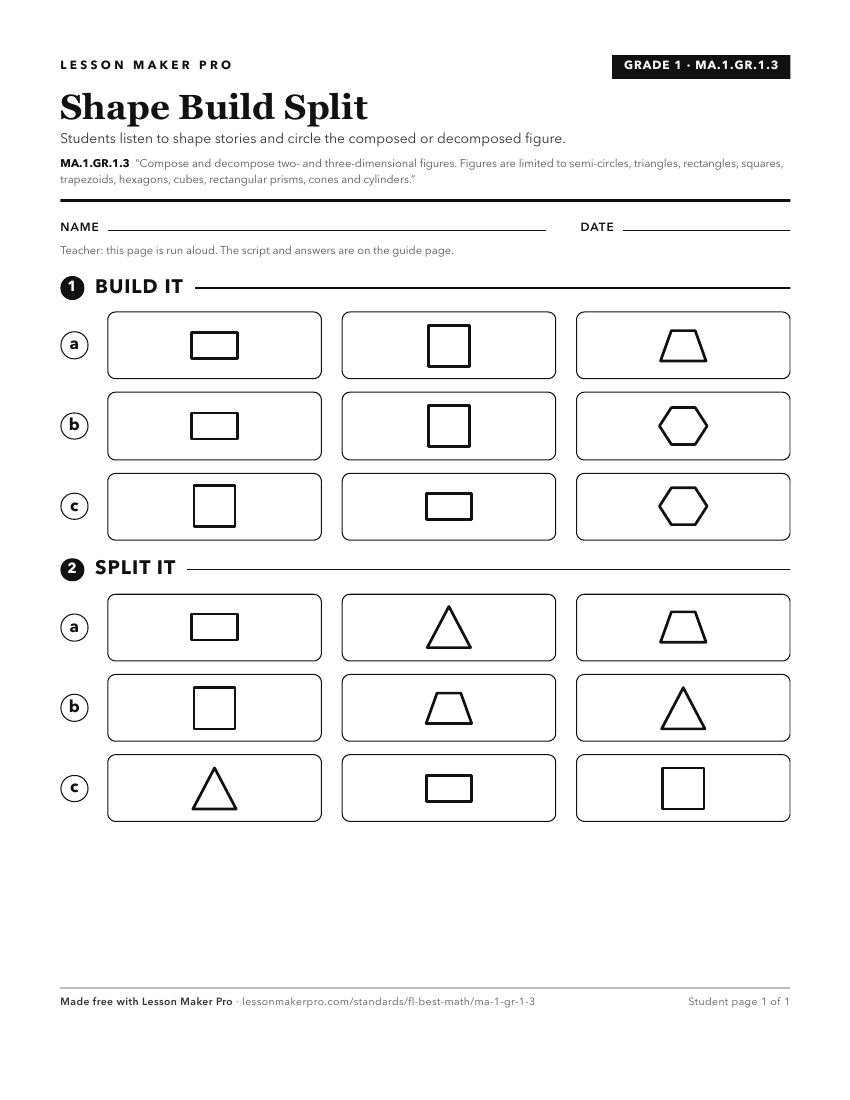
A ready-to-print activity worksheet aligned to MA.1.GR.1.3, with an answer key for the teacher on its own page. No account needed.
PDF, US Letter, prints cleanly in black and white.
Download the worksheetKeep exploring
Related Standards
- MA.1.GR.1.4
Given a real-world object, identify parts that are modeled by two- and three-dimensional figures. Figures are limited to semi-circles, triangles, rectangles, sq...
- MA.1.GR.1.1
Identify, compare and sort two- and three-dimensional figures based on their defining attributes. Figures are limited to circles, semi-circles, triangles, recta...
- MA.K.GR.1.5
Combine two-dimensional figures to form a given composite figure. Figures used to form a composite shape are limited to triangles, rectangles and squares.
- MA.K.GR.1.1
Identify two- and three-dimensional figures regardless of their size or orientation. Figures are limited to circles, triangles, rectangles, squares, spheres, cu...
Turn this exact standard into a lesson
Grade, subject, topic, and the complete standard are prefilled. Create one free, no account needed.
Also for this standard:Make a WorksheetMake a QuizMake a Sub Lesson